Top 10 Questions for Co Pilot Interview

Essential Interview Questions For Co Pilot

1. Explain in detail about the pre-flight briefing?

During a pre-flight briefing, the Captain and First Officer discuss the flight in detail, including:

  • Reviewing the flight plan and weather forecast
  • Discussing any special procedures or considerations for the flight
  • Assigning roles and responsibilities for the flight
  • Ensuring that all necessary equipment is functioning properly
  • Briefing the cabin crew on any relevant information

2. Describe the role and responsibilities of a Co-Pilot?

Cockpit Operations:

  • Assisting the Captain in operating the aircraft
  • Monitoring flight instruments and systems
  • Communicating with air traffic control and other aircraft

Flight Planning and Navigation:

  • Assisting in flight planning and route selection
  • Operating navigation systems and ensuring accurate flight tracking
  • Monitoring weather conditions and making adjustments as necessary

3. How do you prioritize tasks and manage workload during a flight?

To prioritize tasks and manage workload effectively, I follow these steps:

  • Identify essential tasks that must be completed immediately
  • Delegate tasks to the Captain or cabin crew when possible
  • Use checklists and automation to streamline tasks
  • Communicate effectively with the Captain and other crew members
  • Stay alert and prepared for unexpected situations

4. Describe your experience with aircraft systems, including navigation, communication, and electrical systems?

  • Proficient in operating navigation systems such as GPS, INS, and VOR
  • Skilled in using communication systems, including VHF, HF, and satellite communications
  • Familiar with aircraft electrical systems, including generators, batteries, and wiring
  • Capable of troubleshooting and resolving minor system malfunctions

5. How do you handle emergencies and unexpected situations during a flight?

  • Remain calm and assess the situation quickly
  • Follow established emergency procedures and checklists
  • Communicate clearly with the Captain and other crew members
  • Take decisive action to resolve the emergency
  • Document the incident and report it to the appropriate authorities

6. Describe your experience with simulators and how you use them to improve your flying skills?

  • Regularly participate in simulator training to practice normal and emergency procedures
  • Use simulators to enhance situational awareness and decision-making skills
  • Identify areas for improvement and work on developing specific skills
  • Stay up-to-date with industry best practices and simulator technology

7. How do you stay informed about industry regulations, safety procedures, and best practices?

  • Regularly review aviation publications and industry news
  • Attend industry conferences and workshops
  • Participate in company-sponsored training and development programs
  • Stay connected with other pilots and aviation professionals

8. Describe a situation where you had to work effectively as part of a team to resolve an issue during a flight.

During a recent flight, we encountered a pressurization issue shortly after takeoff. The Captain and I worked together to diagnose the problem, isolate the affected system, and implement the appropriate emergency procedures. We communicated clearly throughout the process, ensured the safety of the passengers, and resolved the issue without further incident.

9. Discuss your experience with performance-based navigation (PBN) and its benefits?

  • Familiar with using PBN procedures to optimize flight efficiency and reduce fuel consumption
  • Proficient in operating Required Navigation Performance (RNP) and Area Navigation (RNAV) systems
  • Appreciative of the benefits of PBN, including improved accuracy, reduced workload, and enhanced safety

10. How do you maintain your knowledge and skills as a Co-Pilot?

  • Regularly participate in continuing education and training programs
  • Stay up-to-date with technological advancements and industry best practices
  • Engage in self-study and research to expand my knowledge base
  • Seek feedback from senior pilots and mentors to identify areas for improvement

Interviewers often ask about specific skills and experiences. With ResumeGemini‘s customizable templates, you can tailor your resume to showcase the skills most relevant to the position, making a powerful first impression. Also check out Resume Template specially tailored for Co Pilot.

Career Expert Tips:

  • Ace those interviews! Prepare effectively by reviewing the Top 50 Most Common Interview Questions on ResumeGemini.
  • Navigate your job search with confidence! Explore a wide range of Career Tips on ResumeGemini. Learn about common challenges and recommendations to overcome them.
  • Craft the perfect resume! Master the Art of Resume Writing with ResumeGemini’s guide. Showcase your unique qualifications and achievements effectively.
  • Great Savings With New Year Deals and Discounts! In 2025, boost your job search and build your dream resume with ResumeGemini’s ATS optimized templates.

Researching the company and tailoring your answers is essential. Once you have a clear understanding of the Co Pilot‘s requirements, you can use ResumeGemini to adjust your resume to perfectly match the job description.

Key Job Responsibilities

A Co-Pilot is second-in-command on a flight deck and assists the Captain in the safe operation of the aircraft. They play a crucial role in maintaining the safety and efficiency of flights.

1. Assist the Captain

The Co-Pilot works closely with the Captain and carries out duties as directed, including:

  • Operating aircraft systems and equipment
  • Monitoring flight instruments and navigation systems

2. Monitoring and Managing Systems

The Co-Pilot is responsible for monitoring and managing various aircraft systems and ensuring their proper functioning, including:

  • Power plant systems
  • Electrical systems

3. Flight Planning and Preparation

The Co-Pilot assists the Captain in flight planning and preparation, including:

  • Calculating fuel requirements
  • Obtaining weather briefings

4. Communication

The Co-Pilot is responsible for maintaining clear and effective communication with air traffic control, other aircraft, and ground personnel.

  • Transmitting and receiving messages
  • Following instructions

Interview Tips

Preparing well for a Co-Pilot interview is essential to showcase your skills, experience, and passion for aviation. Here are some tips to help you ace the interview:

1. Research the Airline and Position

Thoroughly research the airline you are applying to, including its history, culture, fleet, and routes. This demonstrates your interest and enthusiasm for the company.

  • Review the job description carefully and identify the key responsibilities and qualifications.
  • Tailor your resume and cover letter to highlight your relevant skills and experience.

2. Practice Common Interview Questions

Anticipate and prepare answers to common interview questions related to your skills, experience, and motivation for becoming a Co-Pilot.

  • Examples include: “Tell us about your experience in aviation,” “Why are you interested in this position,” and “What are your strengths and weaknesses as a pilot?”

3. Highlight Your Technical Expertise

Emphasize your knowledge of aircraft systems, navigation, meteorology, and aviation regulations.

  • Provide specific examples of your experience in operating and monitoring aircraft systems.
  • Demonstrate your understanding of flight planning, weather analysis, and decision-making.

4. Showcase Your Teamwork and Communication Skills

Highlight your ability to work effectively with others, especially in a cockpit environment.

  • Describe your experience in coordinating with Captains, flight attendants, and ground personnel.
  • Emphasize your communication skills, including your ability to listen, interpret, and respond clearly and effectively.
Note: These questions offer general guidance, it’s important to tailor your answers to your specific role, industry, job title, and work experience.

Next Step:

Now that you’re armed with interview-winning answers and a deeper understanding of the Co Pilot role, it’s time to take action! Does your resume accurately reflect your skills and experience for this position? If not, head over to ResumeGemini. Here, you’ll find all the tools and tips to craft a resume that gets noticed. Don’t let a weak resume hold you back from landing your dream job. Polish your resume, hit the “Build Your Resume” button, and watch your career take off! Remember, preparation is key, and ResumeGemini is your partner in interview success.
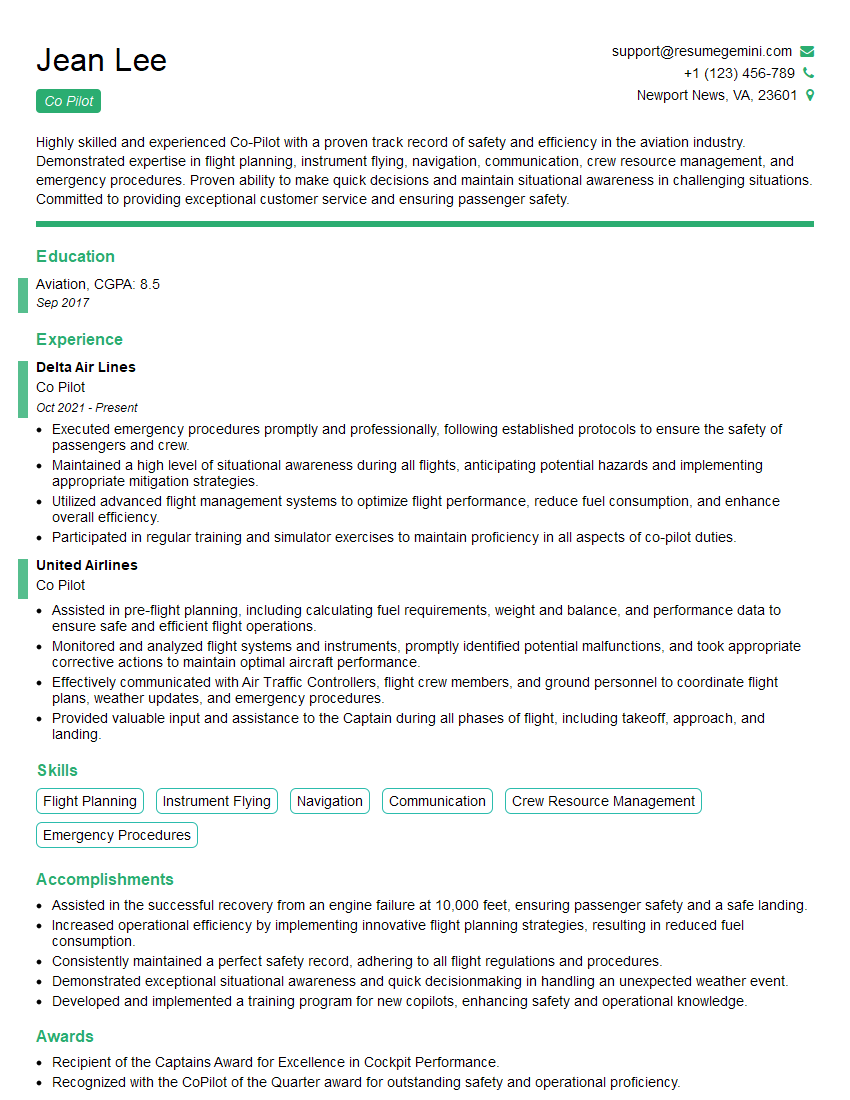
Co Pilot Resume Template by ResumeGemini
Disclaimer: The names and organizations mentioned in these resume samples are purely fictional and used for illustrative purposes only. Any resemblance to actual persons or entities is purely coincidental. These samples are not legally binding and do not represent any real individuals or businesses.

Top 10 Questions for Co-Pilot Interview

Essential Interview Questions For Co-Pilot

1. Tell me about your experience with Boeing 737 aircraft systems.

I have over 1000 hours of flight time in the Boeing 737, and I am very familiar with all of its systems. I have flown the 737 in a variety of conditions, including normal operations, emergencies, and instrument approaches. I am also proficient in using the aircraft’s autopilot and flight management systems.

2. What are your knowledge and experience in handling aircraft emergencies?

CRM and Communication

  • Demonstrate a thorough understanding of Crew Resource Management (CRM) principles and techniques.
  • Exhibit excellent communication and interpersonal skills, both within the cockpit and with other members of the flight crew and ground personnel.

Emergency Procedures

  • Possess a deep understanding of emergency procedures and protocols for various scenarios, including engine failures, hydraulic failures, electrical failures, and loss of control situations.
  • Demonstrate proficiency in executing emergency procedures swiftly and effectively, prioritizing safety and minimizing risk.

3. How do you keep up with the latest aviation regulations and procedures?

  • Regularly review and study aviation regulations and procedures, such as the Federal Aviation Regulations (FARs) and International Civil Aviation Organization (ICAO) standards.
  • Attend industry conferences, seminars, and workshops to stay updated on best practices and technological advancements.
  • Engage in continuous professional development and training programs to enhance knowledge and skills.
  • Subscribe to aviation publications, websites, and social media channels to stay informed about industry news and updates.
  • Actively participate in discussions and forums with other pilots and aviation professionals to exchange knowledge and experiences.

4. What is your approach to maintaining situational awareness during flight?

  • Continuously scan the instrument panel and external environment to monitor aircraft systems, flight parameters, and weather conditions.
  • Effectively use cockpit displays, including primary flight instruments, navigation systems, and weather radar, to gather and interpret information.
  • Maintain clear and concise communication with the pilot-in-command and other crew members to exchange situational updates and coordinate actions.
  • Anticipate potential hazards and develop contingency plans to mitigate risks.
  • Utilize all available resources, such as checklists, manuals, and electronic flight bags, to enhance situational awareness.

5. Describe your experience with using flight planning software.

  • Proficient in using flight planning software, such as Jeppesen FliteDeck Pro or Navigraph Charts, to calculate routes, determine fuel requirements, and file flight plans.
  • Ability to optimize flight plans for efficiency, considering factors such as weather conditions, airspace restrictions, and aircraft performance.
  • Familiar with the use of electronic flight bags (EFBs) to access and manage flight data, including charts, weather information, and NOTAMs.

6. What are your strengths and weaknesses as a co-pilot?

Strengths

  • Exceptional situational awareness and ability to anticipate potential hazards.
  • Strong communication and interpersonal skills.
  • Proficient in aircraft systems and procedures.
  • Calm and collected under pressure.
  • Committed to safety and maintaining high standards of professionalism.

Weaknesses

  • Limited experience in certain types of aircraft or operating environments.
  • Still developing leadership and decision-making skills.
  • Working on improving time management and prioritizing tasks.

7. Why do you want to work for our airline?

I am eager to join your airline because of its reputation for safety, innovation, and commitment to customer service. I am particularly interested in the opportunity to fly the Boeing 737, as I believe my skills and experience would make me a valuable asset to your team.

8. What are your long-term career goals?

My long-term career goal is to become a captain and eventually fly long-haul international routes. I am confident that my dedication, hard work, and commitment to safety will enable me to achieve my goals.

9. Why should we hire you over other candidates?

  • My experience and qualifications are an excellent match for the requirements of this position.
  • I am a highly motivated and safety-conscious individual with a strong work ethic.
  • I am confident that I can make a significant contribution to your airline.

10. Do you have any questions for me?

  • I am eager to learn more about your airline’s training and development programs for co-pilots.
  • Can you provide more information about the company’s safety culture and how it is implemented?
  • What are the opportunities for career advancement within the airline?

Interviewers often ask about specific skills and experiences. With ResumeGemini‘s customizable templates, you can tailor your resume to showcase the skills most relevant to the position, making a powerful first impression. Also check out Resume Template specially tailored for Co-Pilot.

Career Expert Tips:

  • Ace those interviews! Prepare effectively by reviewing the Top 50 Most Common Interview Questions on ResumeGemini.
  • Navigate your job search with confidence! Explore a wide range of Career Tips on ResumeGemini. Learn about common challenges and recommendations to overcome them.
  • Craft the perfect resume! Master the Art of Resume Writing with ResumeGemini’s guide. Showcase your unique qualifications and achievements effectively.
  • Great Savings With New Year Deals and Discounts! In 2025, boost your job search and build your dream resume with ResumeGemini’s ATS optimized templates.

Researching the company and tailoring your answers is essential. Once you have a clear understanding of the Co-Pilot‘s requirements, you can use ResumeGemini to adjust your resume to perfectly match the job description.

Key Job Responsibilities

Co-pilots are responsible for assisting the pilot in the operation of the aircraft during flight. They are also responsible for ensuring the safety of the passengers and crew.

1. Flight Operations

Co-pilots are responsible for assisting the pilot in navigating the aircraft, monitoring the aircraft’s systems, and communicating with air traffic control.

  • Assist the pilot with the pre-flight inspection of the aircraft.
  • Operate the aircraft’s controls during takeoff, landing, and flight.
  • Monitor the aircraft’s systems, including the engine, hydraulics, and electrical systems.
  • Communicate with air traffic control to ensure the aircraft is safely navigated through airspace.

2. Safety Procedures

Co-pilots are responsible for assisting the pilot in ensuring the safety of the passengers and crew.

  • Assist the pilot in responding to emergencies, such as engine failures, electrical failures, and weather-related incidents.
  • Evacuate the aircraft in the event of an emergency.
  • Provide first aid and medical assistance to passengers and crew as needed.

3. Customer Service

Co-pilots are responsible for providing excellent customer service to passengers and crew.

  • Greet passengers and answer their questions.
  • Assist passengers with their luggage and other needs.
  • Create a comfortable and safe environment for passengers and crew.

4. Training and Development

Co-pilots are responsible for maintaining their own skills and knowledge, as well as assisting the pilot with training and development.

  • Attend training courses and seminars to stay up-to-date on the latest aviation technology and procedures.
  • Assist the pilot with training new co-pilots and flight attendants.
  • Mentor and support other co-pilots and flight attendants.

Interview Tips

Preparing for a co-pilot interview can be a daunting task, but by following these tips, you can improve your chances of success:

1. Research the Airline

Take the time to learn about the airline you are applying to. This will help you understand their culture, values, and what they are looking for in a co-pilot.

  • Visit the airline’s website.
  • Read articles about the airline in industry publications.
  • Talk to people who work for the airline.

2. Highlight Your Aviation Experience

In your resume and cover letter, be sure to highlight your aviation experience. This includes your flight hours, type ratings, and any other relevant experience.

  • Quantify your experience whenever possible.
  • Use action verbs to describe your accomplishments.
  • Tailor your resume and cover letter to the specific job you are applying for.

3. Practice Common Interview Questions

There are a number of common interview questions that you are likely to be asked. It is important to practice answering these questions in a clear and concise manner.

  • Why do you want to be a co-pilot?
  • What are your strengths and weaknesses?
  • Tell me about a time when you had to deal with a difficult passenger.
  • How do you stay up-to-date on the latest aviation technology and procedures?

4. Dress Professionally

First impressions matter, so it is important to dress professionally for your interview. This means wearing a suit or business casual attire.

  • Make sure your clothes are clean and pressed.
  • Choose clothes that are appropriate for the weather.
  • Avoid wearing strong perfumes or colognes.

5. Be Yourself

The most important thing is to be yourself during your interview. The interviewer wants to get to know the real you, so don’t try to be someone you’re not.

  • Be honest and genuine in your answers.
  • Show your passion for aviation.
  • Be confident in your abilities.
Note: These questions offer general guidance, it’s important to tailor your answers to your specific role, industry, job title, and work experience.

Next Step:

Armed with this knowledge, you’re now well-equipped to tackle the Co-Pilot interview with confidence. Remember, a well-crafted resume is your first impression. Take the time to tailor your resume to highlight your relevant skills and experiences. And don’t forget to practice your answers to common interview questions. With a little preparation, you’ll be on your way to landing your dream job. So what are you waiting for? Start building your resume and start applying! Build an amazing resume with ResumeGemini.

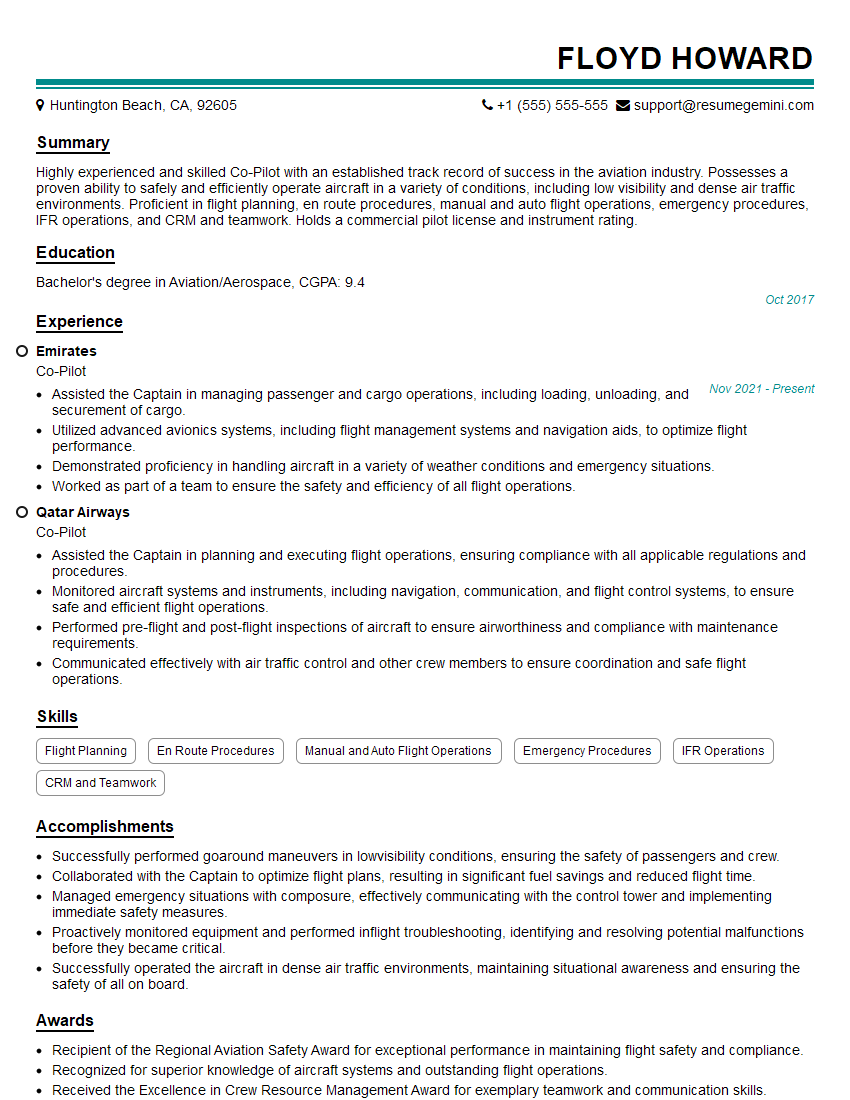
Co-Pilot Resume Template by ResumeGemini
Disclaimer: The names and organizations mentioned in these resume samples are purely fictional and used for illustrative purposes only. Any resemblance to actual persons or entities is purely coincidental. These samples are not legally binding and do not represent any real individuals or businesses.
Scroll to Top