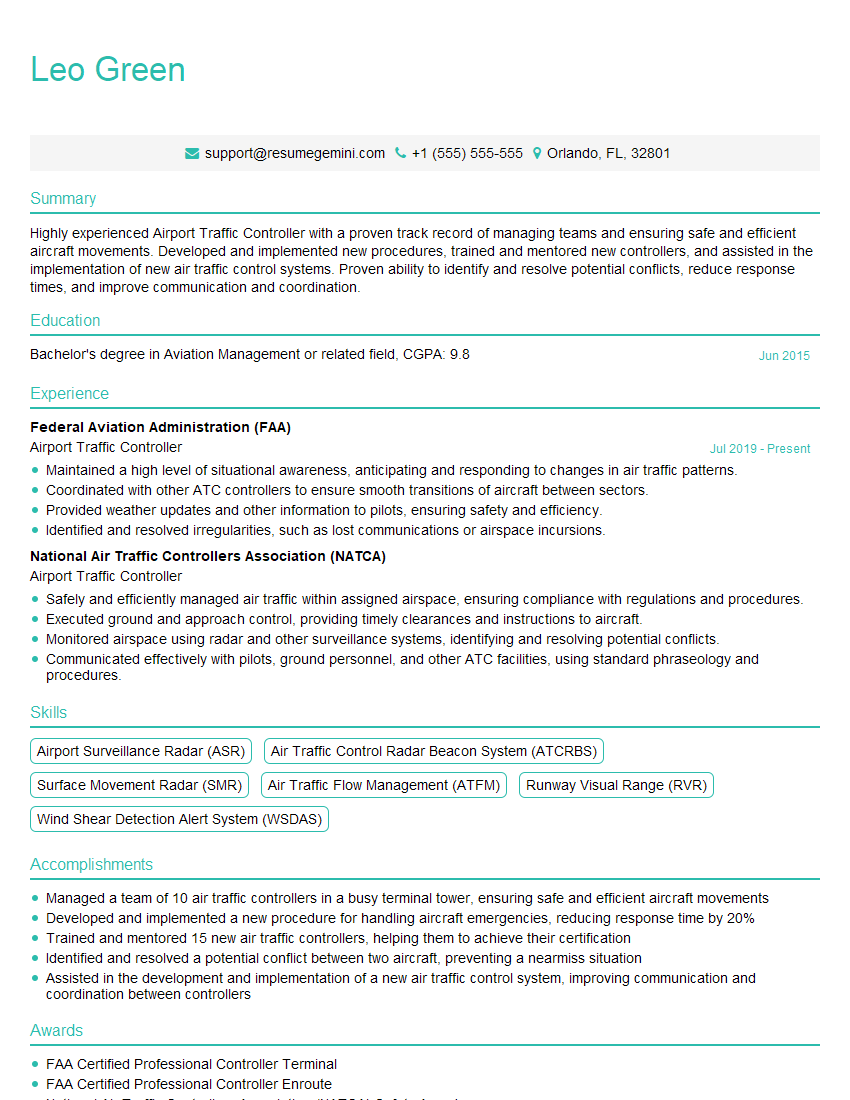
Are you gearing up for an interview for a Airport Traffic Controller position? Whether you’re a seasoned professional or just stepping into the role, understanding what’s expected can make all the difference. In this blog, we dive deep into the essential interview questions for Airport Traffic Controller and break down the key responsibilities of the role. By exploring these insights, you’ll gain a clearer picture of what employers are looking for and how you can stand out. Read on to equip yourself with the knowledge and confidence needed to ace your next interview and land your dream job!
Acing the interview is crucial, but landing one requires a compelling resume that gets you noticed. Crafting a professional document that highlights your skills and experience is the first step toward interview success. ResumeGemini can help you build a standout resume that gets you called in for that dream job.






Essential Interview Questions For Airport Traffic Controller
1. What is the role of an Airport Traffic Controller?
An Airport Traffic Controller is responsible for the safe and efficient movement of aircraft in and around an airport. They provide information and instructions to pilots, and ensure that aircraft are safely separated from each other and from obstacles.
2. What are the key skills and qualities required to be an effective Airport Traffic Controller?
- Excellent communication and interpersonal skills
- Ability to work under pressure and make quick decisions
- Strong problem-solving skills
- Ability to work independently and as part of a team
- Knowledge of aviation regulations and procedures
3. What are the different types of aircraft that you have experience controlling?
I have experience controlling a wide variety of aircraft, including commercial airliners, private jets, and military aircraft.
4. What are the different types of weather conditions that you have experience controlling aircraft in?
I have experience controlling aircraft in a variety of weather conditions, including clear skies, rain, snow, and fog.
5. What are the different types of emergencies that you have experience handling as an Airport Traffic Controller?
I have experience handling a variety of emergencies as an Airport Traffic Controller, including aircraft emergencies, medical emergencies, and weather emergencies.
6. What is your process for handling an aircraft emergency?
- Establish communication with the aircraft
- Assess the situation and determine the nature of the emergency
- Provide instructions to the pilot on how to handle the emergency
- Coordinate with other agencies, such as the fire department and emergency medical services, as necessary
7. What is your process for handling a medical emergency on an aircraft?
- Establish communication with the aircraft
- Assess the situation and determine the nature of the medical emergency
- Provide instructions to the pilot on how to handle the medical emergency
- Coordinate with other agencies, such as the fire department and emergency medical services, as necessary
8. What is your process for handling a weather emergency on an aircraft?
- Establish communication with the aircraft
- Assess the situation and determine the nature of the weather emergency
- Provide instructions to the pilot on how to handle the weather emergency
- Coordinate with other agencies, such as the fire department and emergency medical services, as necessary
9. What is your experience with using radar and other technology to control aircraft?
I have experience using a variety of radar and other technology to control aircraft, including primary radar, secondary radar, and ADS-B. I am also familiar with the use of other technologies, such as GPS and weather information systems.
10. What are your career goals as an Airport Traffic Controller?
My career goal is to become a certified Air Traffic Controller and work in a busy airport environment. I am confident that my skills and experience will make me a valuable asset to any air traffic control team.
Interviewers often ask about specific skills and experiences. With ResumeGemini‘s customizable templates, you can tailor your resume to showcase the skills most relevant to the position, making a powerful first impression. Also check out Resume Template specially tailored for Airport Traffic Controller.
Career Expert Tips:
- Ace those interviews! Prepare effectively by reviewing the Top 50 Most Common Interview Questions on ResumeGemini.
- Navigate your job search with confidence! Explore a wide range of Career Tips on ResumeGemini. Learn about common challenges and recommendations to overcome them.
- Craft the perfect resume! Master the Art of Resume Writing with ResumeGemini’s guide. Showcase your unique qualifications and achievements effectively.
- Great Savings With New Year Deals and Discounts! In 2025, boost your job search and build your dream resume with ResumeGemini’s ATS optimized templates.
Researching the company and tailoring your answers is essential. Once you have a clear understanding of the Airport Traffic Controller‘s requirements, you can use ResumeGemini to adjust your resume to perfectly match the job description.
Key Job Responsibilities
Airport Traffic Controllers fulfill a vital role in the safe and efficient operation of air traffic. Their primary responsibilities encompass:
1. Monitoring Air Traffic
Keep constant vigilance over aircraft movements within their assigned airspace using radar screens and other surveillance systems.
- Detect and track aircraft, monitoring their positions, speeds, and altitudes
- Identify potential conflicts and take timely action to prevent collisions
2. Communicating with Pilots
Provide clear and concise instructions to pilots regarding takeoff, landing, altitude changes, and any potential hazards. Ensure smooth and safe communication exchange.
- Transmit instructions regarding departure procedures, runway assignments, and approach sequences
- Provide weather updates, notify of any airspace closures or restrictions
3. Coordinating with Other Controllers
Collaborate with colleagues in nearby control towers and air traffic control centers. Share information and coordinate airspace management.
- Transfer aircraft from one controller to another as they approach or leave assigned airspace
- Coordinate with ground personnel to ensure safe and efficient taxiing and runway operations
4. Handling Emergencies
Take decisive action in emergency situations. Remain calm and composed under pressure, prioritizing the safety of aircraft and passengers.
- React to aircraft emergencies such as engine failures, sudden weather changes, or onboard incidents
- Provide guidance and support to pilots in distress, assisting them in implementing appropriate emergency procedures
Interview Tips
To ace your interview for an Airport Traffic Controller position, meticulous preparation is crucial. Here are some valuable tips:
1. Research the Industry
Demonstrate your passion for aviation. Stay updated on the latest industry news, regulations, and technological advancements. Research different air traffic control facilities to gain insights into their operations.
- Read industry publications and attend conferences
- Visit air traffic control towers to observe the work environment
2. Practice Communication Skills
Communication is paramount for Airport Traffic Controllers. Practice your ability to convey instructions clearly and concisely. Participate in mock interviews or role-playing scenarios to enhance your confidence.
- Join a public speaking club or participate in debate competitions
- Volunteer or work in customer service roles to develop communication and interpersonal skills
3. Highlight Relevant Experience
Emphasize any experience you have that demonstrates your attention to detail, problem-solving abilities, and ability to handle stressful situations. Highlight your ability to work independently and as part of a team.
- Quantify your accomplishments using specific metrics
- Prepare examples of how you have handled challenging situations effectively
4. Study Air Traffic Control Procedures
Familiarity with air traffic control procedures is crucial. Review FAA regulations and manuals to demonstrate your comprehension of the industry’s technical aspects.
- Enroll in an online or in-person air traffic control course
- Study the Federal Aviation Administration’s (FAA) Air Traffic Control Manual
5. Be Ready for Situational Questions
Interviewers often use situational questions to assess your decision-making and problem-solving abilities. Prepare by anticipating potential scenarios and formulating thoughtful responses.
- Use the STAR method (Situation, Task, Action, Result) to structure your answers
- Practice responding to common interview questions in front of a mirror or with a friend
Next Step:
Now that you’re armed with a solid understanding of what it takes to succeed as a Airport Traffic Controller, it’s time to turn that knowledge into action. Take a moment to revisit your resume, ensuring it highlights your relevant skills and experiences. Tailor it to reflect the insights you’ve gained from this blog and make it shine with your unique qualifications. Don’t wait for opportunities to come to you—start applying for Airport Traffic Controller positions today and take the first step towards your next career milestone. Your dream job is within reach, and with a polished resume and targeted applications, you’ll be well on your way to achieving your career goals! Build your resume now with ResumeGemini.