Are you gearing up for a career shift or aiming to ace your next interview? Look no further! We’ve curated a comprehensive guide to help you crack the interview for the coveted Air Traffic Controller, Center position. From understanding the key responsibilities to mastering the most commonly asked questions, this blog has you covered. So, buckle up and let’s embark on this journey together.
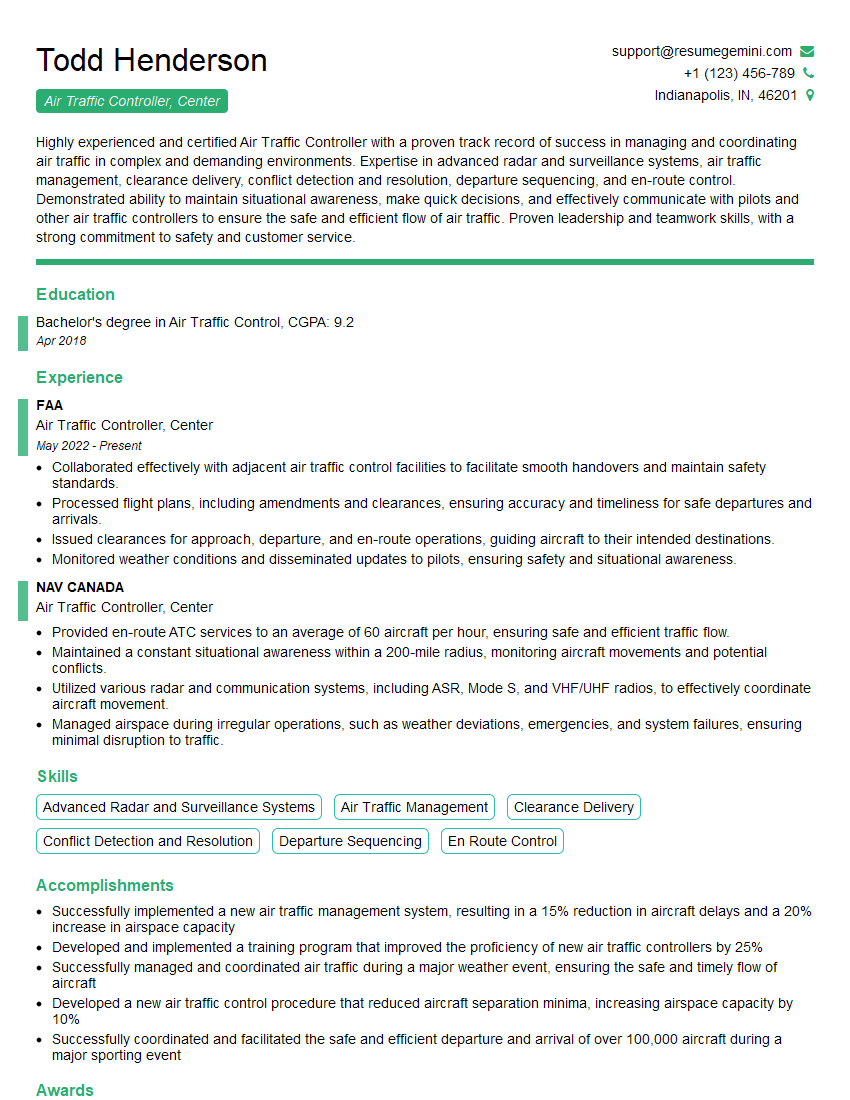
Acing the interview is crucial, but landing one requires a compelling resume that gets you noticed. Crafting a professional document that highlights your skills and experience is the first step toward interview success. ResumeGemini can help you build a standout resume that gets you called in for that dream job.






Essential Interview Questions For Air Traffic Controller, Center
1. Describe the steps you would take to resolve a potential airspace conflict between two aircraft?
- Identify the aircraft involved and their current positions and trajectories.
- Assess the potential for a collision and determine the severity of the conflict.
- Issue appropriate instructions to the aircraft to avoid the conflict, such as altitude changes, course corrections, or holding patterns.
- Coordinate with other sectors or air traffic control centers to ensure a safe and efficient resolution.
- Monitor the situation closely and provide further guidance as necessary to avoid any loss of separation.
2. Explain how you handle aircraft emergencies, such as a loss of communications or a medical emergency?
Coordinating with other agencies
- Establish contact with the aircraft through alternative means, such as secondary radar or VHF emergency frequency.
- Alert nearby aircraft and other agencies, such as the military or airport authorities, to assist in locating and providing aid to the aircraft.
- Coordinate airspace management to facilitate the emergency response and ensure the safety of other aircraft.
Providing assistance to the aircraft
- Issue instructions to the aircraft to assist in maintaining a safe flight path and avoid hazards.
- Provide navigational guidance and assistance in locating emergency landing sites if necessary.
- Remain in constant communication with the aircraft and provide reassurance and support to the crew and passengers.
3. How do you manage heavy traffic volume during peak hours to ensure safe and efficient operations?
- Implement spacing procedures, such as speed adjustments and altitude changes, to maintain safe separation between aircraft.
- Coordinate with adjacent sectors and air traffic control centers to optimize traffic flow and avoid congestion.
- Utilize automation tools, such as conflict alerts and predictive modeling, to identify potential conflicts and take proactive measures to avoid them.
- Communicate effectively with pilots to provide clear instructions and updates on traffic conditions.
- Monitor traffic patterns and make adjustments to sequencing and departure/arrival rates as necessary to maintain a smooth flow.
4. Explain your understanding of the principles of airspace management, including the use of sectors and different types of airspace?
- Air traffic control airspace is divided into sectors, each with a designated controller responsible for managing traffic within that area.
- Different types of airspace, such as controlled airspace, uncontrolled airspace, and special-use airspace, have specific rules and regulations governing aircraft operations.
- Controllers use radar and other surveillance systems to monitor aircraft movements and ensure safe separation between them.
- Coordination between sectors and air traffic control centers is essential for managing traffic flow and maintaining airspace integrity.
5. Describe your experience in using air traffic control automation systems, such as conflict detection and resolution tools?
- Proficient in using conflict detection and resolution tools, such as TCAS II and conflict alert systems, to identify and mitigate potential airspace conflicts.
- Experience in utilizing automated sequencing and spacing tools to optimize traffic flow and maintain safe separation between aircraft.
- Ability to effectively interpret and utilize data presented by automation systems to make informed decisions and provide timely instructions to pilots.
- Understanding of the limitations and capabilities of automation systems and the ability to use them judiciously in conjunction with traditional air traffic control techniques.
6. How do you prioritize tasks and manage workload in a stressful and fast-paced environment?
- Maintaining situational awareness and prioritizing tasks based on safety, efficiency, and the urgency of the situation.
- Effective time management skills, including the ability to handle multiple tasks simultaneously and adapt to changing priorities.
- Utilizing delegation and teamwork to distribute workload and ensure smooth operations.
- Maintaining composure and focus under pressure to make sound decisions and provide clear instructions to pilots.
7. Explain your understanding of the role of an air traffic controller in ensuring the safety and efficiency of air transportation?
- Responsible for the safe separation and sequencing of aircraft in controlled airspace.
- Providing pilots with guidance and instructions to maintain safe flight paths and avoid potential conflicts.
- Coordinating with other air traffic controllers, pilots, and agencies to ensure efficient and orderly traffic flow.
- Monitoring weather conditions and other factors that may impact air traffic operations.
- Upholding safety regulations and adhering to established procedures to prevent accidents and incidents.
8. How do you stay up-to-date with the latest air traffic control procedures and regulations?
- Regularly reviewing and studying air traffic control manuals, directives, and notices to air missions.
- Attending training courses and seminars to enhance knowledge and skills.
- Participating in professional development programs and workshops.
- Keeping abreast of industry best practices and innovations through conferences and publications.
- Consulting with experienced air traffic controllers and supervisors for guidance and mentorship.
9. Describe your experience in handling non-routine situations, such as aircraft emergencies or airspace incursions?
- Maintaining composure and following established emergency procedures to resolve aircraft emergencies, such as loss of communication or medical situations.
- Coordinating with other agencies and emergency responders to ensure timely assistance and minimize risks.
- Effectively managing airspace incursions by unauthorized aircraft, including issuing appropriate instructions to avoid conflicts.
- Documenting and reporting non-routine situations thoroughly and accurately for investigation and improvement purposes.
10. How do you contribute to maintaining a positive and collaborative working environment within the air traffic control team?
- Communicating effectively with colleagues and supervisors to share information and coordinate actions.
- Providing support and assistance to other controllers, especially during periods of high workload or challenging situations.
- Actively participating in team discussions and contributing ideas for improvement.
- Maintaining a respectful and professional demeanor, even under pressure.
- Recognizing and appreciating the contributions of team members.
Interviewers often ask about specific skills and experiences. With ResumeGemini‘s customizable templates, you can tailor your resume to showcase the skills most relevant to the position, making a powerful first impression. Also check out Resume Template specially tailored for Air Traffic Controller, Center.
Career Expert Tips:
- Ace those interviews! Prepare effectively by reviewing the Top 50 Most Common Interview Questions on ResumeGemini.
- Navigate your job search with confidence! Explore a wide range of Career Tips on ResumeGemini. Learn about common challenges and recommendations to overcome them.
- Craft the perfect resume! Master the Art of Resume Writing with ResumeGemini’s guide. Showcase your unique qualifications and achievements effectively.
- Great Savings With New Year Deals and Discounts! In 2025, boost your job search and build your dream resume with ResumeGemini’s ATS optimized templates.
Researching the company and tailoring your answers is essential. Once you have a clear understanding of the Air Traffic Controller, Center‘s requirements, you can use ResumeGemini to adjust your resume to perfectly match the job description.
Key Job Responsibilities
Air Traffic Controllers, Center are responsible for the safe and efficient flow of air traffic within their assigned airspace. They work in collaboration with other air traffic controllers, pilots, and weather forecasters to ensure that aircraft are able to navigate safely and efficiently.
1. Coordinate Air Traffic
Air Traffic Controllers, Center are responsible for coordinating the movement of aircraft within their airspace. This involves providing instructions to pilots on when to take off, land, and change altitude. They also monitor the progress of aircraft and provide guidance to pilots to ensure that they are maintaining safe separation from other aircraft.
- Provide instructions to pilots on when to take off, land, and change altitude.
- Monitor the progress of aircraft and provide guidance to pilots to ensure that they are maintaining safe separation from other aircraft.
2. Manage Air Traffic Flow
Air Traffic Controllers, Center are responsible for managing the flow of air traffic within their airspace. This involves sequencing aircraft for takeoff and landing, as well as providing instructions to pilots on how to avoid other aircraft and airspace restrictions. They also coordinate with other air traffic controllers to ensure that aircraft are able to move smoothly and efficiently through the airspace.
- Sequence aircraft for takeoff and landing.
- Provide instructions to pilots on how to avoid other aircraft and airspace restrictions.
- Coordinate with other air traffic controllers to ensure that aircraft are able to move smoothly and efficiently through the airspace.
3. Communicate with Pilots
Air Traffic Controllers, Center are responsible for communicating with pilots to provide instructions and information. This involves using a variety of communication methods, including voice, data link, and radar. They must be able to clearly and concisely convey instructions to pilots, as well as understand and respond to pilot requests.
- Use a variety of communication methods, including voice, data link, and radar, to communicate with pilots.
- Clearly and concisely convey instructions to pilots.
- Understand and respond to pilot requests.
4. Monitor Weather Conditions
Air Traffic Controllers, Center are responsible for monitoring weather conditions within their airspace. This involves using weather radar and other tools to track the movement of storms and other weather hazards. They must be able to quickly identify and communicate weather hazards to pilots, as well as provide guidance to pilots on how to avoid them.
- Use weather radar and other tools to track the movement of storms and other weather hazards.
- Quickly identify and communicate weather hazards to pilots.
- Provide guidance to pilots on how to avoid weather hazards.
Interview Tips
Preparing for an interview for an Air Traffic Controller, Center position can be a daunting task. However, by following these tips, you can increase your chances of success.
1. Research the Position
Before you go on an interview, it is important to do your research on the position and the company. This will help you to understand the company’s culture, the specific requirements of the position, and the expectations of the interviewer.
- Visit the company’s website.
- Read articles about the company and the position.
- Talk to people who work in the industry.
2. Practice Your Answers
Once you have done your research, it is important to practice your answers to common interview questions. This will help you to feel more confident and prepared during the interview.
- Prepare answers to questions about your experience, skills, and qualifications.
- Practice answering questions in front of a mirror or with a friend.
- Time yourself to make sure that you are able to answer questions within the allotted time.
3. Dress Professionally
First impressions matter, so it is important to dress professionally for your interview. This means wearing a suit or business dress and making sure that you are well-groomed.
- Wear a suit or business dress.
- Make sure that your clothes are clean and pressed.
- Groom your hair and nails.
4. Arrive on Time
Punctuality is important, so make sure that you arrive for your interview on time. This shows the interviewer that you are respectful of their time and that you are serious about the position.
- Give yourself plenty of time to get to the interview location.
- Factor in traffic and parking time.
- Arrive a few minutes early to give yourself time to relax and prepare.
5. Be Yourself
It is important to be yourself during your interview. The interviewer wants to get to know you and your personality, so don’t try to be someone you’re not. Be honest, be yourself, and let your personality shine through.
- Be honest about your experience and qualifications.
- Don’t try to be someone you’re not.
- Let your personality shine through.
Next Step:
Armed with this knowledge, you’re now well-equipped to tackle the Air Traffic Controller, Center interview with confidence. Remember, preparation is key. So, start crafting your resume, highlighting your relevant skills and experiences. Don’t be afraid to tailor your application to each specific job posting. With the right approach and a bit of practice, you’ll be well on your way to landing your dream job. Build your resume now from scratch or optimize your existing resume with ResumeGemini. Wish you luck in your career journey!