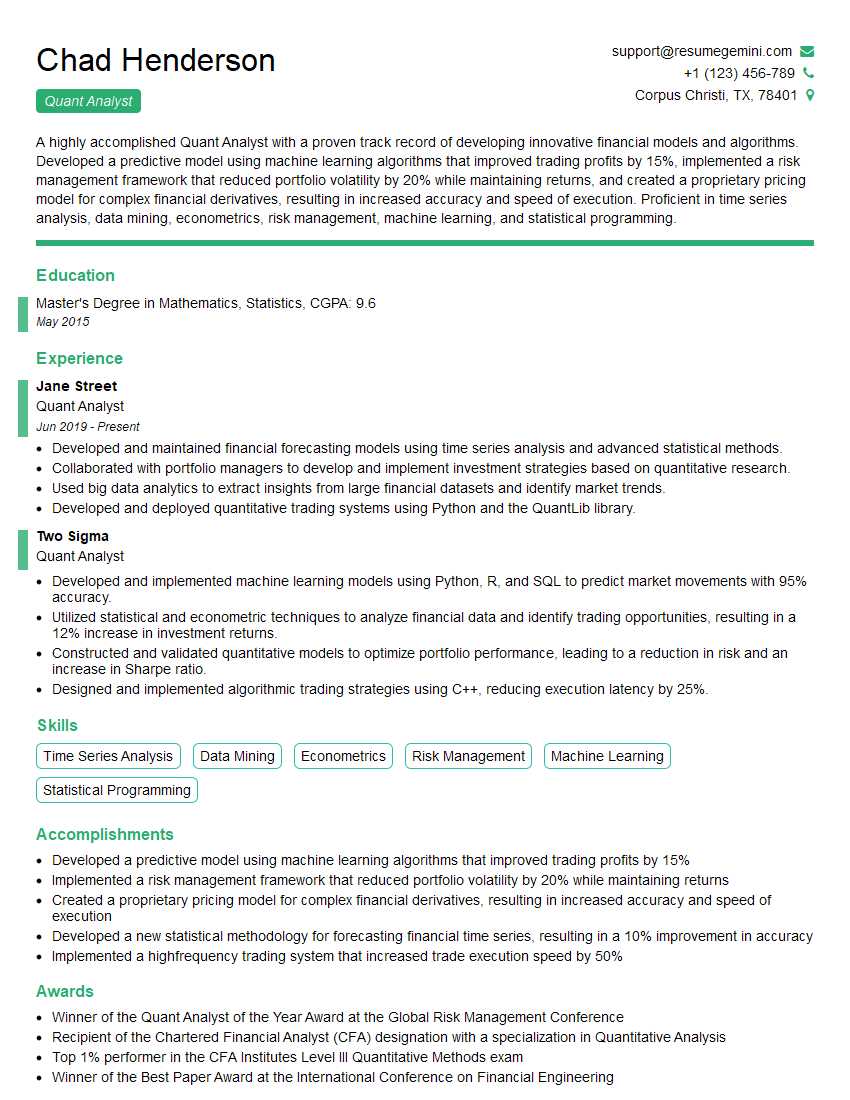
Feeling lost in a sea of interview questions? Landed that dream interview for Quant Analyst but worried you might not have the answers? You’re not alone! This blog is your guide for interview success. We’ll break down the most common Quant Analyst interview questions, providing insightful answers and tips to leave a lasting impression. Plus, we’ll delve into the key responsibilities of this exciting role, so you can walk into your interview feeling confident and prepared.
Acing the interview is crucial, but landing one requires a compelling resume that gets you noticed. Crafting a professional document that highlights your skills and experience is the first step toward interview success. ResumeGemini can help you build a standout resume that gets you called in for that dream job.






Essential Interview Questions For Quant Analyst
1. Explain the concept of Value at Risk (VaR) and how it is used in quantitative finance.
Value at Risk (VaR) is a statistical measure that quantifies the potential loss of an investment or portfolio over a specific time horizon and a given confidence level. It is widely used in quantitative finance for risk management and portfolio optimization.
- VaR estimates the maximum potential loss that an investment or portfolio can experience with a specified probability, typically 95% or 99%, over a defined time period, such as one day or one year.
- It helps financial institutions and investors assess the potential downside risk associated with their investments and make informed decisions about risk exposure and portfolio allocation.
- VaR is calculated using various statistical techniques, including the Delta-Normal method, Monte Carlo simulation, and historical simulation, each with its assumptions and limitations.
2. Describe the difference between parametric and non-parametric statistical models.
Parametric models
- Assume that the data follows a specific probability distribution, such as a normal or lognormal distribution.
- Based on this assumption, statistical parameters are estimated to characterize the distribution.
- Advantages: can make precise inferences and predictions if the assumed distribution accurately represents the data.
- Limitations: sensitive to departures from the assumed distribution and may not be suitable for data with complex or unknown distributions.
Non-parametric models
- Do not make any assumptions about the underlying probability distribution of the data.
- Use data-driven methods to estimate statistical characteristics without relying on specific parametric assumptions.
- Advantages: more robust to deviations from normality and can handle complex data distributions.
- Limitations: may be less efficient than parametric models when the data follows a known distribution.
3. Explain the concept of time series analysis and discuss different techniques used to analyze time series data.
Time series analysis involves analyzing data that is collected over time, such as stock prices, economic indicators, or weather patterns.
- Time series analysis techniques aim to identify patterns, trends, and seasonality in the data and make predictions or forecasts based on historical observations.
- Common techniques include:
- Autoregressive Integrated Moving Average (ARIMA) models
- Exponential Smoothing
- Fourier Analysis
- The choice of technique depends on the characteristics of the data, such as its stationarity, seasonality, and autocorrelation.
4. Discuss the importance of backtesting in quantitative finance models.
Backtesting is a crucial step in quantitative finance to evaluate the performance and robustness of trading strategies and models.
- It involves testing the strategy or model on historical data to assess its predictive power and risk-adjusted returns.
- Backtesting helps identify weaknesses, overfitting, and potential biases in the model before deploying it in live trading.
- It also provides insights into the model’s parameters, assumptions, and limitations.
5. Explain the concept of stochastic processes and their applications in quantitative finance.
Stochastic processes are mathematical models that describe the evolution of random variables over time.
- They are used to model various financial phenomena, such as stock prices, interest rates, and currency exchange rates.
- Common stochastic processes in quantitative finance include Brownian motion, geometric Brownian motion, and jump diffusion processes.
- These processes allow for the simulation of financial data and the pricing of financial instruments, such as options and derivatives.
6. Describe the role of machine learning in quantitative finance.
Machine learning techniques have gained prominence in quantitative finance for various applications.
- Supervised learning algorithms, such as regression and classification models, can be used for tasks like predicting stock prices, credit risk assessment, and fraud detection.
- Unsupervised learning algorithms, such as clustering and dimensionality reduction techniques, can help identify patterns and relationships in financial data.
- Machine learning models can augment traditional quantitative finance models by providing additional insights and improving predictive capabilities.
7. Discuss different approaches to portfolio optimization.
Portfolio optimization aims to construct portfolios that achieve the best possible risk-return trade-off.
- Markowitz portfolio theory is a classic approach that involves optimizing portfolios based on the mean and variance of asset returns.
- Modern portfolio theory (MPT) extends Markowitz theory by incorporating additional risk measures and constraints, such as cardinality constraints and expected shortfall.
- Machine learning techniques, such as reinforcement learning, can also be used for portfolio optimization, allowing for dynamic and adaptive portfolio construction.
8. Describe the challenges and limitations of quantitative finance models.
- Data quality and availability: Quantitative finance models rely heavily on data, and the quality and accuracy of the data can significantly impact the model’s performance.
- Model assumptions and simplifications: Quantitative models often make simplifying assumptions to make them tractable. These assumptions may not always hold true in real-world scenarios, leading to potential limitations in the model’s predictions.
- Parameter estimation and calibration: Estimating and calibrating model parameters can be complex and may require extensive computational resources. The accuracy of the parameter estimates can affect the reliability of the model’s predictions.
9. Explain how you would approach developing a quantitative trading strategy.
- Define the trading objective: Clearly define the goals and constraints of the trading strategy, such as the desired risk-return profile, investment horizon, and asset universe.
- Data collection and analysis: Gather relevant financial data, such as historical prices, economic indicators, and company fundamentals. Analyze the data to identify patterns, trends, and relationships.
- Model development: Develop a quantitative model that utilizes statistical techniques, machine learning algorithms, or stochastic processes to make trading decisions. The model should be robust and adaptable to changing market conditions.
- Model testing and validation: Backtest the model on historical data to evaluate its performance and identify weaknesses. Optimize the model’s parameters and assumptions through cross-validation and parameter tuning.
- Deployment and monitoring: Implement the trading strategy in a live trading environment. Continuously monitor the strategy’s performance and make adjustments as needed based on changing market conditions and model insights.
10. Describe your experience in using programming languages and software for quantitative finance.
In my previous roles as a Quantitative Analyst, I have extensively utilized various programming languages and software for quantitative finance:
- Python: I am proficient in Python for data analysis, model development, and backtesting. I have used Python libraries such as NumPy, Pandas, Scikit-learn, and Matplotlib for data manipulation, statistical analysis, and visualization.
- R: I have experience in using R for statistical modeling, time series analysis, and visualization. I am familiar with R packages such as Tidyverse, ggplot2, and forecast for data wrangling, graphical representation, and time series modeling.
- SQL: I have used SQL for data extraction and management from relational databases. I am proficient in writing SQL queries to retrieve, manipulate, and analyze financial data from various sources.
- MATLAB: I have experience in using MATLAB for numerical computations, matrix operations, and signal processing. I have utilized MATLAB’s built-in functions and toolboxes for financial applications, such as the Financial Instrument Toolbox and Statistics and Machine Learning Toolbox.
Interviewers often ask about specific skills and experiences. With ResumeGemini‘s customizable templates, you can tailor your resume to showcase the skills most relevant to the position, making a powerful first impression. Also check out Resume Template specially tailored for Quant Analyst.
Career Expert Tips:
- Ace those interviews! Prepare effectively by reviewing the Top 50 Most Common Interview Questions on ResumeGemini.
- Navigate your job search with confidence! Explore a wide range of Career Tips on ResumeGemini. Learn about common challenges and recommendations to overcome them.
- Craft the perfect resume! Master the Art of Resume Writing with ResumeGemini’s guide. Showcase your unique qualifications and achievements effectively.
- Great Savings With New Year Deals and Discounts! In 2025, boost your job search and build your dream resume with ResumeGemini’s ATS optimized templates.
Researching the company and tailoring your answers is essential. Once you have a clear understanding of the Quant Analyst‘s requirements, you can use ResumeGemini to adjust your resume to perfectly match the job description.
Key Job Responsibilities
Quant Analysts are highly technical professionals who apply quantitative methods to analyze data and develop models for financial institutions. Their key responsibilities include:
1. Data Analysis and Modeling
Quant Analysts gather, clean, and analyze large datasets using statistical techniques and programming languages. They develop mathematical and statistical models to identify trends, patterns, and risks in financial markets.
2. Trading Strategies Development
Using their models, Quant Analysts design and implement trading strategies for various financial instruments such as stocks, bonds, and derivatives. They optimize portfolios, manage risk, and maximize returns.
3. Risk Management
Quant Analysts assess and manage risk exposure for financial institutions. They develop models to quantify and mitigate risks, enabling informed decision-making and regulatory compliance.
4. Research and Innovation
Quant Analysts stay abreast of the latest quantitative techniques and financial trends. They conduct research to develop new methodologies and improve existing models.
Interview Tips
Preparing thoroughly for a Quant Analyst interview is crucial. Here are some tips:
1. Know the Role and Industry
Research the specific job responsibilities and the industry you’re applying to. Familiarize yourself with the company’s products, services, and financial performance.
2. Practice Data Analysis and Modeling
Interviewers will expect you to demonstrate proficiency in data analysis and statistical modeling. Practice solving real-world problems or review academic exercises.
3. Study Financial Markets
Have a deep understanding of financial markets, including trading instruments, trading strategies, and risk management principles.
4. Prepare Technical Skills
Quant Analysts typically use statistical software like R or Python, data visualization tools, and machine learning techniques. Refresh your skills and be prepared to discuss your proficiency.
5. Prepare Behavioral Interview Questions
Be prepared for behavioral interview questions that assess your problem-solving abilities, teamwork skills, and communication style. Use the STAR method (Situation, Task, Action, Result) to structure your answers.
6. Quantify Your Experience
Whenever possible, quantify your accomplishments and results using specific metrics. For example, instead of saying “I analyzed data,” say “I analyzed 1 terabyte of data using machine learning techniques, reducing processing time by 30%.”
7. Network and Learn
Attend industry events, connect with professionals on LinkedIn, and read industry publications. Networking and continuous learning demonstrate your passion for the field.
Next Step:
Armed with this knowledge, you’re now well-equipped to tackle the Quant Analyst interview with confidence. Remember, preparation is key. So, start crafting your resume, highlighting your relevant skills and experiences. Don’t be afraid to tailor your application to each specific job posting. With the right approach and a bit of practice, you’ll be well on your way to landing your dream job. Build your resume now from scratch or optimize your existing resume with ResumeGemini. Wish you luck in your career journey!