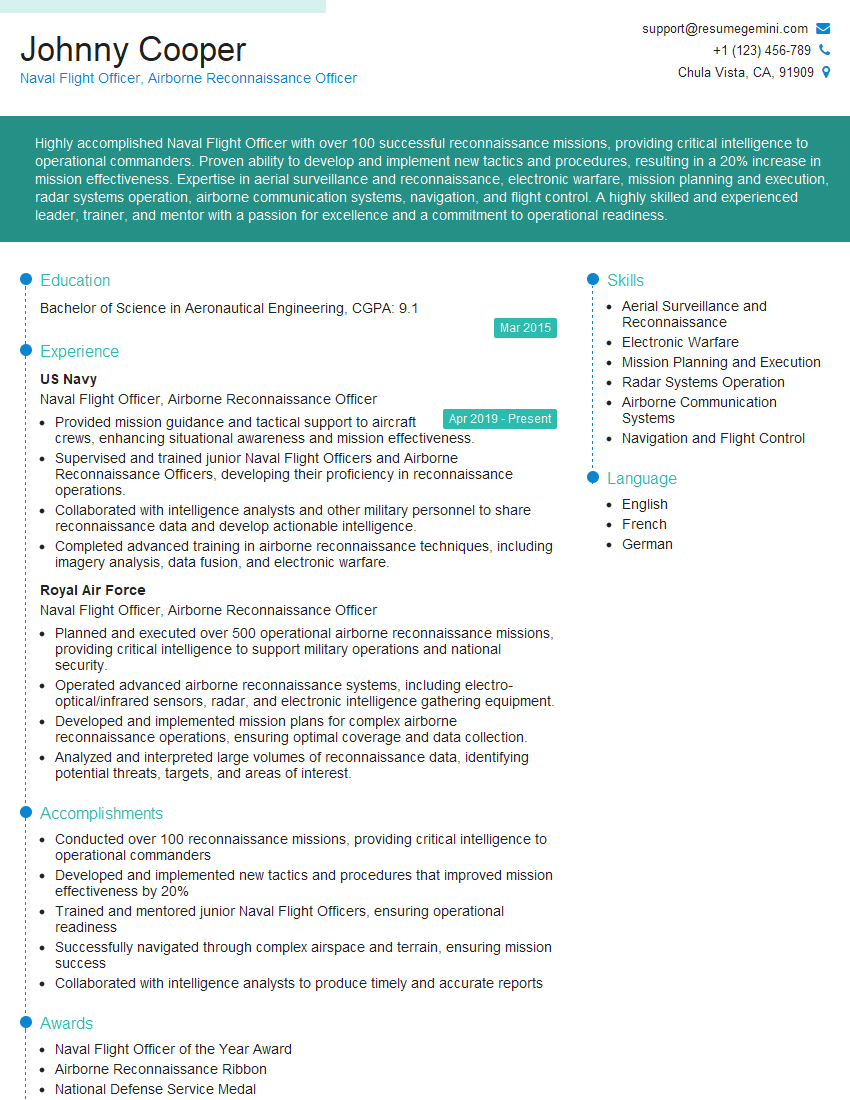
Are you gearing up for a career shift or aiming to ace your next interview? Look no further! We’ve curated a comprehensive guide to help you crack the interview for the coveted Naval Flight Officer, Airborne Reconnaissance Officer position. From understanding the key responsibilities to mastering the most commonly asked questions, this blog has you covered. So, buckle up and let’s embark on this journey together
Acing the interview is crucial, but landing one requires a compelling resume that gets you noticed. Crafting a professional document that highlights your skills and experience is the first step toward interview success. ResumeGemini can help you build a standout resume that gets you called in for that dream job.






Essential Interview Questions For Naval Flight Officer, Airborne Reconnaissance Officer
1. Tell me about your experience in planning and executing airborne reconnaissance missions?
In my previous role as a Naval Flight Officer and Airborne Reconnaissance Officer, I was responsible for planning and executing a wide range of airborne reconnaissance missions. This involved:
- Developing mission plans and objectives in coordination with the mission commander and other team members
- Identifying and prioritizing targets based on intelligence analysis and operational requirements
- Coordinating with other aircraft, ships, and ground units to ensure mission success
- Operating and maintaining sensor systems to collect imagery and data
- Analyzing imagery and data to provide timely and accurate intelligence reports
2. What are the key challenges you have faced in the role and how did you overcome them?
Challenges
- Operating in high-risk environments with potential enemy threats
- Managing complex sensor systems and ensuring data accuracy
- Coordinating with a diverse team of professionals with different backgrounds and expertise
- Working under tight deadlines and in demanding operational conditions
How I overcame them
- Underwent rigorous training and simulations to develop proficiency in mission planning, sensor operations, and threat assessment
- Established clear communication protocols and maintained situational awareness to mitigate risks and ensure mission success
- Collaborated closely with team members, leveraging their expertise and fostering a supportive work environment
- Prioritized tasks, delegated responsibilities, and managed time effectively to meet deadlines and deliver high-quality results
3. Describe your experience with different airborne reconnaissance platforms and sensor systems?
I have extensive experience operating and maintaining a variety of airborne reconnaissance platforms, including:
- P-3 Orion
- EP-3 Aries
- E-2 Hawkeye
I am proficient in using advanced sensor systems such as:
- Electro-optical/infrared (EO/IR) cameras
- Synthetic aperture radar (SAR)
- Electronic warfare (EW) systems
I have received specialized training on the operation and maintenance of these systems, ensuring mission readiness and data accuracy.
4. How do you stay up-to-date with the latest advancements in airborne reconnaissance technologies?
To stay current with the latest advancements in airborne reconnaissance technologies, I actively engage in:
- Attending industry conferences and workshops
- Reading technical journals and research papers
- Participating in online forums and discussion groups
- Collaborating with experts and researchers in the field
I am also actively involved in professional development programs offered by my organization to enhance my knowledge and skills.
5. What are your thoughts on the ethical considerations involved in airborne reconnaissance missions?
I recognize the ethical considerations that arise in airborne reconnaissance missions, particularly regarding privacy, data protection, and potential risks to civilians. I believe it is crucial to adhere to established ethical guidelines and regulations to ensure:
- Respect for individual privacy and civil liberties
- Protection of sensitive information and data
- Minimization of risks to non-combatants
I am committed to conducting missions in a responsible and ethical manner, balancing operational objectives with the need to safeguard individual rights and protect civilians.
6. Tell me about your experience in working as part of a team in a high-pressure environment?
In my previous role, I consistently worked as part of a team in high-pressure environments. I am adept at:
- Communicating effectively and sharing information
- Coordinating actions and making timely decisions
- Adapting to changing priorities and mission objectives
- Supporting and motivating team members under stress
I thrive in collaborative settings and am committed to fostering a positive and productive team environment.
7. How do you handle complex decision-making under time constraints?
When faced with complex decision-making under time constraints, I follow a structured approach that involves:
- Gathering and analyzing relevant information
- Identifying potential risks and benefits
- Considering the impact of different options
- Making a decision and communicating it clearly
I am comfortable making tough decisions and am confident in my ability to lead and guide my team in challenging situations.
8. What motivates you to succeed in this field?
I am motivated to succeed in the field of airborne reconnaissance due to:
- My passion for aviation and technology
- My desire to contribute to national security and intelligence gathering
- The opportunity to work with highly skilled professionals in a challenging and rewarding environment
- My belief that airborne reconnaissance plays a vital role in protecting our country and its allies
I am eager to continue developing my skills and contributing to the success of the team and the mission.
9. What are your career goals and aspirations?
My career goals include:
- Continuing to grow and develop my skills as a Naval Flight Officer and Airborne Reconnaissance Officer
- Taking on leadership roles and responsibilities within my squadron
- Contributing to the development and implementation of new airborne reconnaissance technologies
- Serving as a mentor and role model for junior officers
I am confident that my dedication, hard work, and commitment to excellence will enable me to achieve my career goals and make a meaningful contribution to the Navy and the nation.
10. Do you have any questions for me about the role or the organization?
I am interested in learning more about the specific responsibilities and expectations for this role. I would also like to know more about the organization’s culture and values, as well as its commitment to professional development and training for its employees.
Interviewers often ask about specific skills and experiences. With ResumeGemini‘s customizable templates, you can tailor your resume to showcase the skills most relevant to the position, making a powerful first impression. Also check out Resume Template specially tailored for Naval Flight Officer, Airborne Reconnaissance Officer.
Career Expert Tips:
- Ace those interviews! Prepare effectively by reviewing the Top 50 Most Common Interview Questions on ResumeGemini.
- Navigate your job search with confidence! Explore a wide range of Career Tips on ResumeGemini. Learn about common challenges and recommendations to overcome them.
- Craft the perfect resume! Master the Art of Resume Writing with ResumeGemini’s guide. Showcase your unique qualifications and achievements effectively.
- Great Savings With New Year Deals and Discounts! In 2025, boost your job search and build your dream resume with ResumeGemini’s ATS optimized templates.
Researching the company and tailoring your answers is essential. Once you have a clear understanding of the Naval Flight Officer, Airborne Reconnaissance Officer‘s requirements, you can use ResumeGemini to adjust your resume to perfectly match the job description.
Key Job Responsibilities
Naval Flight Officers (NFOs) and Airborne Reconnaissance Officers (ARO) are pivotal members of the U.S. Navy’s aircrew, entrusted with critical roles in aerial operations.
1. Flight Operations
NFOs perform duties critical to the safe and effective operation of military aircraft, including:
- Navigating and piloting aircraft
- Controlling weapons systems and countermeasures
- Operating electronic warfare and surveillance equipment
- Maintaining communication with pilots and ground personnel
2. Reconnaissance Missions
AROs specialize in conducting airborne reconnaissance missions, gathering critical intelligence for military operations:
- Using advanced sensors and imaging systems to gather data
- Interpreting and analyzing imagery to identify targets and assess threats
- Disseminating intelligence to commanders and decision-makers
- Conducting electronic warfare to counter enemy communications and sensors
3. Training and Leadership
NFOs and AROs are responsible for training and supervising junior officers:
- Developing and executing training programs
- Mentoring and guiding junior officers in their professional development
- Leading and motivating teams to achieve mission objectives
- Maintaining high standards of safety and operational readiness
4. Collaboration and Coordination
NFOs and AROs work closely with pilots, other crew members, and ground personnel to ensure mission success:
- Coordinating with pilots to execute flight plans and maneuvers
- Collaborating with other crew members to operate specialized equipment
- Interfacing with ground personnel to receive mission updates and instructions
- Coordinating with other units and agencies to provide support and receive intelligence
Interview Tips
Preparing thoroughly for an interview is key to making a great impression and increasing your chances of success. Here are some tips to help you ace your interview for a Naval Flight Officer or Airborne Reconnaissance Officer position:
1. Research the Role and Organization
Familiarize yourself with the specific responsibilities and requirements of the role you’re applying for. Research the U.S. Navy’s mission, history, and values to demonstrate your understanding of the organization.
2. Practice Common Interview Questions
Anticipate common interview questions related to your qualifications, experience, and motivations. Practice answering these questions clearly and concisely, highlighting your relevant skills and abilities.
3. Highlight Your Leadership and Teamwork Abilities
NFOs and AROs are expected to lead and work effectively in teams. Emphasize your experience in leadership roles, your ability to motivate and inspire others, and your commitment to teamwork.
4. Demonstrate Your Technical Proficiency
Highlight your technical knowledge and skills related to aviation, navigation, and reconnaissance. Provide specific examples of your experience operating and interpreting specialized equipment.
5. Convey Your Passion and Motivation
Express your enthusiasm for naval aviation and your desire to serve your country as a NFO or ARO. Explain how your personal goals and values align with the mission of the U.S. Navy.
6. Be Prepared for Physical and Psychological Assessments
NFOs and AROs undergo rigorous physical and psychological assessments. Familiarize yourself with the requirements and prepare accordingly to demonstrate your physical fitness and mental resilience.
7. Ask Insightful Questions
At the end of the interview, take the opportunity to ask thoughtful questions about the role, the organization, and the interviewer’s experiences. This shows your engagement and interest in the position.
Next Step:
Armed with this knowledge, you’re now well-equipped to tackle the Naval Flight Officer, Airborne Reconnaissance Officer interview with confidence. Remember, preparation is key. So, start crafting your resume, highlighting your relevant skills and experiences. Don’t be afraid to tailor your application to each specific job posting. With the right approach and a bit of practice, you’ll be well on your way to landing your dream job. Build your resume now from scratch or optimize your existing resume with ResumeGemini. Wish you luck in your career journey!