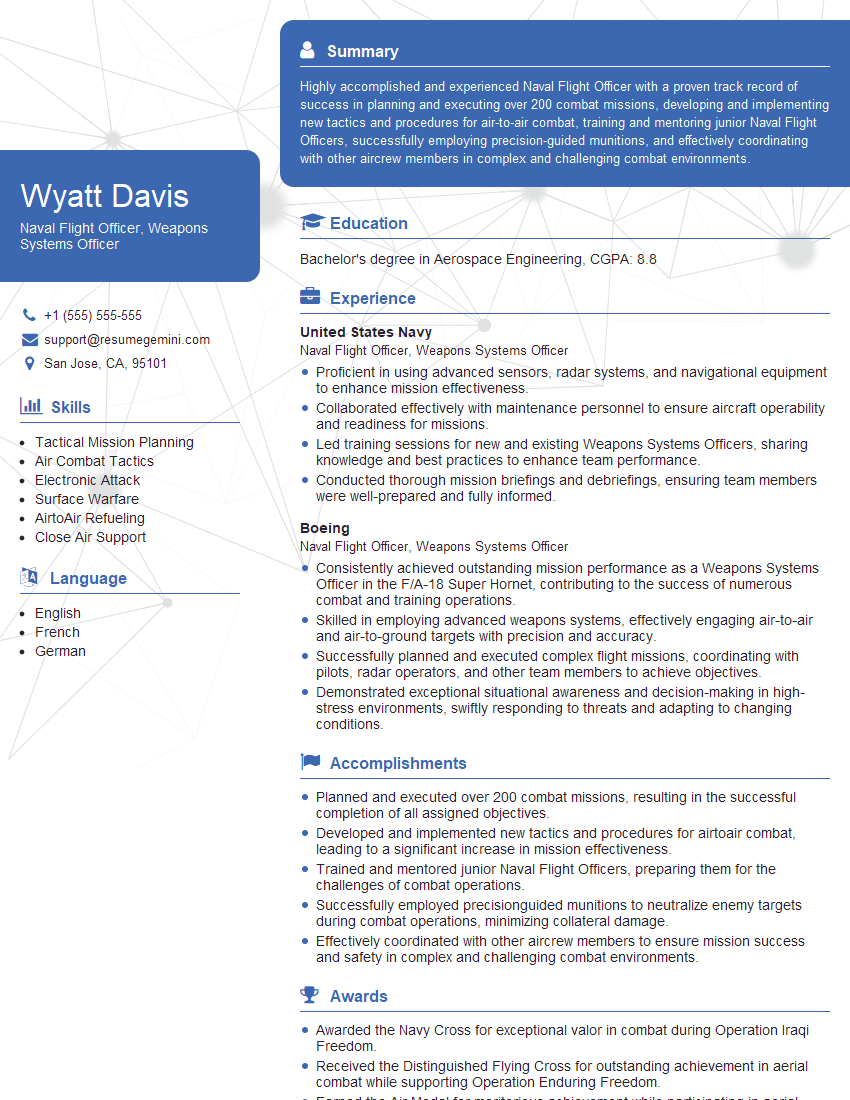
Ever felt underprepared for that crucial job interview? Or perhaps you’ve landed the interview but struggled to articulate your skills and experiences effectively? Fear not! We’ve got you covered. In this blog post, we’re diving deep into the Naval Flight Officer, Weapons Systems Officer interview questions that you’re most likely to encounter. But that’s not all. We’ll also provide expert insights into the key responsibilities of a Naval Flight Officer, Weapons Systems Officer so you can tailor your answers to impress potential employers.
Acing the interview is crucial, but landing one requires a compelling resume that gets you noticed. Crafting a professional document that highlights your skills and experience is the first step toward interview success. ResumeGemini can help you build a standout resume that gets you called in for that dream job.






Essential Interview Questions For Naval Flight Officer, Weapons Systems Officer
1. Describe the primary responsibilities of a Naval Flight Officer, Weapons Systems Officer (NFO/WSO) in the F/A-18 Super Hornet.
- Operate and manage the aircraft’s advanced sensor and weapons systems.
- Assist the pilot in mission planning and execution, including navigation and target acquisition.
- Monitor and control the aircraft’s defensive systems, including electronic warfare and countermeasures.
2. Explain the role of the AN/APG-79 AESA radar in the F/A-18 Super Hornet and how it enhances situational awareness and targeting capabilities.
Air-to-Air Operations:
- Detect and track multiple airborne targets simultaneously.
- Provide early warning of incoming threats.
- Enable long-range air-to-air missile engagements.
Air-to-Ground Operations:
- Generate high-resolution synthetic aperture radar (SAR) images for target identification.
- Detect and track moving ground targets.
- Provide precision targeting data for guided weapons.
3. Discuss the integration of the Joint Helmet-Mounted Cueing System (JHMCS) in the F/A-18 Super Hornet and its advantages in air combat.
- Provides the pilot with a “heads-up” display of critical flight and tactical information.
- Allows the pilot to effortlessly cue sensors and weapons systems by simply looking at a target.
- Enhances situational awareness, reaction time, and target acquisition capabilities.
4. Describe the process of employing the AIM-120 AMRAAM missile from the F/A-18 Super Hornet, including target acquisition, tracking, and missile launch.
- Acquire and identify target using radar or infrared search and track systems.
- Track the target’s position, speed, and altitude using advanced sensor fusion algorithms.
- Lock the missile onto the target and launch it, using precise guidance and control systems.
5. Explain the operation and tactical significance of the Electronic Warfare (EW) suite in the F/A-18 Super Hornet.
- Detects, identifies, and suppresses enemy radar and communication systems.
- Provides situational awareness of the electronic environment and potential threats.
- Enhances survivability and mission effectiveness in contested airspace.
6. Describe the importance of effective communication and coordination between the NFO/WSO and pilot in the F/A-18 Super Hornet.
- Ensures smooth and efficient operation of the aircraft and its systems.
- Facilitates situational awareness sharing, decision-making, and mission execution.
- Promotes safety, mission success, and overall team performance.
7. Discuss the challenges and rewards of working as an NFO/WSO in the United States Navy.
Challenges:
- Physically and mentally demanding environment.
- High-stress and high-stakes missions.
- Long periods away from family and friends.
Rewards:
- Sense of purpose and service to country.
- Advanced training and career development opportunities.
- Unique and unforgettable experiences.
8. Explain how your previous experience and skills have prepared you for the role of an NFO/WSO in the F/A-18 Super Hornet.
- Highlight relevant technical knowledge and proficiency in aviation, electronics, or weapons systems.
- Demonstrate strong analytical, decision-making, and problem-solving abilities.
- Emphasize teamwork and communication skills developed in previous roles.
9. Describe a situation where you had to make a critical decision under pressure and how you handled it effectively.
- Provide a specific example from your experience that showcases your decision-making process.
- Explain how you analyzed the situation, considered options, and made a well-informed choice.
- Emphasize the positive outcomes or lessons learned from the experience.
10. How do you stay updated on the latest advancements in aviation and weapons technology?
- Mention industry conferences, journals, and online resources that you utilize.
- Discuss your personal initiatives to stay abreast of current developments and trends.
- Explain how this knowledge keeps you at the forefront of your field.
Interviewers often ask about specific skills and experiences. With ResumeGemini‘s customizable templates, you can tailor your resume to showcase the skills most relevant to the position, making a powerful first impression. Also check out Resume Template specially tailored for Naval Flight Officer, Weapons Systems Officer.
Career Expert Tips:
- Ace those interviews! Prepare effectively by reviewing the Top 50 Most Common Interview Questions on ResumeGemini.
- Navigate your job search with confidence! Explore a wide range of Career Tips on ResumeGemini. Learn about common challenges and recommendations to overcome them.
- Craft the perfect resume! Master the Art of Resume Writing with ResumeGemini’s guide. Showcase your unique qualifications and achievements effectively.
- Great Savings With New Year Deals and Discounts! In 2025, boost your job search and build your dream resume with ResumeGemini’s ATS optimized templates.
Researching the company and tailoring your answers is essential. Once you have a clear understanding of the Naval Flight Officer, Weapons Systems Officer‘s requirements, you can use ResumeGemini to adjust your resume to perfectly match the job description.
Key Job Responsibilities
Naval Flight Officers (NFOs) and Weapons Systems Officers (WSOs) fulfill exceptionally technical roles within the United States Navy, assisting aviators in various aspects of flight operations. While NFOs provide navigation and tactical expertise, WSOs operate advanced weapons systems, making their contributions crucial to mission success.
1. Tactical Operations and Flight Planning
NFOs are responsible for:
- Analyzing mission objectives and determining optimal flight paths.
- Coordinating with air traffic control and other aircraft to ensure safe and efficient operations.
- Monitoring flight progress and providing updates to the pilot.
2. Sensor and Weapons Management
WSOs operate sophisticated sensor systems, including radar, infrared, and electronic warfare equipment, to:
- Detect and track enemy threats.
- Employ weapons, including missiles, bombs, and guns.
- Provide guidance and support to pilots during combat maneuvers.
3. Mission Planning and Coordination
NFOs and WSOs collaborate to plan and execute missions, including:
- Determining fuel requirements, weapon loadout, and flight routes.
- Coordinating with other aircraft, such as escorts, refueling tankers, and command centers.
- Managing communication and data links to ensure mission effectiveness.
4. Situational Awareness and Intelligence Analysis
NFOs and WSOs continuously monitor the operational environment, including:
- Interpreting radar and electronic intelligence to identify potential threats.
- Maintaining awareness of enemy capabilities and tactics.
- Providing information to pilots and other crew members to facilitate decision-making.
Interview Preparation Tips
Preparing thoroughly for your NFO/WSO interview is vital for showcasing your qualifications and impressing the selection committee.
1. Research and Understanding the Navy
Familiarize yourself with the Navy’s mission, values, and history. Learn about the specific aircraft and weapons systems that NFOs and WSOs operate.
- Visit official Navy websites and social media pages.
- Attend Navy career fairs or speak to current NFOs/WSOs.
2. Practice Answering Common Interview Questions
Prepare thoughtful responses to typical interview questions, such as:
- Why do you want to become an NFO/WSO?
- Describe your experience with navigation, weapons systems, or technical equipment.
- How do you think you would handle the stress and high-pressure situations of combat operations?
3. Showcase Your Leadership and Teamwork Abilities
NFOs and WSOs are vital team members responsible for coordinating with pilots and other personnel. Highlight your ability to work effectively as part of a team and demonstrate leadership potential.
- Share examples of situations where you led or supported a team to achieve a goal.
- Discuss your experiences in clubs, sports, or volunteer organizations where you developed collaborative skills.
4. Physical Fitness and Medical Requirements
NFOs and WSOs undergo rigorous training and must meet specific physical fitness and medical standards. Ensure you are aware of these requirements and demonstrate a commitment to maintaining your health and fitness.
- Visit the Navy’s official website for fitness and medical requirements.
- Consider participating in a physical training program to prepare for the physical challenges of the profession.
Next Step:
Armed with this knowledge, you’re now well-equipped to tackle the Naval Flight Officer, Weapons Systems Officer interview with confidence. Remember, preparation is key. So, start crafting your resume, highlighting your relevant skills and experiences. Don’t be afraid to tailor your application to each specific job posting. With the right approach and a bit of practice, you’ll be well on your way to landing your dream job. Build your resume now from scratch or optimize your existing resume with ResumeGemini. Wish you luck in your career journey!