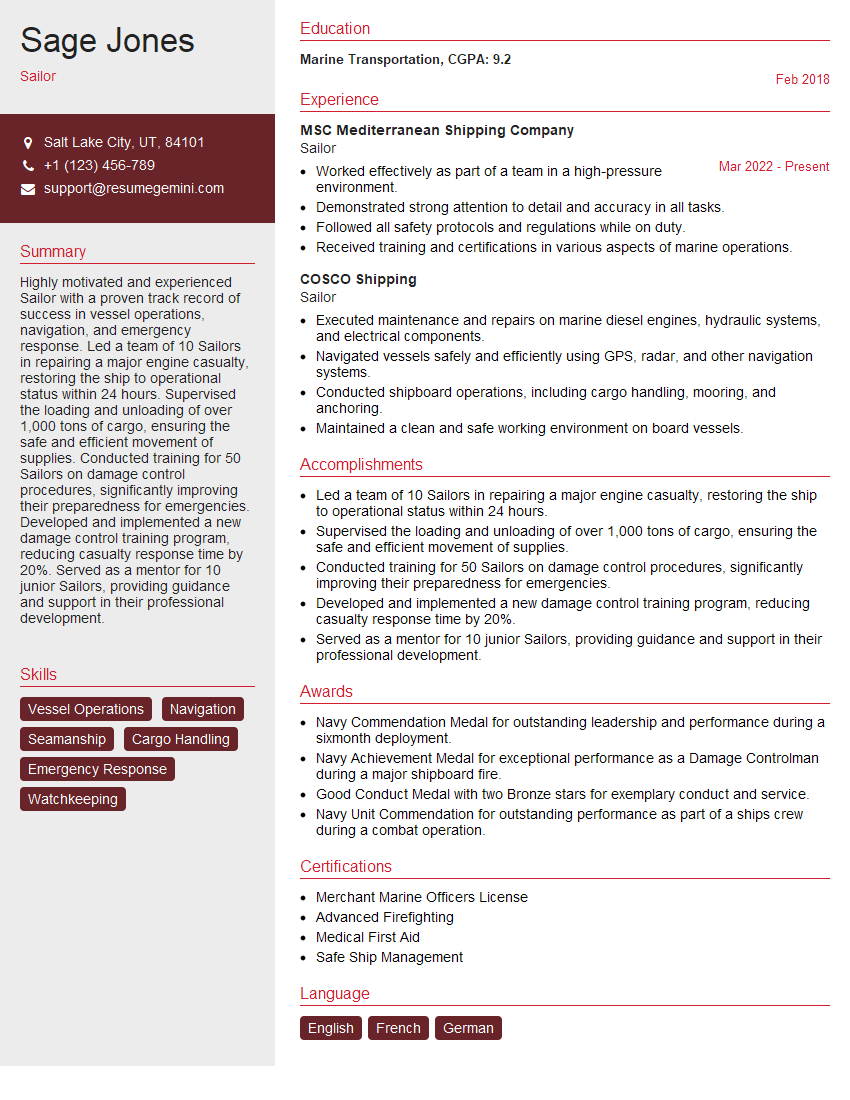
Are you gearing up for a career in Sailor? Feeling nervous about the interview questions that might come your way? Don’t worry, you’re in the right place. In this blog post, we’ll dive deep into the most common interview questions for Sailor and provide you with expert-backed answers. We’ll also explore the key responsibilities of this role so you can tailor your responses to showcase your perfect fit.
Acing the interview is crucial, but landing one requires a compelling resume that gets you noticed. Crafting a professional document that highlights your skills and experience is the first step toward interview success. ResumeGemini can help you build a standout resume that gets you called in for that dream job.






Essential Interview Questions For Sailor
1. What is the difference between a halyard and a line?
A halyard is a rope or cable used to hoist or lower sails, while a line is a general term for any rope or cord used on a boat.
2. What is the purpose of a reef point?
Knot tying
- To secure a reef in the sail, reducing its area and windage.
Sail handling
- To make the sail easier to handle in strong winds.
3. What is a jib sheet used for?
- To control the angle of the jib sail.
- To trim the sail for different wind conditions.
4. What is the difference between a cleat and a cam cleat?
- A cleat is a device used to hold a line in place.
- A cam cleat is a type of cleat that uses a cam to hold the line, making it easier to release.
5. What is a winch used for?
- To apply mechanical advantage to a line.
- To make it easier to hoist sails or trim lines.
6. What is the difference between a block and a tackle?
- A block is a single pulley.
- A tackle is a system of blocks used to multiply mechanical advantage.
7. What is a spinnaker?
- A large, lightweight sail used for downwind sailing.
- Designed to catch the maximum amount of wind and propel the boat forward.
8. What is the purpose of a vang?
- To control the boom angle on a sailboat.
- To keep the boom from swinging out too far and capsizing the boat.
9. What is the difference between a headsail and a mainsail?
- A headsail is a sail that is hoisted forward of the mast.
- A mainsail is a sail that is hoisted behind the mast.
10. What is the purpose of a bilge pump?
- To remove water from the bilge of a boat.
- To prevent the boat from sinking.
Interviewers often ask about specific skills and experiences. With ResumeGemini‘s customizable templates, you can tailor your resume to showcase the skills most relevant to the position, making a powerful first impression. Also check out Resume Template specially tailored for Sailor.
Career Expert Tips:
- Ace those interviews! Prepare effectively by reviewing the Top 50 Most Common Interview Questions on ResumeGemini.
- Navigate your job search with confidence! Explore a wide range of Career Tips on ResumeGemini. Learn about common challenges and recommendations to overcome them.
- Craft the perfect resume! Master the Art of Resume Writing with ResumeGemini’s guide. Showcase your unique qualifications and achievements effectively.
- Great Savings With New Year Deals and Discounts! In 2025, boost your job search and build your dream resume with ResumeGemini’s ATS optimized templates.
Researching the company and tailoring your answers is essential. Once you have a clear understanding of the Sailor‘s requirements, you can use ResumeGemini to adjust your resume to perfectly match the job description.
Key Job Responsibilities
Sailors are responsible for the safe operation and maintenance of marine vessels. They are also responsible for the welfare of passengers and crew, and for ensuring that all safety regulations are followed.
1. Navigation and Seamanship
Sailors must be proficient in navigation and seamanship. They must be able to read charts, operate GPS systems, and make sound decisions in challenging weather conditions.
- Navigate vessels using charts, GPS systems, and other navigational aids
- Operate marine engines, sails, and other systems
- Perform routine maintenance and repairs on vessels
- Comply with all safety regulations
2. Shipboard Operations
Sailors are responsible for the daily operations of the vessel. They must be able to operate the engine, sails, and other systems, and perform routine maintenance and repairs.
- Operate and maintain marine engines
- Control sails and rigging
- Perform routine maintenance and repairs
- Handle and store cargo
3. Passenger and Crew Safety
Sailors are responsible for the safety of passengers and crew. They must be able to respond to emergencies, such as fires, floods, and medical emergencies.
- Ensure the safety of passengers and crew
- Respond to emergencies
- Provide first aid and medical assistance
- Conduct safety drills and training
4. Compliance with Regulations
Sailors must comply with all safety regulations. They must be familiar with the International Maritime Organization (IMO) regulations, as well as national and local regulations.
- Comply with all IMO regulations
- Comply with national and local regulations
- Maintain a clean and safe vessel
- Report any deficiencies or accidents to the authorities
Interview Tips
Preparing for a sailor job interview can be daunting, but with the right preparation, you can increase your chances of success. Here are some tips to help you ace your interview:
1. Research the Company and the Position
Before you go into your interview, it’s important to do your research. Learn as much as you can about the company and the position you’re applying for. This will help you understand the company’s culture and values, and the specific requirements of the job.
- Visit the company’s website
- Read the job description carefully
- Talk to people who work for the company
- Learn about the industry and the latest trends
2. Prepare Your Answers to Common Interview Questions
There are a few common interview questions that you’re likely to be asked, such as “Tell me about yourself” and “Why are you interested in this position?” It’s helpful to prepare your answers to these questions in advance so that you can deliver them confidently and concisely.
- Practice your answers out loud
- Tailor your answers to the specific job you’re applying for
- Be prepared to talk about your skills and experience
- Be enthusiastic and positive
3. Dress Professionally and Arrive on Time
First impressions matter, so it’s important to dress professionally and arrive on time for your interview. This shows that you’re serious about the job and that you respect the interviewer’s time.
- Dress in business attire
- Be punctual
- Be polite and respectful
- Make eye contact and smile
4. Be Yourself and Be Authentic
The most important thing is to be yourself and be authentic. The interviewer wants to get to know the real you, so don’t try to be someone you’re not. Be honest about your skills and experience, and be confident in your abilities.
- Be honest and truthful
- Be confident in your abilities
- Don’t be afraid to ask questions
- Follow up with the interviewer after the interview
Next Step:
Now that you’re armed with interview-winning answers and a deeper understanding of the Sailor role, it’s time to take action! Does your resume accurately reflect your skills and experience for this position? If not, head over to ResumeGemini. Here, you’ll find all the tools and tips to craft a resume that gets noticed. Don’t let a weak resume hold you back from landing your dream job. Polish your resume, hit the “Build Your Resume” button, and watch your career take off! Remember, preparation is key, and ResumeGemini is your partner in interview success.