Are you a seasoned Apiarist seeking a new career path? Discover our professionally built Apiarist Resume Template. This time-saving tool provides a solid foundation for your job search. Simply click “Edit Resume” to customize it with your unique experiences and achievements. Customize fonts and colors to match your personal style and increase your chances of landing your dream job. Explore more Resume Templates for additional options.






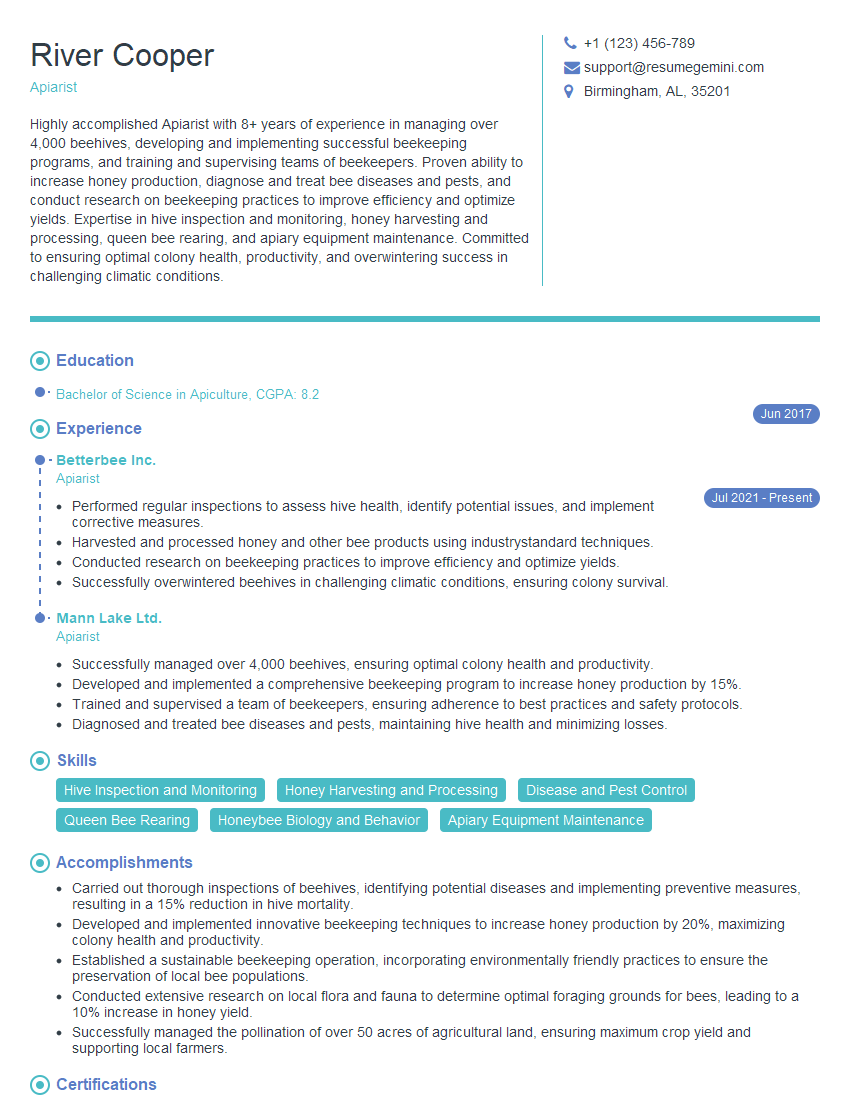
River Cooper
Apiarist
Summary
Highly accomplished Apiarist with 8+ years of experience in managing over 4,000 beehives, developing and implementing successful beekeeping programs, and training and supervising teams of beekeepers. Proven ability to increase honey production, diagnose and treat bee diseases and pests, and conduct research on beekeeping practices to improve efficiency and optimize yields. Expertise in hive inspection and monitoring, honey harvesting and processing, queen bee rearing, and apiary equipment maintenance. Committed to ensuring optimal colony health, productivity, and overwintering success in challenging climatic conditions.
Education
Bachelor of Science in Apiculture
June 2017
Skills
- Hive Inspection and Monitoring
- Honey Harvesting and Processing
- Disease and Pest Control
- Queen Bee Rearing
- Honeybee Biology and Behavior
- Apiary Equipment Maintenance
Work Experience
Apiarist
- Performed regular inspections to assess hive health, identify potential issues, and implement corrective measures.
- Harvested and processed honey and other bee products using industrystandard techniques.
- Conducted research on beekeeping practices to improve efficiency and optimize yields.
- Successfully overwintered beehives in challenging climatic conditions, ensuring colony survival.
Apiarist
- Successfully managed over 4,000 beehives, ensuring optimal colony health and productivity.
- Developed and implemented a comprehensive beekeeping program to increase honey production by 15%.
- Trained and supervised a team of beekeepers, ensuring adherence to best practices and safety protocols.
- Diagnosed and treated bee diseases and pests, maintaining hive health and minimizing losses.
Accomplishments
- Carried out thorough inspections of beehives, identifying potential diseases and implementing preventive measures, resulting in a 15% reduction in hive mortality.
- Developed and implemented innovative beekeeping techniques to increase honey production by 20%, maximizing colony health and productivity.
- Established a sustainable beekeeping operation, incorporating environmentally friendly practices to ensure the preservation of local bee populations.
- Conducted extensive research on local flora and fauna to determine optimal foraging grounds for bees, leading to a 10% increase in honey yield.
- Successfully managed the pollination of over 50 acres of agricultural land, ensuring maximum crop yield and supporting local farmers.
Certificates
- Certified Master Beekeeper (CMB)
- Journeyman Beekeeper (JB)
- Apprentice Beekeeper (AB)
- American Beekeeping Federation (ABF) Member
Languages
- English
- French
- German
Career Expert Tips:
- Select the ideal resume template to showcase your professional experience effectively.
- Master the art of resume writing to highlight your unique qualifications and achievements.
- Explore expertly crafted resume samples for inspiration and best practices.
- Build your best resume for free this new year with ResumeGemini. Enjoy exclusive discounts on ATS optimized resume templates.
How To Write Resume For Apiarist
- Highlight your experience and expertise in managing large-scale apiaries and increasing honey production.
- Demonstrate your knowledge of bee biology, behavior, and disease management.
- Emphasize your ability to train and supervise beekeepers effectively.
- Showcase your research skills and contributions to improving beekeeping practices.
Essential Experience Highlights for a Strong Apiarist Resume
- Managed over 4,000 beehives, ensuring optimal colony health and productivity.
- Developed and implemented a comprehensive beekeeping program to increase honey production by 15%.
- Trained and supervised a team of beekeepers, ensuring adherence to best practices and safety protocols.
- Diagnosed and treated bee diseases and pests, maintaining hive health and minimizing losses.
- Performed regular inspections to assess hive health, identify potential issues, and implement corrective measures.
- Harvested and processed honey and other bee products using industry-standard techniques.
- Conducted research on beekeeping practices to improve efficiency and optimize yields.
Frequently Asked Questions (FAQ’s) For Apiarist
What is the role of an Apiarist?
An Apiarist, also known as a Beekeeper, is responsible for managing and maintaining beehives to produce honey and other bee products. They ensure the health and productivity of bee colonies, diagnose and treat diseases, and conduct research to improve beekeeping practices.
What qualifications are required to become an Apiarist?
While formal education is not always required, many Apiarists hold a Bachelor’s degree in Apiculture, Entomology, or a related field. Practical experience and training are also essential.
What are the key skills needed to be a successful Apiarist?
Successful Apiarists possess a deep understanding of bee biology and behavior, hive management techniques, disease and pest control, and honey production methods. They are also skilled in equipment maintenance, record-keeping, and research.
What are the challenges faced by Apiarists?
Apiarists face various challenges, including colony collapse disorder, pests and diseases, climate change, and the availability of suitable forage for bees. They must also adapt to changing market conditions and consumer demands.
What are the career prospects for Apiarists?
Apiarists can find employment in various settings, including commercial honey production, pollination services, research institutions, and government agencies. They can also start their own beekeeping businesses or become consultants.
How can I learn more about Apiculture?
There are numerous resources available to learn more about Apiculture, including books, online courses, workshops, and conferences. Joining beekeeping associations and connecting with experienced Apiarists can also provide valuable insights and support.
What is the importance of bees?
Bees play a crucial role in the ecosystem as pollinators, supporting the reproduction of plants and contributing to biodiversity. They are also essential for honey production, which is a valuable food source and has medicinal properties.