Are you a seasoned Business Continuity Planner seeking a new career path? Discover our professionally built Business Continuity Planner Resume Template. This time-saving tool provides a solid foundation for your job search. Simply click “Edit Resume” to customize it with your unique experiences and achievements. Customize fonts and colors to match your personal style and increase your chances of landing your dream job. Explore more Resume Templates for additional options.






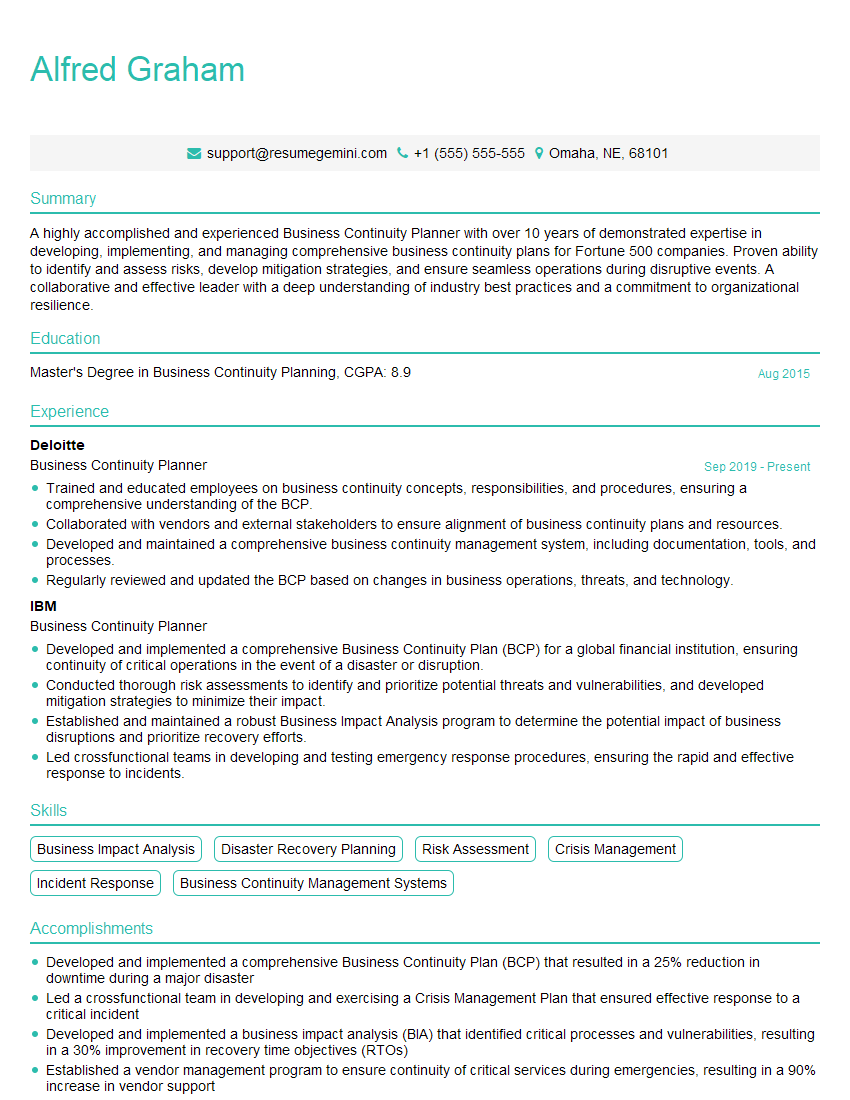
Alfred Graham
Business Continuity Planner
Summary
A highly accomplished and experienced Business Continuity Planner with over 10 years of demonstrated expertise in developing, implementing, and managing comprehensive business continuity plans for Fortune 500 companies. Proven ability to identify and assess risks, develop mitigation strategies, and ensure seamless operations during disruptive events. A collaborative and effective leader with a deep understanding of industry best practices and a commitment to organizational resilience.
Education
Master’s Degree in Business Continuity Planning
August 2015
Skills
- Business Impact Analysis
- Disaster Recovery Planning
- Risk Assessment
- Crisis Management
- Incident Response
- Business Continuity Management Systems
Work Experience
Business Continuity Planner
- Trained and educated employees on business continuity concepts, responsibilities, and procedures, ensuring a comprehensive understanding of the BCP.
- Collaborated with vendors and external stakeholders to ensure alignment of business continuity plans and resources.
- Developed and maintained a comprehensive business continuity management system, including documentation, tools, and processes.
- Regularly reviewed and updated the BCP based on changes in business operations, threats, and technology.
Business Continuity Planner
- Developed and implemented a comprehensive Business Continuity Plan (BCP) for a global financial institution, ensuring continuity of critical operations in the event of a disaster or disruption.
- Conducted thorough risk assessments to identify and prioritize potential threats and vulnerabilities, and developed mitigation strategies to minimize their impact.
- Established and maintained a robust Business Impact Analysis program to determine the potential impact of business disruptions and prioritize recovery efforts.
- Led crossfunctional teams in developing and testing emergency response procedures, ensuring the rapid and effective response to incidents.
Accomplishments
- Developed and implemented a comprehensive Business Continuity Plan (BCP) that resulted in a 25% reduction in downtime during a major disaster
- Led a crossfunctional team in developing and exercising a Crisis Management Plan that ensured effective response to a critical incident
- Developed and implemented a business impact analysis (BIA) that identified critical processes and vulnerabilities, resulting in a 30% improvement in recovery time objectives (RTOs)
- Established a vendor management program to ensure continuity of critical services during emergencies, resulting in a 90% increase in vendor support
- Developed and delivered tailored training programs on business continuity planning and response, reaching over 2,000 employees
Awards
- Recognized for Outstanding Achievement in Business Continuity Planning by the Business Continuity Institute (BCI)
- Received the Presidents Award for Exceptional Performance in Business Continuity Management
- Honored with the BC Practitioner of the Year Award for contributions to the field of Business Continuity
- Recognized as a Certified Business Continuity Professional (CBCP) by the Disaster Recovery Institute International (DRII)
Certificates
- Certified Business Continuity Professional (CBCP)
- Certified Information Systems Security Professional (CISSP)
- Certified Information Systems Auditor (CISA)
- Certified Disaster Recovery Professional (CDRP)
Career Expert Tips:
- Select the ideal resume template to showcase your professional experience effectively.
- Master the art of resume writing to highlight your unique qualifications and achievements.
- Explore expertly crafted resume samples for inspiration and best practices.
- Build your best resume for free this new year with ResumeGemini. Enjoy exclusive discounts on ATS optimized resume templates.
How To Write Resume For Business Continuity Planner
- Quantify your accomplishments whenever possible, using specific metrics to demonstrate the impact of your work.
- Showcase your knowledge of industry best practices and standards, such as ISO 22301 and NIST SP 800-34.
- Highlight your ability to work effectively with crossfunctional teams and stakeholders at all levels of the organization.
- Demonstrate your commitment to continuous learning and professional development by obtaining relevant certifications, such as the CBCP (Certified Business Continuity Professional) or MBCP (Master Business Continuity Professional).
Essential Experience Highlights for a Strong Business Continuity Planner Resume
- Developed and implemented a comprehensive Business Continuity Plan (BCP) for a global financial institution, ensuring continuity of critical operations in the event of a disaster or disruption.
- Conducted thorough risk assessments to identify and prioritize potential threats and vulnerabilities, and developed mitigation strategies to minimize their impact.
- Established and maintained a robust Business Impact Analysis program to determine the potential impact of business disruptions and prioritize recovery efforts.
- Led crossfunctional teams in developing and testing emergency response procedures, ensuring the rapid and effective response to incidents.
- Trained and educated employees on business continuity concepts, responsibilities, and procedures, ensuring a comprehensive understanding of the BCP.
- Collaborated with vendors and external stakeholders to ensure alignment of business continuity plans and resources.
- Developed and maintained a comprehensive business continuity management system, including documentation, tools, and processes.
Frequently Asked Questions (FAQ’s) For Business Continuity Planner
What are the primary responsibilities of a Business Continuity Planner?
The primary responsibilities of a Business Continuity Planner include conducting risk assessments, developing and implementing business continuity plans, establishing and maintaining a business impact analysis program, leading crossfunctional teams in developing emergency response procedures, training and educating employees, and collaborating with vendors and external stakeholders.
What are the key skills and qualifications required to become a Business Continuity Planner?
Key skills and qualifications for a Business Continuity Planner include knowledge of business continuity best practices and standards, experience in conducting risk assessments and developing mitigation strategies, strong communication and interpersonal skills, and the ability to work effectively with crossfunctional teams.
What are the career prospects for a Business Continuity Planner?
Business Continuity Planners can advance to roles such as Business Continuity Manager, Director of Business Continuity, or Chief Resilience Officer. They may also specialize in specific areas, such as cybersecurity, disaster recovery, or pandemic planning.
What are the common challenges faced by Business Continuity Planners?
Common challenges faced by Business Continuity Planners include keeping up with evolving threats and vulnerabilities, gaining buyin from senior management, and ensuring that business continuity plans are regularly tested and updated.
What are the key trends in the field of Business Continuity Planning?
Key trends in the field of Business Continuity Planning include the increasing use of technology, the focus on resilience, and the growing importance of collaboration and partnerships.
What are the professional organizations and certifications available for Business Continuity Planners?
Professional organizations and certifications for Business Continuity Planners include the Disaster Recovery Institute International (DRII), the Business Continuity Institute (BCI), and the International Association of Emergency Managers (IAEM).
What are the salary expectations for a Business Continuity Planner?
Salary expectations for a Business Continuity Planner vary depending on experience, qualifications, and industry. According to Salary.com, the average salary for a Business Continuity Planner in the United States is around $100,000 per year.
What are the ethical considerations for a Business Continuity Planner?
Ethical considerations for a Business Continuity Planner include maintaining confidentiality, avoiding conflicts of interest, and acting in the best interests of the organization.