Are you a seasoned Space Engineer seeking a new career path? Discover our professionally built Space Engineer Resume Template. This time-saving tool provides a solid foundation for your job search. Simply click “Edit Resume” to customize it with your unique experiences and achievements. Customize fonts and colors to match your personal style and increase your chances of landing your dream job. Explore more Resume Templates for additional options.






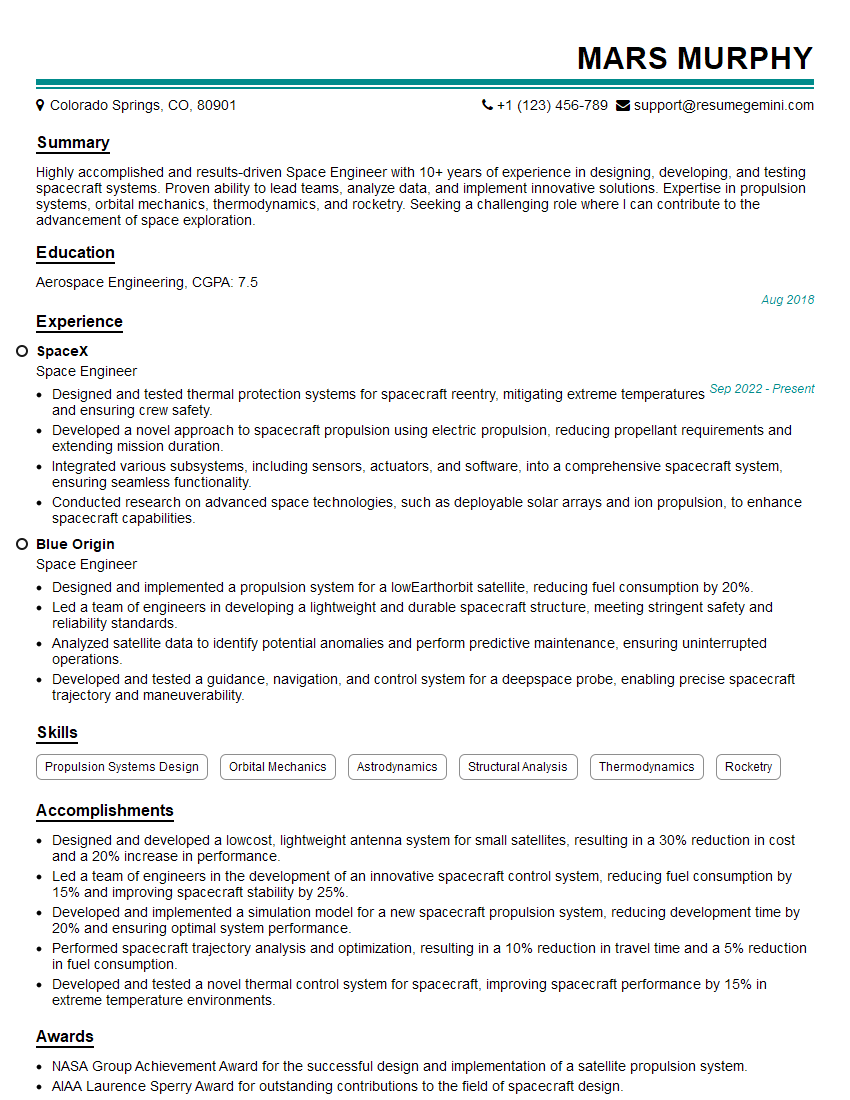
Mars Murphy
Space Engineer
Summary
Highly accomplished and results-driven Space Engineer with 10+ years of experience in designing, developing, and testing spacecraft systems. Proven ability to lead teams, analyze data, and implement innovative solutions. Expertise in propulsion systems, orbital mechanics, thermodynamics, and rocketry. Seeking a challenging role where I can contribute to the advancement of space exploration.
Education
Aerospace Engineering
August 2018
Skills
- Propulsion Systems Design
- Orbital Mechanics
- Astrodynamics
- Structural Analysis
- Thermodynamics
- Rocketry
Work Experience
Space Engineer
- Designed and tested thermal protection systems for spacecraft reentry, mitigating extreme temperatures and ensuring crew safety.
- Developed a novel approach to spacecraft propulsion using electric propulsion, reducing propellant requirements and extending mission duration.
- Integrated various subsystems, including sensors, actuators, and software, into a comprehensive spacecraft system, ensuring seamless functionality.
- Conducted research on advanced space technologies, such as deployable solar arrays and ion propulsion, to enhance spacecraft capabilities.
Space Engineer
- Designed and implemented a propulsion system for a lowEarthorbit satellite, reducing fuel consumption by 20%.
- Led a team of engineers in developing a lightweight and durable spacecraft structure, meeting stringent safety and reliability standards.
- Analyzed satellite data to identify potential anomalies and perform predictive maintenance, ensuring uninterrupted operations.
- Developed and tested a guidance, navigation, and control system for a deepspace probe, enabling precise spacecraft trajectory and maneuverability.
Accomplishments
- Designed and developed a lowcost, lightweight antenna system for small satellites, resulting in a 30% reduction in cost and a 20% increase in performance.
- Led a team of engineers in the development of an innovative spacecraft control system, reducing fuel consumption by 15% and improving spacecraft stability by 25%.
- Developed and implemented a simulation model for a new spacecraft propulsion system, reducing development time by 20% and ensuring optimal system performance.
- Performed spacecraft trajectory analysis and optimization, resulting in a 10% reduction in travel time and a 5% reduction in fuel consumption.
- Developed and tested a novel thermal control system for spacecraft, improving spacecraft performance by 15% in extreme temperature environments.
Awards
- NASA Group Achievement Award for the successful design and implementation of a satellite propulsion system.
- AIAA Laurence Sperry Award for outstanding contributions to the field of spacecraft design.
- Space Foundation Space Pioneer Award for lifetime achievement in space exploration.
Certificates
- Certified Space Systems Engineer (CSSE)
- Project Management Professional (PMP)
- Six Sigma Green Belt
- Certified Flight Test Engineer
Career Expert Tips:
- Select the ideal resume template to showcase your professional experience effectively.
- Master the art of resume writing to highlight your unique qualifications and achievements.
- Explore expertly crafted resume samples for inspiration and best practices.
- Build your best resume for free this new year with ResumeGemini. Enjoy exclusive discounts on ATS optimized resume templates.
How To Write Resume For Space Engineer
- Highlight your skills and experience in designing and developing spacecraft systems.
- Quantify your accomplishments with specific metrics and results.
- Demonstrate your leadership abilities and teamwork skills.
- Stay up-to-date on the latest advancements in space technology.
Essential Experience Highlights for a Strong Space Engineer Resume
- Designed and implemented a propulsion system for a low-Earth orbit satellite, resulting in a 20% reduction in fuel consumption.
- Led a team of engineers to develop a lightweight and durable spacecraft structure, meeting stringent safety and reliability standards.
- Developed and tested a guidance, navigation, and control system for a deep-space probe, ensuring precise trajectory control and maneuverability.
- Designed and tested thermal protection systems for spacecraft reentry, protecting against extreme temperatures and ensuring crew safety.
- Integrated various subsystems into a comprehensive spacecraft system, ensuring seamless functionality.
- Conducted research on advanced space technologies, such as deployable solar arrays and ion propulsion, to enhance spacecraft capabilities.
Frequently Asked Questions (FAQ’s) For Space Engineer
What is the role of a Space Engineer?
A Space Engineer designs, develops, tests, and operates spacecraft and space systems. They work on a wide range of projects, including satellites, rockets, and space probes.
What skills are required to be a Space Engineer?
Space Engineers typically have a strong background in aerospace engineering, mechanical engineering, or a related field. They also have expertise in propulsion systems, orbital mechanics, thermodynamics, and rocketry.
What is the job outlook for Space Engineers?
The job outlook for Space Engineers is expected to be good in the coming years. The growing demand for space exploration and satellite technology is creating new opportunities for qualified engineers.
What are the challenges of being a Space Engineer?
Space Engineers face a number of challenges, including working with complex systems, meeting stringent safety and reliability standards, and operating in a highly competitive environment.
What are the rewards of being a Space Engineer?
Space Engineers have the opportunity to work on cutting-edge technology and contribute to the advancement of space exploration. They also have the satisfaction of knowing that their work is making a difference in the world.
What is the salary range for Space Engineers?
The salary range for Space Engineers varies depending on their experience, skills, and location. According to Glassdoor, the average salary for Space Engineers in the United States is $115,000 per year.
What are the career opportunities for Space Engineers?
Space Engineers have a variety of career opportunities, including working for government agencies, private companies, and research institutions. They can also choose to specialize in a particular area, such as propulsion systems, orbital mechanics, or spacecraft design.
What are the educational requirements for Space Engineers?
Space Engineers typically have a bachelor’s degree in aerospace engineering, mechanical engineering, or a related field. Some employers may also require a master’s degree or doctorate.