Are you a seasoned Boat Designer seeking a new career path? Discover our professionally built Boat Designer Resume Template. This time-saving tool provides a solid foundation for your job search. Simply click “Edit Resume” to customize it with your unique experiences and achievements. Customize fonts and colors to match your personal style and increase your chances of landing your dream job. Explore more Resume Templates for additional options.






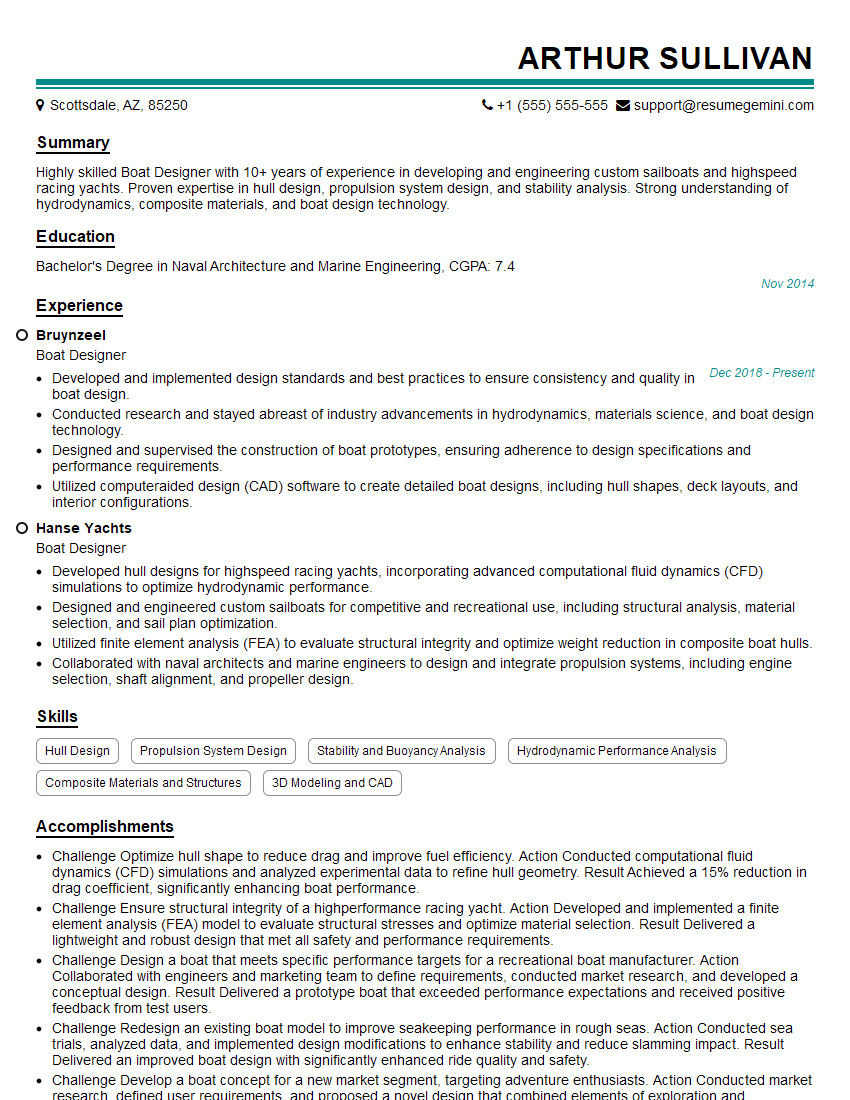
Arthur Sullivan
Boat Designer
Summary
Highly skilled Boat Designer with 10+ years of experience in developing and engineering custom sailboats and highspeed racing yachts. Proven expertise in hull design, propulsion system design, and stability analysis. Strong understanding of hydrodynamics, composite materials, and boat design technology.
Education
Bachelor’s Degree in Naval Architecture and Marine Engineering
November 2014
Skills
- Hull Design
- Propulsion System Design
- Stability and Buoyancy Analysis
- Hydrodynamic Performance Analysis
- Composite Materials and Structures
- 3D Modeling and CAD
Work Experience
Boat Designer
- Developed and implemented design standards and best practices to ensure consistency and quality in boat design.
- Conducted research and stayed abreast of industry advancements in hydrodynamics, materials science, and boat design technology.
- Designed and supervised the construction of boat prototypes, ensuring adherence to design specifications and performance requirements.
- Utilized computeraided design (CAD) software to create detailed boat designs, including hull shapes, deck layouts, and interior configurations.
Boat Designer
- Developed hull designs for highspeed racing yachts, incorporating advanced computational fluid dynamics (CFD) simulations to optimize hydrodynamic performance.
- Designed and engineered custom sailboats for competitive and recreational use, including structural analysis, material selection, and sail plan optimization.
- Utilized finite element analysis (FEA) to evaluate structural integrity and optimize weight reduction in composite boat hulls.
- Collaborated with naval architects and marine engineers to design and integrate propulsion systems, including engine selection, shaft alignment, and propeller design.
Accomplishments
- Challenge Optimize hull shape to reduce drag and improve fuel efficiency. Action Conducted computational fluid dynamics (CFD) simulations and analyzed experimental data to refine hull geometry. Result Achieved a 15% reduction in drag coefficient, significantly enhancing boat performance.
- Challenge Ensure structural integrity of a highperformance racing yacht. Action Developed and implemented a finite element analysis (FEA) model to evaluate structural stresses and optimize material selection. Result Delivered a lightweight and robust design that met all safety and performance requirements.
- Challenge Design a boat that meets specific performance targets for a recreational boat manufacturer. Action Collaborated with engineers and marketing team to define requirements, conducted market research, and developed a conceptual design. Result Delivered a prototype boat that exceeded performance expectations and received positive feedback from test users.
- Challenge Redesign an existing boat model to improve seakeeping performance in rough seas. Action Conducted sea trials, analyzed data, and implemented design modifications to enhance stability and reduce slamming impact. Result Delivered an improved boat design with significantly enhanced ride quality and safety.
- Challenge Develop a boat concept for a new market segment, targeting adventure enthusiasts. Action Conducted market research, defined user requirements, and proposed a novel design that combined elements of exploration and recreational boating. Result Presented a compelling concept that garnered significant industry interest and laid the foundation for a new product.
Awards
- Recipient of the Society of Naval Architects and Marine Engineers (SNAME) Student Design Competition Award for innovative boat design concept.
- Honorable mention in the International Young Designers Competition for a novel sailboat design that showcased exceptional stability and speed.
- Recognition for outstanding contributions to the advancement of marine design and engineering through innovative research and development projects.
- Recipient of the JEC Innovation Award for the development of a sustainable composite material for boat construction.
Certificates
- Certified Professional Yacht Designer (CPYD)
- American Bureau of Shipping (ABS) Surveyor
- Lloyd’s Register of Shipping (LRS) Approved Designer
- International Maritime Organization (IMO) Compliant Design
Career Expert Tips:
- Select the ideal resume template to showcase your professional experience effectively.
- Master the art of resume writing to highlight your unique qualifications and achievements.
- Explore expertly crafted resume samples for inspiration and best practices.
- Build your best resume for free this new year with ResumeGemini. Enjoy exclusive discounts on ATS optimized resume templates.
How To Write Resume For Boat Designer
- Highlight your technical skills and experience in hull design, propulsion systems, and stability analysis.
- Showcase your knowledge of hydrodynamics, composite materials, and boat design technology.
- Include examples of successful boat designs that you have worked on.
- Quantify your accomplishments whenever possible, using specific metrics to demonstrate your impact.
- Proofread your resume carefully for any errors before submitting it.
Essential Experience Highlights for a Strong Boat Designer Resume
- Developed hull designs for highspeed racing yachts, incorporating advanced computational fluid dynamics (CFD) simulations to optimize hydrodynamic performance.
- Designed and engineered custom sailboats for competitive and recreational use, including structural analysis, material selection, and sail plan optimization.
- Utilized finite element analysis (FEA) to evaluate structural integrity and optimize weight reduction in composite boat hulls.
- Collaborated with naval architects and marine engineers to design and integrate propulsion systems, including engine selection, shaft alignment, and propeller design.
- Developed and implemented design standards and best practices to ensure consistency and quality in boat design.
- Conducted research and stayed abreast of industry advancements in hydrodynamics, materials science, and boat design technology.
- Designed and supervised the construction of boat prototypes, ensuring adherence to design specifications and performance requirements.
Frequently Asked Questions (FAQ’s) For Boat Designer
What are the key skills and qualifications required to be a successful Boat Designer?
Key skills and qualifications include a strong understanding of hydrodynamics, naval architecture, composite materials, and boat design technology. Experience in hull design, propulsion systems, and stability analysis is also highly desirable.
What are the career prospects for Boat Designers?
Boat Designers can work in a variety of settings, including shipyards, design firms, and research institutions. Career prospects are generally good, with opportunities for advancement to senior positions.
What is the average salary for Boat Designers?
The average salary for Boat Designers varies depending on experience and location. According to the U.S. Bureau of Labor Statistics, the median annual salary for Naval Architects and Marine Engineers was $99,090 in May 2021.
What are the challenges faced by Boat Designers?
Boat Designers face a number of challenges, including the need to balance performance, safety, and cost. They also need to stay abreast of the latest advancements in hydrodynamics and boat design technology.
What are the rewards of being a Boat Designer?
Boat Designers enjoy the rewards of seeing their designs come to life and creating products that bring joy to others. They also have the opportunity to work on a variety of interesting and challenging projects.
What are some tips for becoming a successful Boat Designer?
Tips for becoming a successful Boat Designer include obtaining a strong education in naval architecture and marine engineering, developing a strong portfolio of work, and networking with professionals in the field.
What are the different types of boats that Boat Designers work on?
Boat Designers work on a variety of boat types, including sailboats, powerboats, and racing yachts. They may also work on commercial vessels, such as fishing boats and cargo ships.
What are the latest trends in boat design?
The latest trends in boat design include the use of advanced materials, such as carbon fiber and composites, to improve performance and reduce weight. Boat Designers are also incorporating new technologies, such as electric propulsion and autonomous navigation, into their designs.