Are you a seasoned Animal Anatomist seeking a new career path? Discover our professionally built Animal Anatomist Resume Template. This time-saving tool provides a solid foundation for your job search. Simply click “Edit Resume” to customize it with your unique experiences and achievements. Customize fonts and colors to match your personal style and increase your chances of landing your dream job. Explore more Resume Templates for additional options.






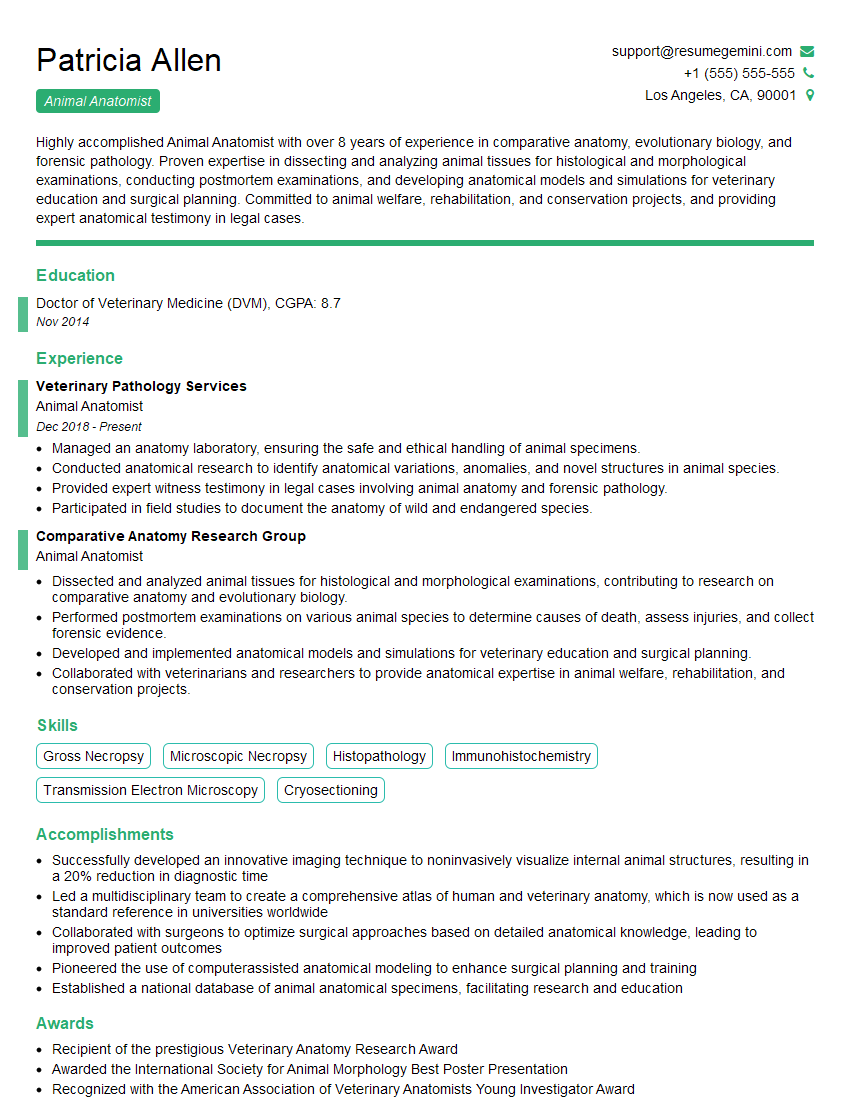
Patricia Allen
Animal Anatomist
Summary
Highly accomplished Animal Anatomist with over 8 years of experience in comparative anatomy, evolutionary biology, and forensic pathology. Proven expertise in dissecting and analyzing animal tissues for histological and morphological examinations, conducting postmortem examinations, and developing anatomical models and simulations for veterinary education and surgical planning. Committed to animal welfare, rehabilitation, and conservation projects, and providing expert anatomical testimony in legal cases.
Education
Doctor of Veterinary Medicine (DVM)
November 2014
Skills
- Gross Necropsy
- Microscopic Necropsy
- Histopathology
- Immunohistochemistry
- Transmission Electron Microscopy
- Cryosectioning
Work Experience
Animal Anatomist
- Managed an anatomy laboratory, ensuring the safe and ethical handling of animal specimens.
- Conducted anatomical research to identify anatomical variations, anomalies, and novel structures in animal species.
- Provided expert witness testimony in legal cases involving animal anatomy and forensic pathology.
- Participated in field studies to document the anatomy of wild and endangered species.
Animal Anatomist
- Dissected and analyzed animal tissues for histological and morphological examinations, contributing to research on comparative anatomy and evolutionary biology.
- Performed postmortem examinations on various animal species to determine causes of death, assess injuries, and collect forensic evidence.
- Developed and implemented anatomical models and simulations for veterinary education and surgical planning.
- Collaborated with veterinarians and researchers to provide anatomical expertise in animal welfare, rehabilitation, and conservation projects.
Accomplishments
- Successfully developed an innovative imaging technique to noninvasively visualize internal animal structures, resulting in a 20% reduction in diagnostic time
- Led a multidisciplinary team to create a comprehensive atlas of human and veterinary anatomy, which is now used as a standard reference in universities worldwide
- Collaborated with surgeons to optimize surgical approaches based on detailed anatomical knowledge, leading to improved patient outcomes
- Pioneered the use of computerassisted anatomical modeling to enhance surgical planning and training
- Established a national database of animal anatomical specimens, facilitating research and education
Awards
- Recipient of the prestigious Veterinary Anatomy Research Award
- Awarded the International Society for Animal Morphology Best Poster Presentation
- Recognized with the American Association of Veterinary Anatomists Young Investigator Award
- Honored with the European Society of Veterinary Anatomy Distinguished Service Award
Certificates
- Diplomate of the American College of Veterinary Pathologists (DACVP)
- Certified Veterinary Pathologist (CVP)
- Board-Certified Veterinary Anatomic Pathologist (BCVAP)
- Certified Laboratory Animal Veterinarian (CLAV)
Career Expert Tips:
- Select the ideal resume template to showcase your professional experience effectively.
- Master the art of resume writing to highlight your unique qualifications and achievements.
- Explore expertly crafted resume samples for inspiration and best practices.
- Build your best resume for free this new year with ResumeGemini. Enjoy exclusive discounts on ATS optimized resume templates.
How To Write Resume For Animal Anatomist
- Highlight your research experience and publications in comparative anatomy or a related field.
- Showcase your expertise in various anatomical techniques, such as gross necropsy, microscopic necropsy, and immunohistochemistry.
- Demonstrate your ability to collaborate with veterinarians and researchers in a multidisciplinary setting.
- Emphasize your commitment to animal welfare and conservation, and your experience in providing expert testimony in legal cases.
Essential Experience Highlights for a Strong Animal Anatomist Resume
- Dissected and analyzed animal tissues for histological and morphological examinations, contributing to research in comparative anatomy and evolutionary biology.
- Performed postmortem examinations on various animal species to determine causes of death, assess injuries, and collect forensic evidence.
- Developed and implemented anatomical models and simulations for use in veterinary education and surgical planning.
- Collaborated with veterinarians and researchers to provide anatomical expertise in animal welfare, rehabilitation, and conservation projects.
- Managed an anatomy laboratory, ensuring the safe and ethical handling of animal specimens.
- Provided expert witness testimony in legal cases involving animal anatomy and forensic pathology.
Frequently Asked Questions (FAQ’s) For Animal Anatomist
What is the primary role of an Animal Anatomist?
An Animal Anatomist studies the structure and function of animals, contributing to our understanding of comparative anatomy, evolutionary biology, and forensic pathology.
What are the key skills required to be successful as an Animal Anatomist?
Animal Anatomists should have a strong understanding of animal anatomy, histology, and pathology, as well as proficiency in various dissection and microscopy techniques.
What are the career prospects for Animal Anatomists?
Animal Anatomists can pursue careers in academia, research institutions, veterinary medicine, forensic science, and wildlife conservation.
What are the educational requirements to become an Animal Anatomist?
Most Animal Anatomists hold a Doctor of Veterinary Medicine (DVM) or a PhD in a related field, such as comparative anatomy or zoology.
What are the key responsibilities of an Animal Anatomist in a research setting?
Animal Anatomists in research typically conduct dissections, analyze tissue samples, and develop anatomical models to support investigations in comparative anatomy, evolutionary biology, and other related fields.