Are you a seasoned Agronomy Research Manager seeking a new career path? Discover our professionally built Agronomy Research Manager Resume Template. This time-saving tool provides a solid foundation for your job search. Simply click “Edit Resume” to customize it with your unique experiences and achievements. Customize fonts and colors to match your personal style and increase your chances of landing your dream job. Explore more Resume Templates for additional options.






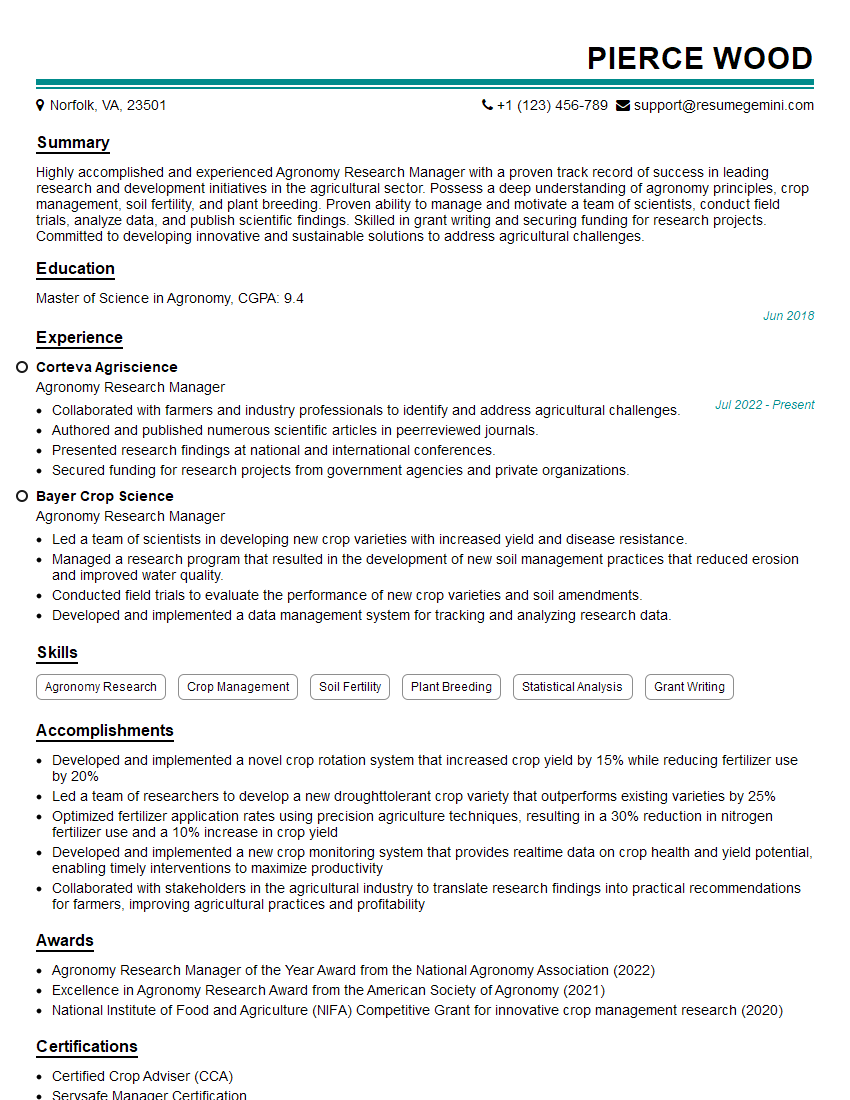
Pierce Wood
Agronomy Research Manager
Summary
Highly accomplished and experienced Agronomy Research Manager with a proven track record of success in leading research and development initiatives in the agricultural sector. Possess a deep understanding of agronomy principles, crop management, soil fertility, and plant breeding. Proven ability to manage and motivate a team of scientists, conduct field trials, analyze data, and publish scientific findings. Skilled in grant writing and securing funding for research projects. Committed to developing innovative and sustainable solutions to address agricultural challenges.
Education
Master of Science in Agronomy
June 2018
Skills
- Agronomy Research
- Crop Management
- Soil Fertility
- Plant Breeding
- Statistical Analysis
- Grant Writing
Work Experience
Agronomy Research Manager
- Collaborated with farmers and industry professionals to identify and address agricultural challenges.
- Authored and published numerous scientific articles in peerreviewed journals.
- Presented research findings at national and international conferences.
- Secured funding for research projects from government agencies and private organizations.
Agronomy Research Manager
- Led a team of scientists in developing new crop varieties with increased yield and disease resistance.
- Managed a research program that resulted in the development of new soil management practices that reduced erosion and improved water quality.
- Conducted field trials to evaluate the performance of new crop varieties and soil amendments.
- Developed and implemented a data management system for tracking and analyzing research data.
Accomplishments
- Developed and implemented a novel crop rotation system that increased crop yield by 15% while reducing fertilizer use by 20%
- Led a team of researchers to develop a new droughttolerant crop variety that outperforms existing varieties by 25%
- Optimized fertilizer application rates using precision agriculture techniques, resulting in a 30% reduction in nitrogen fertilizer use and a 10% increase in crop yield
- Developed and implemented a new crop monitoring system that provides realtime data on crop health and yield potential, enabling timely interventions to maximize productivity
- Collaborated with stakeholders in the agricultural industry to translate research findings into practical recommendations for farmers, improving agricultural practices and profitability
Awards
- Agronomy Research Manager of the Year Award from the National Agronomy Association (2022)
- Excellence in Agronomy Research Award from the American Society of Agronomy (2021)
- National Institute of Food and Agriculture (NIFA) Competitive Grant for innovative crop management research (2020)
Certificates
- Certified Crop Adviser (CCA)
- Servsafe Manager Certification
- ISO 14001 Environmental Management Systems Auditor
- Project Management Professional (PMP)
Career Expert Tips:
- Select the ideal resume template to showcase your professional experience effectively.
- Master the art of resume writing to highlight your unique qualifications and achievements.
- Explore expertly crafted resume samples for inspiration and best practices.
- Build your best resume for free this new year with ResumeGemini. Enjoy exclusive discounts on ATS optimized resume templates.
How To Write Resume For Agronomy Research Manager
- Highlight your skills and experience in agronomy research, crop management, and soil fertility.
- Quantify your accomplishments and provide specific examples of your successes.
- Demonstrate your ability to lead and manage a team of scientists.
- Showcase your communication and presentation skills.
- Emphasize your commitment to developing innovative and sustainable agricultural solutions.
Essential Experience Highlights for a Strong Agronomy Research Manager Resume
- Led a team of scientists in developing new crop varieties with increased yield and disease resistance.
- Managed a research program that resulted in the development of new soil management practices that reduced erosion and improved water quality.
- Conducted field trials to evaluate the performance of new crop varieties and soil amendments.
- Developed and implemented a data management system for tracking and analyzing research data.
- Collaborated with farmers and industry professionals to identify and address agricultural challenges.
- Authored and published numerous scientific articles in peer-reviewed journals.
- Presented research findings at national and international conferences.
Frequently Asked Questions (FAQ’s) For Agronomy Research Manager
What are the key responsibilities of an Agronomy Research Manager?
Key responsibilities include leading research teams, conducting field trials, analyzing data, and developing innovative agricultural solutions.
What qualifications are required to become an Agronomy Research Manager?
Typically, a Master’s degree in Agronomy or a related field is required, along with experience in research and management.
What are the career prospects for Agronomy Research Managers?
With experience and expertise, Agronomy Research Managers can advance to senior leadership roles in research and development, academia, and industry.
What are the challenges faced by Agronomy Research Managers?
Challenges include securing funding, managing complex research projects, and addressing emerging agricultural issues.
What skills are essential for Agronomy Research Managers?
Essential skills include strong technical knowledge, leadership abilities, analytical skills, and effective communication skills.
How can I become a successful Agronomy Research Manager?
To succeed, focus on developing your expertise, building strong relationships, and staying abreast of the latest advancements in agronomy research.