Are you a seasoned Chemical Analyst seeking a new career path? Discover our professionally built Chemical Analyst Resume Template. This time-saving tool provides a solid foundation for your job search. Simply click “Edit Resume” to customize it with your unique experiences and achievements. Customize fonts and colors to match your personal style and increase your chances of landing your dream job. Explore more Resume Templates for additional options.






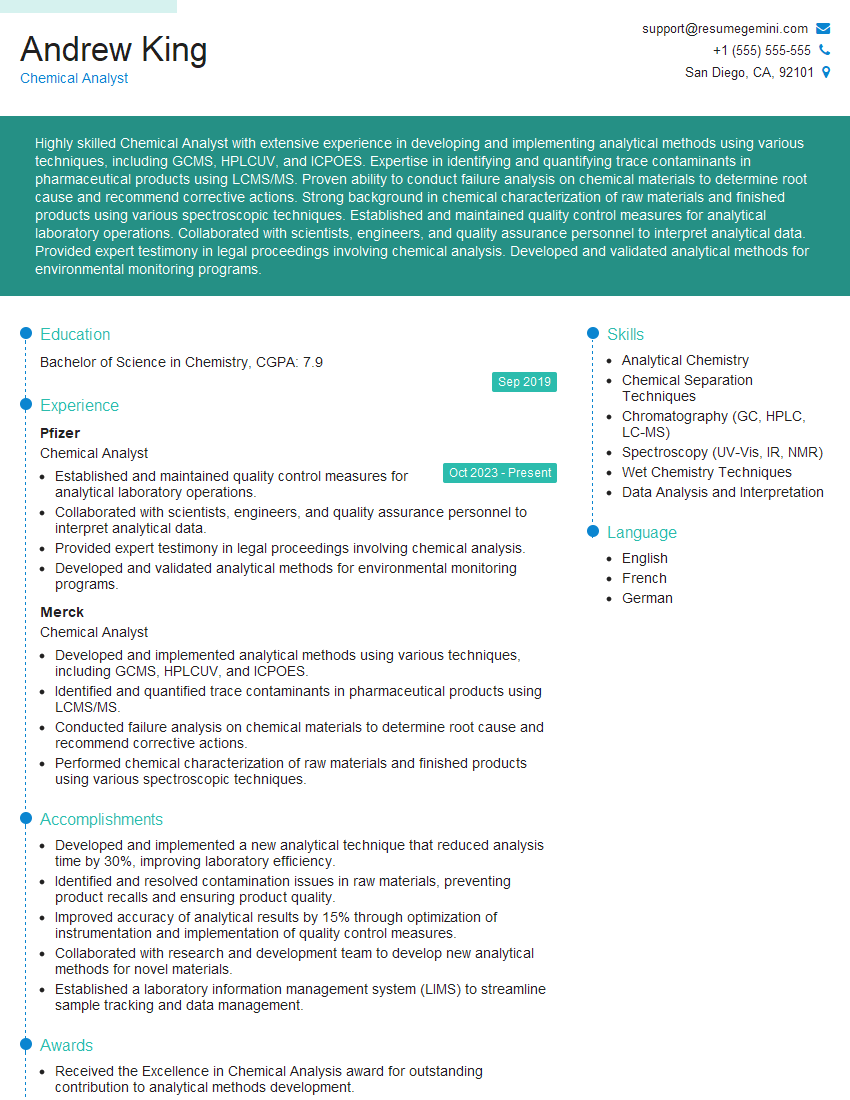
Andrew King
Chemical Analyst
Summary
Highly skilled Chemical Analyst with extensive experience in developing and implementing analytical methods using various techniques, including GCMS, HPLCUV, and ICPOES. Expertise in identifying and quantifying trace contaminants in pharmaceutical products using LCMS/MS. Proven ability to conduct failure analysis on chemical materials to determine root cause and recommend corrective actions. Strong background in chemical characterization of raw materials and finished products using various spectroscopic techniques. Established and maintained quality control measures for analytical laboratory operations. Collaborated with scientists, engineers, and quality assurance personnel to interpret analytical data. Provided expert testimony in legal proceedings involving chemical analysis. Developed and validated analytical methods for environmental monitoring programs.
Education
Bachelor of Science in Chemistry
September 2019
Skills
- Analytical Chemistry
- Chemical Separation Techniques
- Chromatography (GC, HPLC, LC-MS)
- Spectroscopy (UV-Vis, IR, NMR)
- Wet Chemistry Techniques
- Data Analysis and Interpretation
Work Experience
Chemical Analyst
- Established and maintained quality control measures for analytical laboratory operations.
- Collaborated with scientists, engineers, and quality assurance personnel to interpret analytical data.
- Provided expert testimony in legal proceedings involving chemical analysis.
- Developed and validated analytical methods for environmental monitoring programs.
Chemical Analyst
- Developed and implemented analytical methods using various techniques, including GCMS, HPLCUV, and ICPOES.
- Identified and quantified trace contaminants in pharmaceutical products using LCMS/MS.
- Conducted failure analysis on chemical materials to determine root cause and recommend corrective actions.
- Performed chemical characterization of raw materials and finished products using various spectroscopic techniques.
Accomplishments
- Developed and implemented a new analytical technique that reduced analysis time by 30%, improving laboratory efficiency.
- Identified and resolved contamination issues in raw materials, preventing product recalls and ensuring product quality.
- Improved accuracy of analytical results by 15% through optimization of instrumentation and implementation of quality control measures.
- Collaborated with research and development team to develop new analytical methods for novel materials.
- Established a laboratory information management system (LIMS) to streamline sample tracking and data management.
Awards
- Received the Excellence in Chemical Analysis award for outstanding contribution to analytical methods development.
- Recognized for exceptional accuracy and precision in complex chemical analysis, maintaining laboratory accreditation.
- Received a certificate of appreciation for assisting in the investigation of a major industrial accident.
- Honored with a Rising Star award for innovation in chemical analysis techniques.
Certificates
- American Chemical Society (ACS) Certified Professional Chemist
- American Association of Laboratory Accreditation (A2LA) Accredited Laboratory
- ISO/IEC 17025:2017 Accredited Laboratory
- Certified Safety Professional (CSP)
Career Expert Tips:
- Select the ideal resume template to showcase your professional experience effectively.
- Master the art of resume writing to highlight your unique qualifications and achievements.
- Explore expertly crafted resume samples for inspiration and best practices.
- Build your best resume for free this new year with ResumeGemini. Enjoy exclusive discounts on ATS optimized resume templates.
How To Write Resume For Chemical Analyst
Highlight your relevant skills and experience.
When writing your resume, be sure to emphasize the skills and experience that are most relevant to the job you are applying for. This includes your technical skills, such as your knowledge of analytical chemistry, chemical separation techniques, and chromatography. It also includes your soft skills, such as your ability to work independently and as part of a team.Use keywords.
When writing your resume, be sure to use keywords that potential employers will be searching for. This includes keywords related to your skills and experience, as well as keywords related to the job you are applying for. You can find a list of relevant keywords by researching job postings and company websites.Proofread your resume carefully.
Before you submit your resume, be sure to proofread it carefully for any errors. This includes checking for typos, grammatical errors, and formatting errors.Get feedback from others.
Once you have written your resume, ask a friend, family member, or career counselor to review it. They can provide you with feedback on your writing style, your use of keywords, and your overall presentation.
Essential Experience Highlights for a Strong Chemical Analyst Resume
- Develop and implement analytical methods using various techniques, including GCMS, HPLCUV, and ICPOES.
- Identify and quantify trace contaminants in pharmaceutical products using LCMS/MS.
- Conduct failure analysis on chemical materials to determine root cause and recommend corrective actions.
- Perform chemical characterization of raw materials and finished products using various spectroscopic techniques.
- Collaborate with scientists, engineers, and quality assurance personnel to interpret analytical data.
- Provide expert testimony in legal proceedings involving chemical analysis.
- Develop and validate analytical methods for environmental monitoring programs.
Frequently Asked Questions (FAQ’s) For Chemical Analyst
What is the job outlook for chemical analysts?
The job outlook for chemical analysts is expected to be good over the next few years. The demand for chemical analysts is expected to grow as the pharmaceutical, food, and manufacturing industries continue to expand.
What are the typical salary expectations for a chemical analyst?
The typical salary expectations for a chemical analyst can vary depending on experience, location, and industry. However, the median annual salary for chemical analysts was $62,290 in May 2020.
What are the educational requirements for becoming a chemical analyst?
The educational requirements for becoming a chemical analyst typically include a bachelor’s degree in chemistry or a related field. Some employers may also require a master’s degree or doctorate.
What are the key skills and experience required for a chemical analyst?
The key skills and experience required for a chemical analyst include strong analytical skills, experience with analytical chemistry techniques such as GCMS and HPLC, and a knowledge of chemical regulations.
What are the career advancement opportunities for chemical analysts?
The career advancement opportunities for chemical analysts can vary depending on experience and qualifications. Some chemical analysts may advance to positions such as laboratory manager, quality control manager, or research scientist.
What is the work environment like for chemical analysts?
The work environment for chemical analysts is typically a laboratory setting. Chemical analysts may work independently or as part of a team. The work can be physically demanding, and chemical analysts may be exposed to hazardous chemicals.