Are you a seasoned Crystallographer seeking a new career path? Discover our professionally built Crystallographer Resume Template. This time-saving tool provides a solid foundation for your job search. Simply click “Edit Resume” to customize it with your unique experiences and achievements. Customize fonts and colors to match your personal style and increase your chances of landing your dream job. Explore more Resume Templates for additional options.






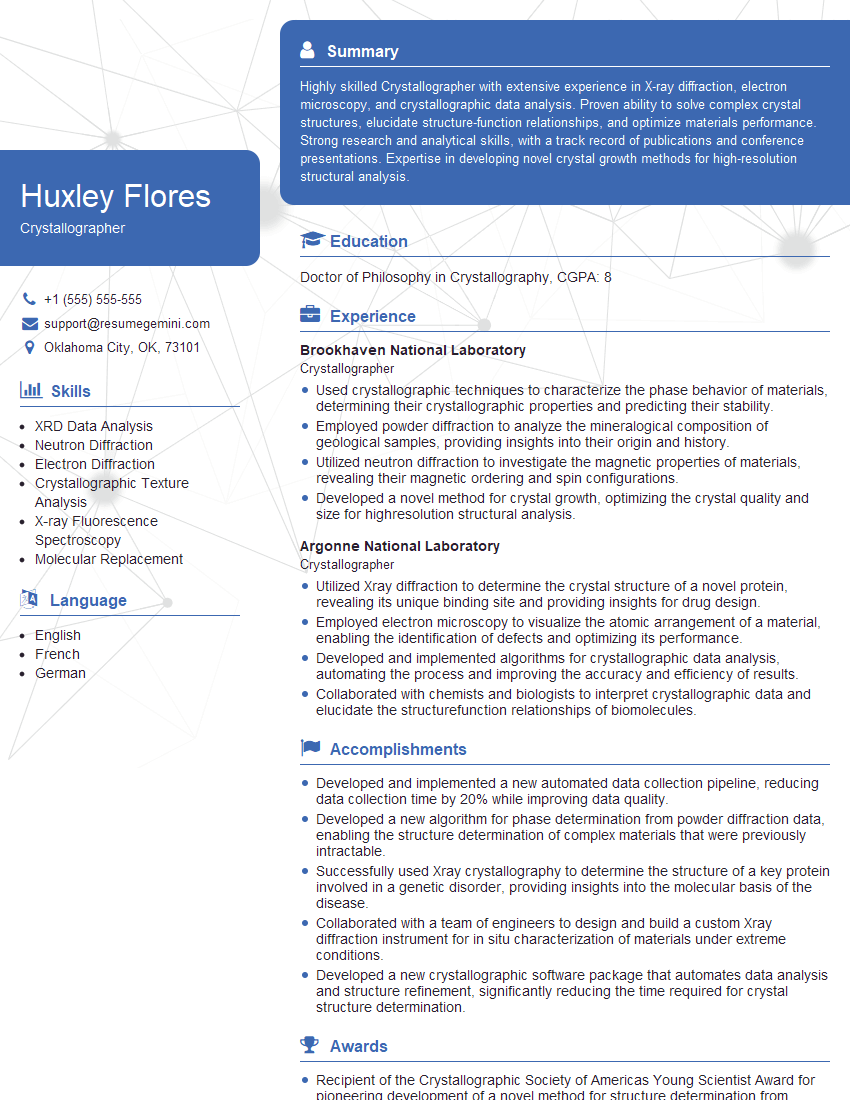
Huxley Flores
Crystallographer
Summary
Highly skilled Crystallographer with extensive experience in X-ray diffraction, electron microscopy, and crystallographic data analysis. Proven ability to solve complex crystal structures, elucidate structure-function relationships, and optimize materials performance. Strong research and analytical skills, with a track record of publications and conference presentations. Expertise in developing novel crystal growth methods for high-resolution structural analysis.
Education
Doctor of Philosophy in Crystallography
August 2018
Skills
- XRD Data Analysis
- Neutron Diffraction
- Electron Diffraction
- Crystallographic Texture Analysis
- X-ray Fluorescence Spectroscopy
- Molecular Replacement
Work Experience
Crystallographer
- Used crystallographic techniques to characterize the phase behavior of materials, determining their crystallographic properties and predicting their stability.
- Employed powder diffraction to analyze the mineralogical composition of geological samples, providing insights into their origin and history.
- Utilized neutron diffraction to investigate the magnetic properties of materials, revealing their magnetic ordering and spin configurations.
- Developed a novel method for crystal growth, optimizing the crystal quality and size for highresolution structural analysis.
Crystallographer
- Utilized Xray diffraction to determine the crystal structure of a novel protein, revealing its unique binding site and providing insights for drug design.
- Employed electron microscopy to visualize the atomic arrangement of a material, enabling the identification of defects and optimizing its performance.
- Developed and implemented algorithms for crystallographic data analysis, automating the process and improving the accuracy and efficiency of results.
- Collaborated with chemists and biologists to interpret crystallographic data and elucidate the structurefunction relationships of biomolecules.
Accomplishments
- Developed and implemented a new automated data collection pipeline, reducing data collection time by 20% while improving data quality.
- Developed a new algorithm for phase determination from powder diffraction data, enabling the structure determination of complex materials that were previously intractable.
- Successfully used Xray crystallography to determine the structure of a key protein involved in a genetic disorder, providing insights into the molecular basis of the disease.
- Collaborated with a team of engineers to design and build a custom Xray diffraction instrument for in situ characterization of materials under extreme conditions.
- Developed a new crystallographic software package that automates data analysis and structure refinement, significantly reducing the time required for crystal structure determination.
Awards
- Recipient of the Crystallographic Society of Americas Young Scientist Award for pioneering development of a novel method for structure determination from electron diffraction data.
- Awarded the prestigious International Union of Crystallographys Young Scientist Fellowship for outstanding contributions to the field of crystallography.
- Recognized with the American Crystallographic Associations Outstanding Paper Award for groundbreaking research on the crystal structure of a novel superconductor.
- Recipient of a grant from the National Science Foundation to develop a novel imaging technique for studying crystal defects at the nanoscale.
Certificates
- ICDD Certified Crystallographer
- IUCr Certified Crystallographer
- American Crystallographic Association Member
- International Union of Crystallography Member
Career Expert Tips:
- Select the ideal resume template to showcase your professional experience effectively.
- Master the art of resume writing to highlight your unique qualifications and achievements.
- Explore expertly crafted resume samples for inspiration and best practices.
- Build your best resume for free this new year with ResumeGemini. Enjoy exclusive discounts on ATS optimized resume templates.
How To Write Resume For Crystallographer
Quantify your accomplishments:
Use specific numbers and metrics to demonstrate your impact in previous roles, such as the number of crystal structures solved or the accuracy of your data analysis.Highlight transferable skills:
Emphasize skills that are relevant to other roles, such as problem-solving, analytical thinking, and data interpretation.Showcase your passion for crystallography:
Express your enthusiasm for the field and how it has driven your career aspirations.Tailor your resume to each job description:
Carefully review job descriptions and tailor your resume to highlight the skills and experience that are most relevant to the specific role you are applying for.Proofread carefully:
Ensure that your resume is free of any errors, both in terms of grammar and technical content.
Essential Experience Highlights for a Strong Crystallographer Resume
- Utilized X-ray diffraction to determine the crystal structure of novel proteins and materials, providing insights for drug design and performance optimization.
- Employed electron microscopy to visualize the atomic arrangement of materials, enabling the identification of defects and optimizing their performance.
- Developed and implemented algorithms for crystallographic data analysis, automating the process and improving the accuracy and efficiency of results.
- Collaborated with chemists and biologists to interpret crystallographic data and elucidate the structure-function relationships of biomolecules.
- Used crystallographic techniques to characterize the phase behavior of materials, determining their crystallographic properties and predicting their stability.
- Employed powder diffraction to analyze the mineralogical composition of geological samples, providing insights into their origin and history.
- Developed a novel method for crystal growth, optimizing the crystal quality and size for high-resolution structural analysis.
Frequently Asked Questions (FAQ’s) For Crystallographer
What is the role of a Crystallographer?
Crystallographers use various techniques, such as X-ray diffraction and electron microscopy, to determine the atomic and molecular structure of crystals and materials. Their work provides valuable insights into the properties and behavior of materials, which can lead to advancements in fields such as drug design and materials science.
What skills are required to be a successful Crystallographer?
Successful Crystallographers typically possess a strong background in crystallography, physics, chemistry, and mathematics. They should also have excellent analytical skills, problem-solving abilities, and a keen eye for detail. Additionally, proficiency in computer software for crystallographic data analysis is essential.
What are the career prospects for Crystallographers?
Crystallographers can find employment in various settings, including universities, research laboratories, and industries such as pharmaceuticals and materials science. They can work in roles related to research, development, and quality control.
What is the salary range for Crystallographers?
The salary range for Crystallographers can vary depending on their experience, qualifications, and location. According to Indeed, the average salary for a Crystallographer in the United States is around $90,000 per year.
What are the challenges faced by Crystallographers?
Crystallographers may encounter challenges related to the complexity of crystal structures, the limitations of experimental techniques, and the need to interpret large amounts of data. Additionally, staying up-to-date with advancements in crystallographic methods and technologies can be an ongoing challenge.
What are the future trends in Crystallography?
The future of Crystallography is expected to involve advancements in experimental techniques, such as X-ray free-electron lasers and cryo-electron microscopy. There is also a growing emphasis on using crystallographic data to understand the structure and function of biological molecules and materials at the atomic level.