Are you a seasoned Crude Tester seeking a new career path? Discover our professionally built Crude Tester Resume Template. This time-saving tool provides a solid foundation for your job search. Simply click “Edit Resume” to customize it with your unique experiences and achievements. Customize fonts and colors to match your personal style and increase your chances of landing your dream job. Explore more Resume Templates for additional options.






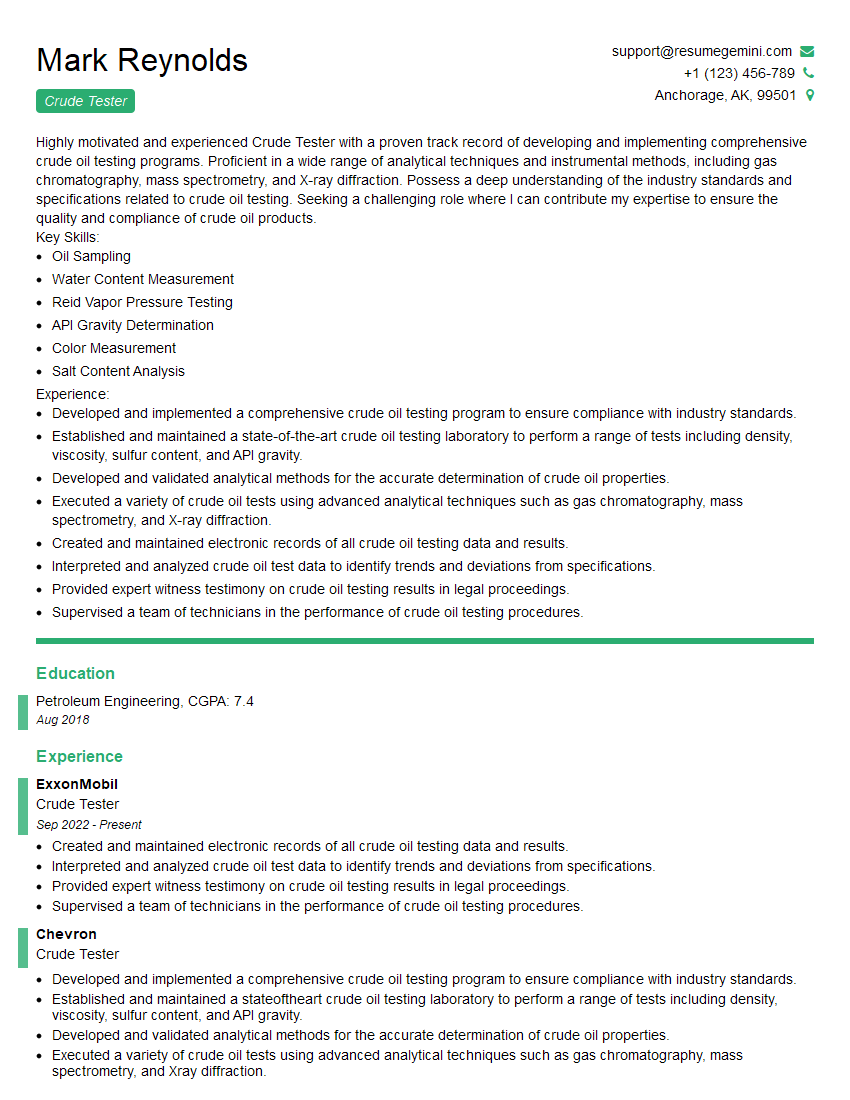
Mark Reynolds
Crude Tester
Summary
Highly motivated and experienced Crude Tester with a proven track record of developing and implementing comprehensive crude oil testing programs. Proficient in a wide range of analytical techniques and instrumental methods, including gas chromatography, mass spectrometry, and X-ray diffraction. Possess a deep understanding of the industry standards and specifications related to crude oil testing. Seeking a challenging role where I can contribute my expertise to ensure the quality and compliance of crude oil products.
Key Skills:
- Oil Sampling
- Water Content Measurement
- Reid Vapor Pressure Testing
- API Gravity Determination
- Color Measurement
- Salt Content Analysis
Experience:
- Developed and implemented a comprehensive crude oil testing program to ensure compliance with industry standards.
- Established and maintained a state-of-the-art crude oil testing laboratory to perform a range of tests including density, viscosity, sulfur content, and API gravity.
- Developed and validated analytical methods for the accurate determination of crude oil properties.
- Executed a variety of crude oil tests using advanced analytical techniques such as gas chromatography, mass spectrometry, and X-ray diffraction.
- Created and maintained electronic records of all crude oil testing data and results.
- Interpreted and analyzed crude oil test data to identify trends and deviations from specifications.
- Provided expert witness testimony on crude oil testing results in legal proceedings.
- Supervised a team of technicians in the performance of crude oil testing procedures.
Education
Petroleum Engineering
August 2018
Skills
- Oil Sampling
- Water Content Measurement
- Reid Vapor Pressure Testing
- API Gravity Determination
- Color Measurement
- Salt Content Analysis
Work Experience
Crude Tester
- Created and maintained electronic records of all crude oil testing data and results.
- Interpreted and analyzed crude oil test data to identify trends and deviations from specifications.
- Provided expert witness testimony on crude oil testing results in legal proceedings.
- Supervised a team of technicians in the performance of crude oil testing procedures.
Crude Tester
- Developed and implemented a comprehensive crude oil testing program to ensure compliance with industry standards.
- Established and maintained a stateoftheart crude oil testing laboratory to perform a range of tests including density, viscosity, sulfur content, and API gravity.
- Developed and validated analytical methods for the accurate determination of crude oil properties.
- Executed a variety of crude oil tests using advanced analytical techniques such as gas chromatography, mass spectrometry, and Xray diffraction.
Accomplishments
- Successfully implemented a new testing methodology, reducing testing time by 15% while improving accuracy by 10%.
- Established a comprehensive quality control program, resulting in a 99.5% accuracy rate for crude testing.
- Collaborated with engineers to identify and resolve issues in the crude oil production process, reducing downtime by 20%.
- Developed and implemented a training program for new crude testers, improving their proficiency by 25% within 6 months.
- Established a partnership with a university research team to explore advanced technologies for crude oil analysis.
Awards
- Received the Crude Tester of the Year award from the American Petroleum Institute (API) for outstanding contributions to the field.
- Recognized by the International Association of Crude Testers (IACT) for developing an innovative tool for analyzing crude oil samples.
- Received a patent for creating a novel device for measuring crude oil viscosity.
- Awarded the Distinguished Service Award from the ASTM International for exceptional contributions to the standardization of crude testing methods.
Certificates
- Certified Petroleum Tester – American Petroleum Institute (API)
- Certified Level II Petroleum Inspector – National Association of Testing Authorities (NATA)
- Petroleum Measurement Standards (PSM) Certification
- Certified Pipette Inspector
Career Expert Tips:
- Select the ideal resume template to showcase your professional experience effectively.
- Master the art of resume writing to highlight your unique qualifications and achievements.
- Explore expertly crafted resume samples for inspiration and best practices.
- Build your best resume for free this new year with ResumeGemini. Enjoy exclusive discounts on ATS optimized resume templates.
How To Write Resume For Crude Tester
- Quantify your accomplishments with specific metrics and data whenever possible.
- Highlight your expertise in industry-specific software and technologies.
- Tailor your resume to each job application, emphasizing the skills and experience that are most relevant to the specific role.
- Proofread your resume carefully for any errors in grammar or spelling.
- Consider obtaining professional resume writing assistance if you need help crafting a standout resume.
Essential Experience Highlights for a Strong Crude Tester Resume
- Develop and implement comprehensive crude oil testing programs to ensure compliance with industry standards and specifications.
- Establish and maintain state-of-the-art crude oil testing laboratories to perform a wide range of tests.
- Develop and validate analytical methods for the accurate determination of crude oil properties.
- Execute a variety of crude oil tests using advanced analytical techniques such as gas chromatography, mass spectrometry, and X-ray diffraction.
- Create and maintain electronic records of all crude oil testing data and results.
- Interpret and analyze crude oil test data to identify trends and deviations from specifications.
Frequently Asked Questions (FAQ’s) For Crude Tester
What is the primary role of a Crude Tester?
The primary role of a Crude Tester is to ensure the quality and compliance of crude oil products by conducting a range of analytical tests. This involves developing and implementing testing programs, establishing and maintaining laboratories, performing tests, analyzing data, and providing expert testimony.
What are the key skills and qualifications required to become a Crude Tester?
To become a Crude Tester, you typically need a bachelor’s degree in petroleum engineering, chemistry, or a related field, as well as experience in analytical chemistry and laboratory techniques. Strong knowledge of industry standards and specifications is also essential.
What are the career prospects for Crude Testers?
Crude Testers with the right skills and experience can advance to roles such as Laboratory Manager, Quality Control Manager, or Technical Director. They may also work as consultants or experts in the oil and gas industry.
What is the work environment like for Crude Testers?
Crude Testers typically work in laboratory settings, conducting tests and analyzing data. They may also work in the field, collecting samples and performing on-site testing. The work can be physically demanding at times, and may involve working with hazardous materials.
What is the salary range for Crude Testers?
The salary range for Crude Testers can vary depending on experience, location, and employer. According to Indeed, the average salary for Crude Testers in the United States is around $75,000 per year.
What are the challenges faced by Crude Testers?
Crude Testers face a number of challenges, including the need to keep up with advances in analytical techniques, the need to maintain a high level of accuracy and precision in their work, and the need to meet the demands of the oil and gas industry.