Are you a seasoned Juvenile Correctional Officer seeking a new career path? Discover our professionally built Juvenile Correctional Officer Resume Template. This time-saving tool provides a solid foundation for your job search. Simply click “Edit Resume” to customize it with your unique experiences and achievements. Customize fonts and colors to match your personal style and increase your chances of landing your dream job. Explore more Resume Templates for additional options.






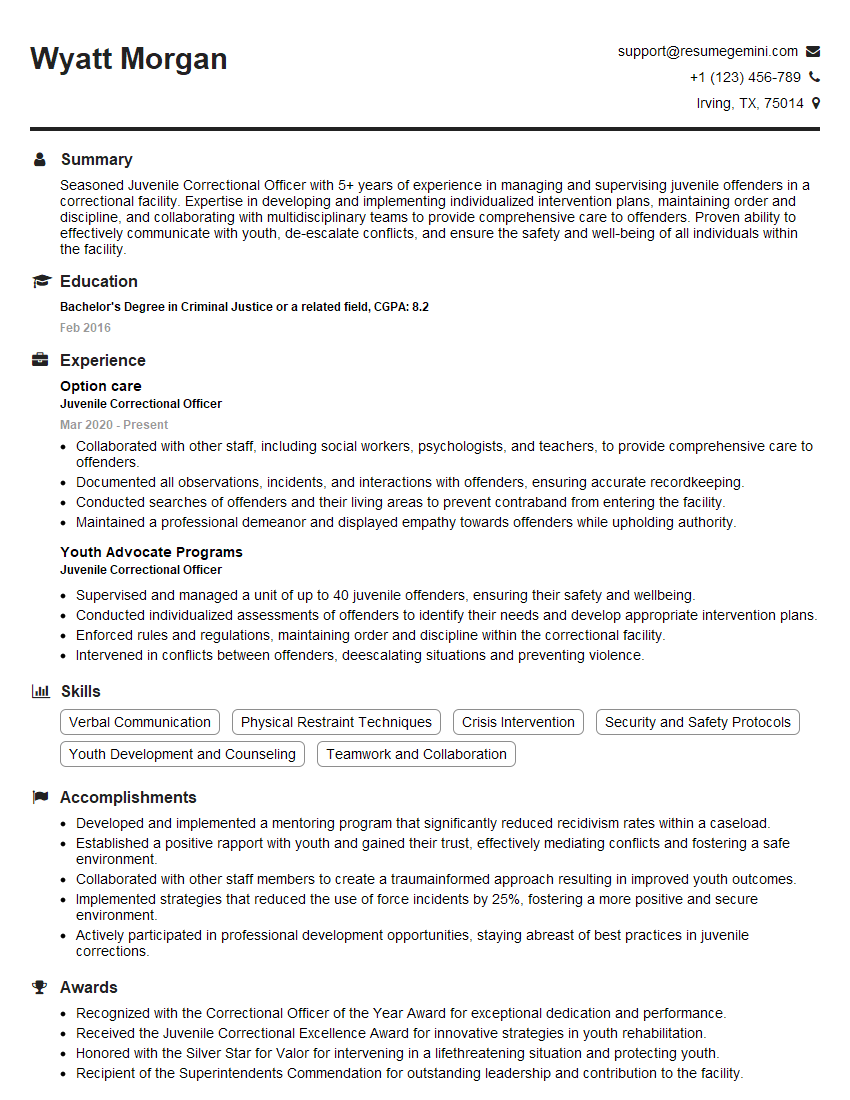
Wyatt Morgan
Juvenile Correctional Officer
Summary
Seasoned Juvenile Correctional Officer with 5+ years of experience in managing and supervising juvenile offenders in a correctional facility. Expertise in developing and implementing individualized intervention plans, maintaining order and discipline, and collaborating with multidisciplinary teams to provide comprehensive care to offenders. Proven ability to effectively communicate with youth, de-escalate conflicts, and ensure the safety and well-being of all individuals within the facility.
Education
Bachelor’s Degree in Criminal Justice or a related field
February 2016
Skills
- Verbal Communication
- Physical Restraint Techniques
- Crisis Intervention
- Security and Safety Protocols
- Youth Development and Counseling
- Teamwork and Collaboration
Work Experience
Juvenile Correctional Officer
- Collaborated with other staff, including social workers, psychologists, and teachers, to provide comprehensive care to offenders.
- Documented all observations, incidents, and interactions with offenders, ensuring accurate recordkeeping.
- Conducted searches of offenders and their living areas to prevent contraband from entering the facility.
- Maintained a professional demeanor and displayed empathy towards offenders while upholding authority.
Juvenile Correctional Officer
- Supervised and managed a unit of up to 40 juvenile offenders, ensuring their safety and wellbeing.
- Conducted individualized assessments of offenders to identify their needs and develop appropriate intervention plans.
- Enforced rules and regulations, maintaining order and discipline within the correctional facility.
- Intervened in conflicts between offenders, deescalating situations and preventing violence.
Accomplishments
- Developed and implemented a mentoring program that significantly reduced recidivism rates within a caseload.
- Established a positive rapport with youth and gained their trust, effectively mediating conflicts and fostering a safe environment.
- Collaborated with other staff members to create a traumainformed approach resulting in improved youth outcomes.
- Implemented strategies that reduced the use of force incidents by 25%, fostering a more positive and secure environment.
- Actively participated in professional development opportunities, staying abreast of best practices in juvenile corrections.
Awards
- Recognized with the Correctional Officer of the Year Award for exceptional dedication and performance.
- Received the Juvenile Correctional Excellence Award for innovative strategies in youth rehabilitation.
- Honored with the Silver Star for Valor for intervening in a lifethreatening situation and protecting youth.
- Recipient of the Superintendents Commendation for outstanding leadership and contribution to the facility.
Certificates
- Juvenile Correctional Officer License
- First Aid and CPR Certification
- Defensive Tactics Training Certification
- Mental Health First Aid Certification
Career Expert Tips:
- Select the ideal resume template to showcase your professional experience effectively.
- Master the art of resume writing to highlight your unique qualifications and achievements.
- Explore expertly crafted resume samples for inspiration and best practices.
- Build your best resume for free this new year with ResumeGemini. Enjoy exclusive discounts on ATS optimized resume templates.
How To Write Resume For Juvenile Correctional Officer
- Highlight your passion for working with youth and your understanding of juvenile justice principles in your resume summary.
- Showcase your ability to build rapport with youth, de-escalate conflicts, and create a safe and supportive environment in your experience section.
- Quantify your accomplishments whenever possible, using specific metrics to demonstrate the impact of your work on the youth you supervised.
- Tailor your resume to each specific job posting, highlighting the skills and experiences that are most relevant to the position you are applying for.
Essential Experience Highlights for a Strong Juvenile Correctional Officer Resume
- Supervised and managed up to 40 juvenile offenders, ensuring their safety and wellbeing in a correctional facility.
- Developed and implemented individualized treatment plans for offenders, outlining specific goals, objectives, and interventions tailored to their individual needs and risk factors.
- Consistently enforced rules and regulations, maintaining order and discipline within the correctional facility, while treating youth with respect and dignity.
- Intervened in conflicts between offenders, de-escalating situations and preventing violence, using verbal communication and physical restraint techniques when necessary.
- Collaborated with other staff, including social workers, psychologists, teachers, and medical professionals, to provide comprehensive care to offenders, ensuring their physical, mental, and emotional well-being.
- Documented all interactions with offenders, including observations, incidents, and interventions, ensuring accurate and detailed recordkeeping.
- Conducted thorough searches of offenders and their living areas to prevent contraband from entering the facility, maintaining a safe and secure environment.
Frequently Asked Questions (FAQ’s) For Juvenile Correctional Officer
What is the role of a Juvenile Correctional Officer?
Juvenile Correctional Officers are responsible for supervising and managing juvenile offenders in a correctional facility. They ensure the safety and well-being of the youth, maintain order and discipline, and provide guidance and support to help them rehabilitate and reintegrate into society.
What are the qualifications to become a Juvenile Correctional Officer?
Most Juvenile Correctional Officer positions require a high school diploma or equivalent, as well as some experience working with youth or in a correctional setting. Some employers may prefer candidates with a bachelor’s degree in criminal justice, social work, or a related field.
What are the key skills and qualities of a successful Juvenile Correctional Officer?
Successful Juvenile Correctional Officers typically possess strong communication and interpersonal skills, as well as the ability to de-escalate conflicts and maintain order in challenging situations. They are also patient, compassionate, and have a genuine desire to help youth succeed.
What is the work environment of a Juvenile Correctional Officer like?
Juvenile Correctional Officers typically work in correctional facilities, which can be fast-paced and demanding environments. They may work shifts that include evenings, weekends, and holidays.
What is the career outlook for Juvenile Correctional Officers?
The career outlook for Juvenile Correctional Officers is expected to be good in the coming years, as the demand for qualified professionals in the field continues to grow.
What are the benefits of working as a Juvenile Correctional Officer?
Juvenile Correctional Officers can enjoy a variety of benefits, including competitive salaries, health and dental insurance, paid time off, and opportunities for professional development.