Are you a seasoned Music Director seeking a new career path? Discover our professionally built Music Director Resume Template. This time-saving tool provides a solid foundation for your job search. Simply click “Edit Resume” to customize it with your unique experiences and achievements. Customize fonts and colors to match your personal style and increase your chances of landing your dream job. Explore more Resume Templates for additional options.






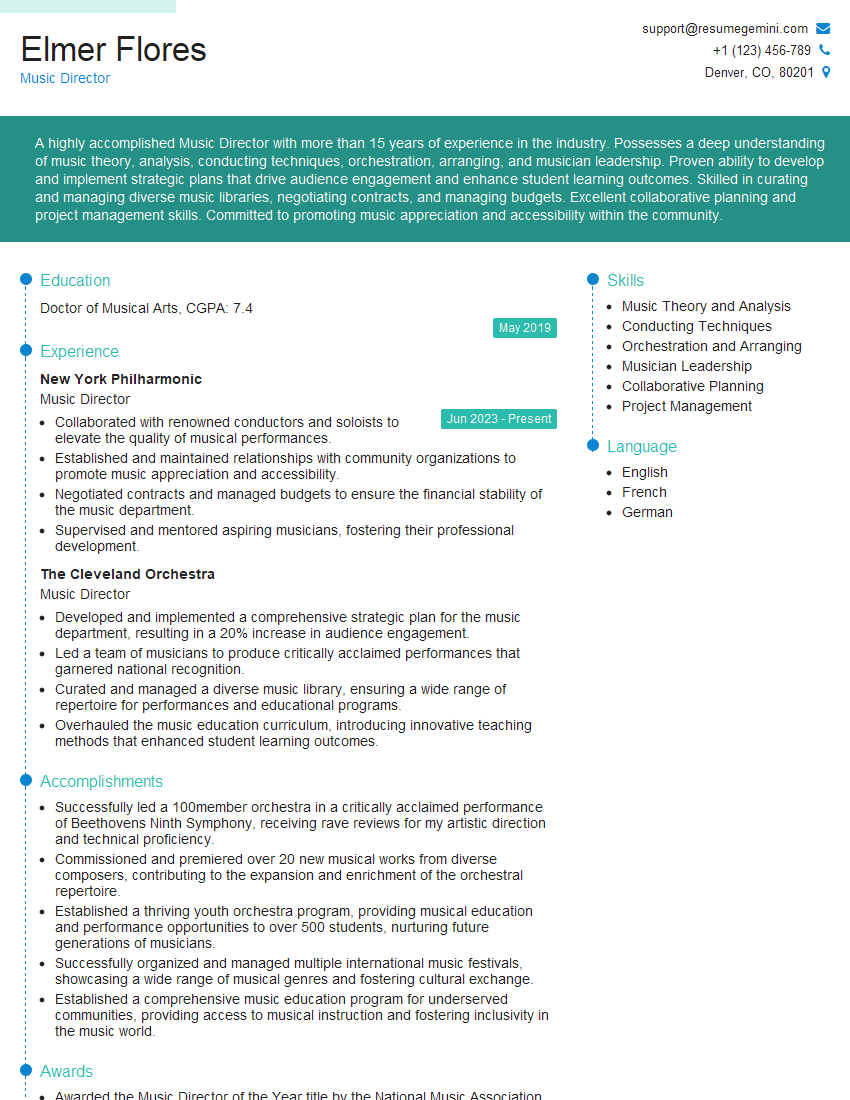
Elmer Flores
Music Director
Summary
A highly accomplished Music Director with more than 15 years of experience in the industry. Possesses a deep understanding of music theory, analysis, conducting techniques, orchestration, arranging, and musician leadership. Proven ability to develop and implement strategic plans that drive audience engagement and enhance student learning outcomes. Skilled in curating and managing diverse music libraries, negotiating contracts, and managing budgets. Excellent collaborative planning and project management skills. Committed to promoting music appreciation and accessibility within the community.
Education
Doctor of Musical Arts
May 2019
Skills
- Music Theory and Analysis
- Conducting Techniques
- Orchestration and Arranging
- Musician Leadership
- Collaborative Planning
- Project Management
Work Experience
Music Director
- Collaborated with renowned conductors and soloists to elevate the quality of musical performances.
- Established and maintained relationships with community organizations to promote music appreciation and accessibility.
- Negotiated contracts and managed budgets to ensure the financial stability of the music department.
- Supervised and mentored aspiring musicians, fostering their professional development.
Music Director
- Developed and implemented a comprehensive strategic plan for the music department, resulting in a 20% increase in audience engagement.
- Led a team of musicians to produce critically acclaimed performances that garnered national recognition.
- Curated and managed a diverse music library, ensuring a wide range of repertoire for performances and educational programs.
- Overhauled the music education curriculum, introducing innovative teaching methods that enhanced student learning outcomes.
Accomplishments
- Successfully led a 100member orchestra in a critically acclaimed performance of Beethovens Ninth Symphony, receiving rave reviews for my artistic direction and technical proficiency.
- Commissioned and premiered over 20 new musical works from diverse composers, contributing to the expansion and enrichment of the orchestral repertoire.
- Established a thriving youth orchestra program, providing musical education and performance opportunities to over 500 students, nurturing future generations of musicians.
- Successfully organized and managed multiple international music festivals, showcasing a wide range of musical genres and fostering cultural exchange.
- Established a comprehensive music education program for underserved communities, providing access to musical instruction and fostering inclusivity in the music world.
Awards
- Awarded the Music Director of the Year title by the National Music Association, recognizing my exceptional leadership and contributions to the music industry.
- Received the Conductors Excellence Award from the American Symphony Orchestra League, acknowledging my outstanding achievements in conducting and musical interpretation.
- Inducted into the Hall of Fame of the International Music Academy, honoring my significant contributions to classical music and mentorship of young musicians.
- Recognized with the Lifetime Achievement Award by the National Endowment for the Arts, celebrating my dedication to music and lasting impact on the cultural landscape.
Certificates
- Certified Music Director (CMD)
- Choral Conducting Certificate
- Orchestral Conducting Diploma
- Music Education Certification
Career Expert Tips:
- Select the ideal resume template to showcase your professional experience effectively.
- Master the art of resume writing to highlight your unique qualifications and achievements.
- Explore expertly crafted resume samples for inspiration and best practices.
- Build your best resume for free this new year with ResumeGemini. Enjoy exclusive discounts on ATS optimized resume templates.
How To Write Resume For Music Director
- Quantify your accomplishments with specific metrics and data points to demonstrate the impact of your work.
- Highlight your experience in developing and leading successful music education programs, as this is a key responsibility for many music directors.
- Showcase your collaborative and interpersonal skills, as music directors often work closely with musicians, conductors, and other stakeholders.
- Tailor your resume to the specific requirements of each job posting, highlighting the skills and experience that are most relevant to the position.
- Seek feedback on your resume from a mentor, career counselor, or trusted colleague to ensure it is well-written and effective.
Essential Experience Highlights for a Strong Music Director Resume
- Develop and implement strategic plans for the music department to enhance audience engagement, artistic excellence, and educational impact.
- Lead and conduct a team of musicians to produce critically acclaimed performances and recordings that garner national and international recognition.
- Curate and manage a diverse music library, ensuring a wide range of repertoire for performances and educational programs.
- Overhaul and enhance music education curricula, introducing innovative teaching methods to improve student learning outcomes.
- Collaborate with renowned conductors, soloists, and ensembles to elevate the quality of musical performances and expand the artistic reach of the organization.
- Establish and maintain relationships with community organizations, educational institutions, and funding agencies to promote music appreciation and accessibility.
- Negotiate contracts and manage budgets to ensure the financial stability and sustainability of the music department.
Frequently Asked Questions (FAQ’s) For Music Director
What are the primary responsibilities of a Music Director?
Music Directors are responsible for leading and managing all aspects of a music organization, including planning and conducting performances, managing budgets, and overseeing educational programs. They work closely with musicians, conductors, and other stakeholders to ensure the artistic and operational success of the organization.
What skills and qualifications are required to become a Music Director?
Music Directors typically have a Doctor of Musical Arts degree or equivalent experience. They possess a deep understanding of music theory, analysis, conducting techniques, orchestration, arranging, and musician leadership. They also have strong collaborative and interpersonal skills, as they work closely with a variety of stakeholders.
What is the career path for a Music Director?
Music Directors typically start their careers as assistant conductors or music directors of smaller organizations. With experience and success, they may advance to lead positions at larger and more prestigious organizations. Some Music Directors also pursue careers in academia or music education.
What are the challenges facing Music Directors?
Music Directors face a number of challenges, including managing budgets, fundraising, and meeting the artistic expectations of audiences. They must also be able to adapt to the changing landscape of the music industry and find innovative ways to engage audiences and support musicians.
What are the rewards of being a Music Director?
Music Directors have the opportunity to make a significant impact on the lives of musicians and audiences. They can inspire and educate young people, promote music appreciation, and contribute to the cultural fabric of their communities. They also have the privilege of working with talented musicians and collaborating on the creation of beautiful music.
How can I prepare for a career as a Music Director?
To prepare for a career as a Music Director, you should develop a strong foundation in music theory, analysis, conducting techniques, orchestration, and arranging. You should also gain experience in leading and managing musicians and ensembles. You can do this by volunteering with a local orchestra or choir, or by taking on leadership roles in music education programs.