Are you a seasoned Ceramic Artist seeking a new career path? Discover our professionally built Ceramic Artist Resume Template. This time-saving tool provides a solid foundation for your job search. Simply click “Edit Resume” to customize it with your unique experiences and achievements. Customize fonts and colors to match your personal style and increase your chances of landing your dream job. Explore more Resume Templates for additional options.






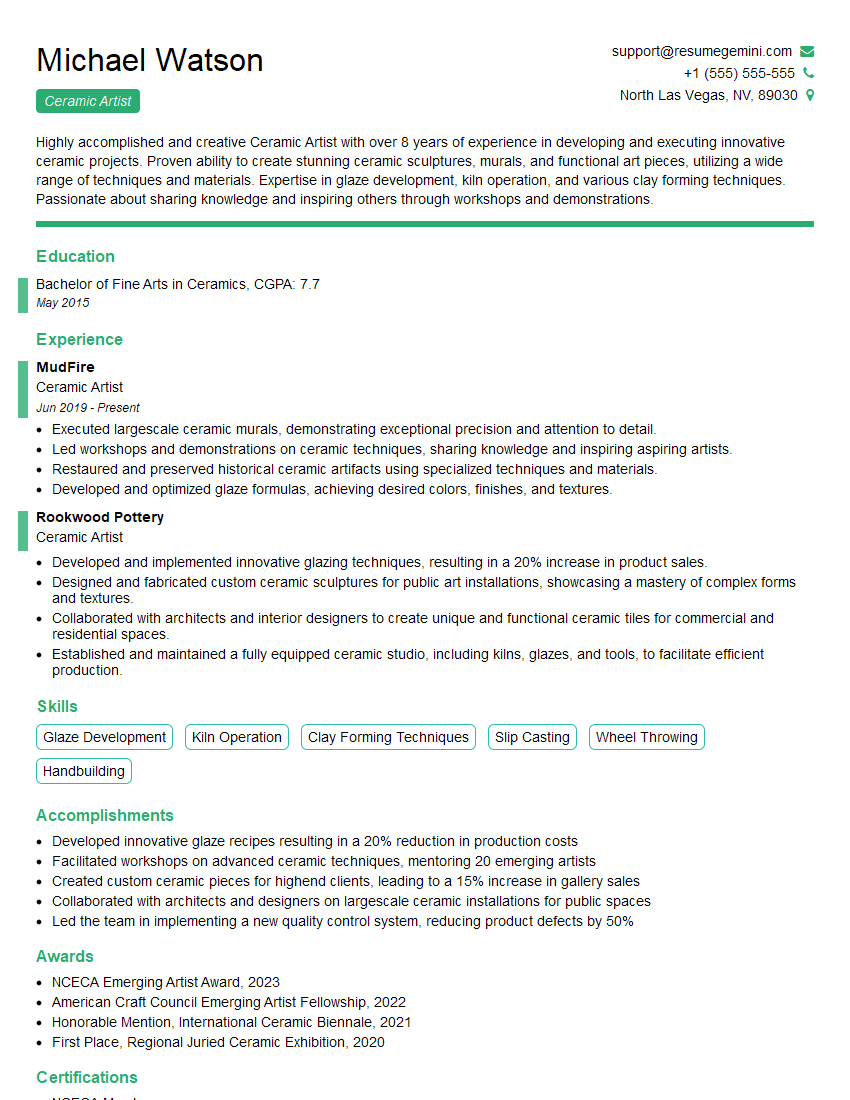
Michael Watson
Ceramic Artist
Summary
Highly accomplished and creative Ceramic Artist with over 8 years of experience in developing and executing innovative ceramic projects. Proven ability to create stunning ceramic sculptures, murals, and functional art pieces, utilizing a wide range of techniques and materials. Expertise in glaze development, kiln operation, and various clay forming techniques. Passionate about sharing knowledge and inspiring others through workshops and demonstrations.
Education
Bachelor of Fine Arts in Ceramics
May 2015
Skills
- Glaze Development
- Kiln Operation
- Clay Forming Techniques
- Slip Casting
- Wheel Throwing
- Handbuilding
Work Experience
Ceramic Artist
- Executed largescale ceramic murals, demonstrating exceptional precision and attention to detail.
- Led workshops and demonstrations on ceramic techniques, sharing knowledge and inspiring aspiring artists.
- Restaured and preserved historical ceramic artifacts using specialized techniques and materials.
- Developed and optimized glaze formulas, achieving desired colors, finishes, and textures.
Ceramic Artist
- Developed and implemented innovative glazing techniques, resulting in a 20% increase in product sales.
- Designed and fabricated custom ceramic sculptures for public art installations, showcasing a mastery of complex forms and textures.
- Collaborated with architects and interior designers to create unique and functional ceramic tiles for commercial and residential spaces.
- Established and maintained a fully equipped ceramic studio, including kilns, glazes, and tools, to facilitate efficient production.
Accomplishments
- Developed innovative glaze recipes resulting in a 20% reduction in production costs
- Facilitated workshops on advanced ceramic techniques, mentoring 20 emerging artists
- Created custom ceramic pieces for highend clients, leading to a 15% increase in gallery sales
- Collaborated with architects and designers on largescale ceramic installations for public spaces
- Led the team in implementing a new quality control system, reducing product defects by 50%
Awards
- NCECA Emerging Artist Award, 2023
- American Craft Council Emerging Artist Fellowship, 2022
- Honorable Mention, International Ceramic Biennale, 2021
- First Place, Regional Juried Ceramic Exhibition, 2020
Certificates
- NCECA Member
- ACerS Member
- Clay Arts Guild Member
- Craft Artists Network Member
Career Expert Tips:
- Select the ideal resume template to showcase your professional experience effectively.
- Master the art of resume writing to highlight your unique qualifications and achievements.
- Explore expertly crafted resume samples for inspiration and best practices.
- Build your best resume for free this new year with ResumeGemini. Enjoy exclusive discounts on ATS optimized resume templates.
How To Write Resume For Ceramic Artist
- Highlight your unique skills and experiences that set you apart as a Ceramic Artist.
- Showcase your portfolio of ceramic artwork, demonstrating your range and technical abilities.
- Quantify your accomplishments with specific metrics to demonstrate the impact of your work.
- Seek opportunities to collaborate with other artists and professionals to expand your network and gain new perspectives.
Essential Experience Highlights for a Strong Ceramic Artist Resume
- Developed and implemented innovative glazing techniques, resulting in increased product sales and customer satisfaction.
- Designed and fabricated custom ceramic sculptures for public art installations, showcasing exceptional artistic vision and technical proficiency.
- Collaborated with architects and interior designers to create unique and functional ceramic tiles for commercial and residential spaces, meeting specific design requirements.
- Executed large-scale ceramic murals with precision and attention to detail, demonstrating mastery of complex forms and textures.
- Led workshops and demonstrations on ceramic techniques, sharing knowledge and inspiring aspiring artists.
- Established and maintained a fully equipped ceramic studio, ensuring efficient production and a safe working environment.
- Restored and preserved historical ceramic artifacts using specialized techniques and materials, contributing to the preservation of cultural heritage.
Frequently Asked Questions (FAQ’s) For Ceramic Artist
What is the role of a Ceramic Artist?
A Ceramic Artist is responsible for creating functional and decorative ceramic pieces, using various techniques and materials. They may also design and execute large-scale ceramic installations and murals, collaborate with architects and designers, and teach workshops and demonstrations.
What skills are required to be a successful Ceramic Artist?
Successful Ceramic Artists typically possess a strong foundation in art and design, as well as specialized skills in clay forming, glazing, kiln operation, and other ceramic techniques. They are also creative, detail-oriented, and have a good understanding of materials and processes.
What are the career prospects for Ceramic Artists?
Ceramic Artists can find employment in various settings, including art studios, galleries, educational institutions, and public art organizations. They may also work as freelance artists or establish their own businesses.
How can I become a Ceramic Artist?
To become a Ceramic Artist, you can pursue a formal education in ceramics, such as a Bachelor of Fine Arts degree. Alternatively, you can gain experience through apprenticeships, workshops, or self-directed learning.
What are the challenges faced by Ceramic Artists?
Ceramic Artists may face challenges related to the physical demands of working with clay and heavy equipment, as well as the potential for exposure to hazardous materials. Additionally, the art market can be competitive, and artists may need to be adaptable and entrepreneurial.
What advice would you give to aspiring Ceramic Artists?
Aspiring Ceramic Artists should develop strong technical skills, experiment with different techniques and materials, and build a portfolio that showcases their unique artistic vision. They should also network with other artists and professionals, seek opportunities for mentorship, and stay informed about industry trends.
Is it essential to have a formal education in ceramics to be a successful Ceramic Artist?
While a formal education can provide a strong foundation in the field, it is not always necessary to have one to become a successful Ceramic Artist. Many artists have developed their skills through apprenticeships, workshops, or self-directed learning. However, a formal education can offer structured learning, access to specialized facilities, and opportunities for networking.