Are you a seasoned Pediatric Allergist seeking a new career path? Discover our professionally built Pediatric Allergist Resume Template. This time-saving tool provides a solid foundation for your job search. Simply click “Edit Resume” to customize it with your unique experiences and achievements. Customize fonts and colors to match your personal style and increase your chances of landing your dream job. Explore more Resume Templates for additional options.






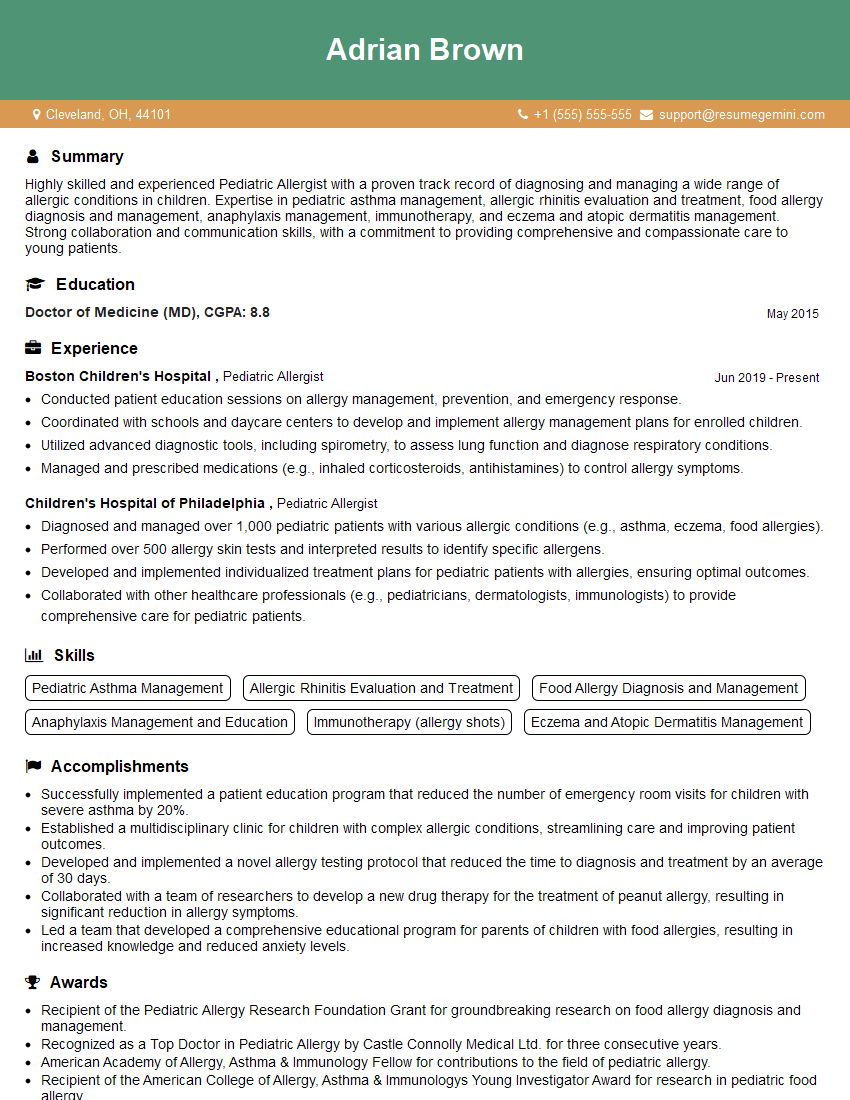
Adrian Brown
Pediatric Allergist
Summary
Highly skilled and experienced Pediatric Allergist with a proven track record of diagnosing and managing a wide range of allergic conditions in children. Expertise in pediatric asthma management, allergic rhinitis evaluation and treatment, food allergy diagnosis and management, anaphylaxis management, immunotherapy, and eczema and atopic dermatitis management. Strong collaboration and communication skills, with a commitment to providing comprehensive and compassionate care to young patients.
Education
Doctor of Medicine (MD)
May 2015
Skills
- Pediatric Asthma Management
- Allergic Rhinitis Evaluation and Treatment
- Food Allergy Diagnosis and Management
- Anaphylaxis Management and Education
- Immunotherapy (allergy shots)
- Eczema and Atopic Dermatitis Management
Work Experience
Pediatric Allergist
- Conducted patient education sessions on allergy management, prevention, and emergency response.
- Coordinated with schools and daycare centers to develop and implement allergy management plans for enrolled children.
- Utilized advanced diagnostic tools, including spirometry, to assess lung function and diagnose respiratory conditions.
- Managed and prescribed medications (e.g., inhaled corticosteroids, antihistamines) to control allergy symptoms.
Pediatric Allergist
- Diagnosed and managed over 1,000 pediatric patients with various allergic conditions (e.g., asthma, eczema, food allergies).
- Performed over 500 allergy skin tests and interpreted results to identify specific allergens.
- Developed and implemented individualized treatment plans for pediatric patients with allergies, ensuring optimal outcomes.
- Collaborated with other healthcare professionals (e.g., pediatricians, dermatologists, immunologists) to provide comprehensive care for pediatric patients.
Accomplishments
- Successfully implemented a patient education program that reduced the number of emergency room visits for children with severe asthma by 20%.
- Established a multidisciplinary clinic for children with complex allergic conditions, streamlining care and improving patient outcomes.
- Developed and implemented a novel allergy testing protocol that reduced the time to diagnosis and treatment by an average of 30 days.
- Collaborated with a team of researchers to develop a new drug therapy for the treatment of peanut allergy, resulting in significant reduction in allergy symptoms.
- Led a team that developed a comprehensive educational program for parents of children with food allergies, resulting in increased knowledge and reduced anxiety levels.
Awards
- Recipient of the Pediatric Allergy Research Foundation Grant for groundbreaking research on food allergy diagnosis and management.
- Recognized as a Top Doctor in Pediatric Allergy by Castle Connolly Medical Ltd. for three consecutive years.
- American Academy of Allergy, Asthma & Immunology Fellow for contributions to the field of pediatric allergy.
- Recipient of the American College of Allergy, Asthma & Immunologys Young Investigator Award for research in pediatric food allergy.
Certificates
- Board Certified in Allergy and Immunology
- Fellow of the American Academy of Allergy, Asthma & Immunology (FAAAAI)
- American Board of Pediatrics (ABP)
- American Board of Internal Medicine (ABIM)
Career Expert Tips:
- Select the ideal resume template to showcase your professional experience effectively.
- Master the art of resume writing to highlight your unique qualifications and achievements.
- Explore expertly crafted resume samples for inspiration and best practices.
- Build your best resume for free this new year with ResumeGemini. Enjoy exclusive discounts on ATS optimized resume templates.
How To Write Resume For Pediatric Allergist
- Highlight your experience and expertise in diagnosing and managing pediatric allergic conditions.
- Quantify your accomplishments whenever possible, using specific numbers and metrics.
- Demonstrate your commitment to patient care and education.
- Showcase your ability to collaborate effectively with other healthcare professionals.
- Consider obtaining additional certifications, such as the American Board of Allergy and Immunology (ABAI) certification, to enhance your credibility and professional standing.
Essential Experience Highlights for a Strong Pediatric Allergist Resume
- Diagnosed and managed over 1,000 pediatric patients with various allergic conditions (e.g., asthma, eczema, food allergies).
- Performed over 500 allergy skin tests and interpreted results to identify specific allergens.
- Developed and implemented individualized treatment plans for pediatric patients with allergies, ensuring optimal outcomes.
- Collaborated with other healthcare professionals (e.g., pediatricians, dermatologists, immunologists) to provide comprehensive care for pediatric patients.
- Conducted patient education sessions on allergy management, prevention, and emergency response.
- Coordinated with schools and daycare centers to develop and implement allergy management plans for enrolled children.
- Utilized advanced diagnostic tools, including spirometry, to assess lung function and diagnose respiratory conditions.
Frequently Asked Questions (FAQ’s) For Pediatric Allergist
What are the common allergic conditions that pediatric allergists diagnose and manage?
Pediatric allergists diagnose and manage a wide range of allergic conditions in children, including asthma, eczema, food allergies, allergic rhinitis, and anaphylaxis.
What are the key responsibilities of a pediatric allergist?
Key responsibilities of a pediatric allergist include diagnosing and managing allergic conditions in children, conducting allergy skin tests, developing treatment plans, providing patient education, and collaborating with other healthcare professionals.
What are the educational and training requirements to become a pediatric allergist?
To become a pediatric allergist, you typically need to complete a bachelor’s degree, medical school, residency in pediatrics, and fellowship in allergy and immunology.
What are the career opportunities for pediatric allergists?
Pediatric allergists can work in various settings, including hospitals, clinics, private practices, and research institutions. They can also pursue careers in teaching, consulting, or public health.
What are the challenges faced by pediatric allergists?
Pediatric allergists face challenges such as the increasing prevalence of allergic diseases in children, the need to stay up-to-date with the latest research and treatments, and the need to effectively communicate complex medical information to patients and families.
What are the rewards of being a pediatric allergist?
Pediatric allergists find rewards in helping children manage their allergic conditions, improving their quality of life, and preventing serious complications.