Are you a seasoned Educational Speech-Language Clinician seeking a new career path? Discover our professionally built Educational Speech-Language Clinician Resume Template. This time-saving tool provides a solid foundation for your job search. Simply click “Edit Resume” to customize it with your unique experiences and achievements. Customize fonts and colors to match your personal style and increase your chances of landing your dream job. Explore more Resume Templates for additional options.






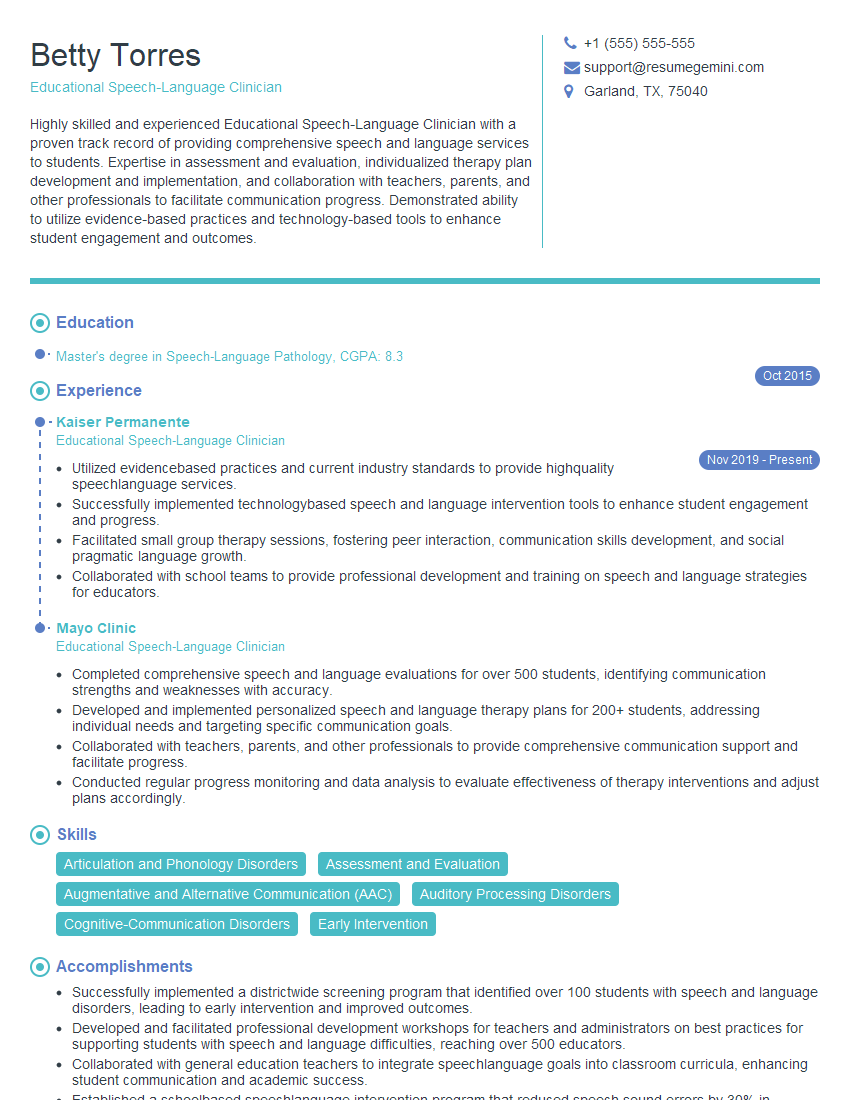
Betty Torres
Educational Speech-Language Clinician
Summary
Highly skilled and experienced Educational Speech-Language Clinician with a proven track record of providing comprehensive speech and language services to students. Expertise in assessment and evaluation, individualized therapy plan development and implementation, and collaboration with teachers, parents, and other professionals to facilitate communication progress. Demonstrated ability to utilize evidence-based practices and technology-based tools to enhance student engagement and outcomes.
Education
Master’s degree in Speech-Language Pathology
October 2015
Skills
- Articulation and Phonology Disorders
- Assessment and Evaluation
- Augmentative and Alternative Communication (AAC)
- Auditory Processing Disorders
- Cognitive-Communication Disorders
- Early Intervention
Work Experience
Educational Speech-Language Clinician
- Utilized evidencebased practices and current industry standards to provide highquality speechlanguage services.
- Successfully implemented technologybased speech and language intervention tools to enhance student engagement and progress.
- Facilitated small group therapy sessions, fostering peer interaction, communication skills development, and social pragmatic language growth.
- Collaborated with school teams to provide professional development and training on speech and language strategies for educators.
Educational Speech-Language Clinician
- Completed comprehensive speech and language evaluations for over 500 students, identifying communication strengths and weaknesses with accuracy.
- Developed and implemented personalized speech and language therapy plans for 200+ students, addressing individual needs and targeting specific communication goals.
- Collaborated with teachers, parents, and other professionals to provide comprehensive communication support and facilitate progress.
- Conducted regular progress monitoring and data analysis to evaluate effectiveness of therapy interventions and adjust plans accordingly.
Accomplishments
- Successfully implemented a districtwide screening program that identified over 100 students with speech and language disorders, leading to early intervention and improved outcomes.
- Developed and facilitated professional development workshops for teachers and administrators on best practices for supporting students with speech and language difficulties, reaching over 500 educators.
- Collaborated with general education teachers to integrate speechlanguage goals into classroom curricula, enhancing student communication and academic success.
- Established a schoolbased speechlanguage intervention program that reduced speech sound errors by 30% in kindergarten students.
- Created and implemented individualized intervention plans that resulted in significant gains in language comprehension, vocabulary, and pragmatic skills for students with language disorders.
Awards
- Received the ASHA Award for Excellence in Clinical Practice for outstanding contributions to the field of speechlanguage pathology in educational settings.
- Recognized with the National Education Associations Friend of Education Award for exceptional advocacy and support of students with communication challenges.
- Honored with the State SpeechLanguageHearing Associations Clinician of the Year Award for unwavering dedication and innovation in educational speechlanguage pathology.
- Recipient of the American SpeechLanguageHearing Foundations Research Grant for groundbreaking work on the impact of augmentative and alternative communication (AAC) on student learning.
Certificates
- Certificate of Clinical Competence in Speech-Language Pathology (CCC-SLP)
- Licensed Speech-Language Pathologist (LSLP)
- National Board for Certification in Speech-Language Pathology (NBC-SLP)
- American Speech-Language-Hearing Association (ASHA)
Career Expert Tips:
- Select the ideal resume template to showcase your professional experience effectively.
- Master the art of resume writing to highlight your unique qualifications and achievements.
- Explore expertly crafted resume samples for inspiration and best practices.
- Build your best resume for free this new year with ResumeGemini. Enjoy exclusive discounts on ATS optimized resume templates.
How To Write Resume For Educational Speech-Language Clinician
- Highlight your passion for working with children and your understanding of their unique communication needs.
- Emphasize your expertise in assessment, evaluation, and therapy planning, providing specific examples of successful interventions.
- Showcase your ability to collaborate effectively with parents, teachers, and other professionals to support student success.
- Demonstrate your commitment to professional development and staying abreast of current best practices in the field.
- Proofread your resume carefully for any errors before submitting it.
Essential Experience Highlights for a Strong Educational Speech-Language Clinician Resume
- Conduct comprehensive speech and language evaluations to identify communication strengths and weaknesses.
- Develop and implement personalized speech and language therapy plans tailored to individual student needs.
- Collaborate with teachers, parents, and school teams to provide comprehensive communication support.
- Conduct regular progress monitoring and data analysis to evaluate therapy effectiveness and adjust plans accordingly.
- Facilitate small group therapy sessions to promote peer interaction and communication skills development.
- Utilize evidence-based practices and current industry standards to provide high-quality services.
- Provide professional development and training on speech and language strategies for educators.
Frequently Asked Questions (FAQ’s) For Educational Speech-Language Clinician
What is the role of an Educational Speech-Language Clinician?
Educational Speech-Language Clinicians work with children and adolescents in educational settings to assess and address speech, language, and communication disorders. They collaborate with teachers and parents to develop and implement individualized therapy plans, and provide ongoing support and monitoring to help students achieve their communication goals.
What are the qualifications required to become an Educational Speech-Language Clinician?
Educational Speech-Language Clinicians typically hold a Master’s degree in Speech-Language Pathology from an accredited university program. They must also pass a national examination administered by the American Speech-Language-Hearing Association (ASHA) in order to obtain their Certificate of Clinical Competence (CCC).
What are the key responsibilities of an Educational Speech-Language Clinician?
Educational Speech-Language Clinicians are responsible for conducting speech and language evaluations, developing and implementing therapy plans, collaborating with teachers and parents, monitoring student progress, and providing professional development and training.
What are the different types of speech, language, and communication disorders that Educational Speech-Language Clinicians address?
Educational Speech-Language Clinicians address a wide range of speech, language, and communication disorders, including articulation and phonology disorders, language disorders, fluency disorders, voice disorders, and social pragmatic communication disorders.
How can I find an Educational Speech-Language Clinician in my area?
You can find an Educational Speech-Language Clinician in your area by contacting your local school district, visiting the website of the American Speech-Language-Hearing Association (ASHA), or searching online for speech-language pathology services.
What is the difference between a Speech-Language Pathologist and an Educational Speech-Language Clinician?
Speech-Language Pathologists and Educational Speech-Language Clinicians both provide speech and language services, but they work in different settings. Speech-Language Pathologists can work in a variety of settings, including hospitals, clinics, schools, and private practice, while Educational Speech-Language Clinicians specifically work in educational settings.
What is the job outlook for Educational Speech-Language Clinicians?
The job outlook for Educational Speech-Language Clinicians is expected to be good over the next several years. The increasing prevalence of communication disorders and the need for early intervention services are driving the demand for qualified Speech-Language Pathologists.
What are the earning potential for Educational Speech-Language Clinicians?
The earning potential for Educational Speech-Language Clinicians varies depending on their experience, location, and work setting. According to the U.S. Bureau of Labor Statistics, the median annual salary for Speech-Language Pathologists in May 2021 was $85,280.