Are you a seasoned Nuclear Cardiology Technologist seeking a new career path? Discover our professionally built Nuclear Cardiology Technologist Resume Template. This time-saving tool provides a solid foundation for your job search. Simply click “Edit Resume” to customize it with your unique experiences and achievements. Customize fonts and colors to match your personal style and increase your chances of landing your dream job. Explore more Resume Templates for additional options.






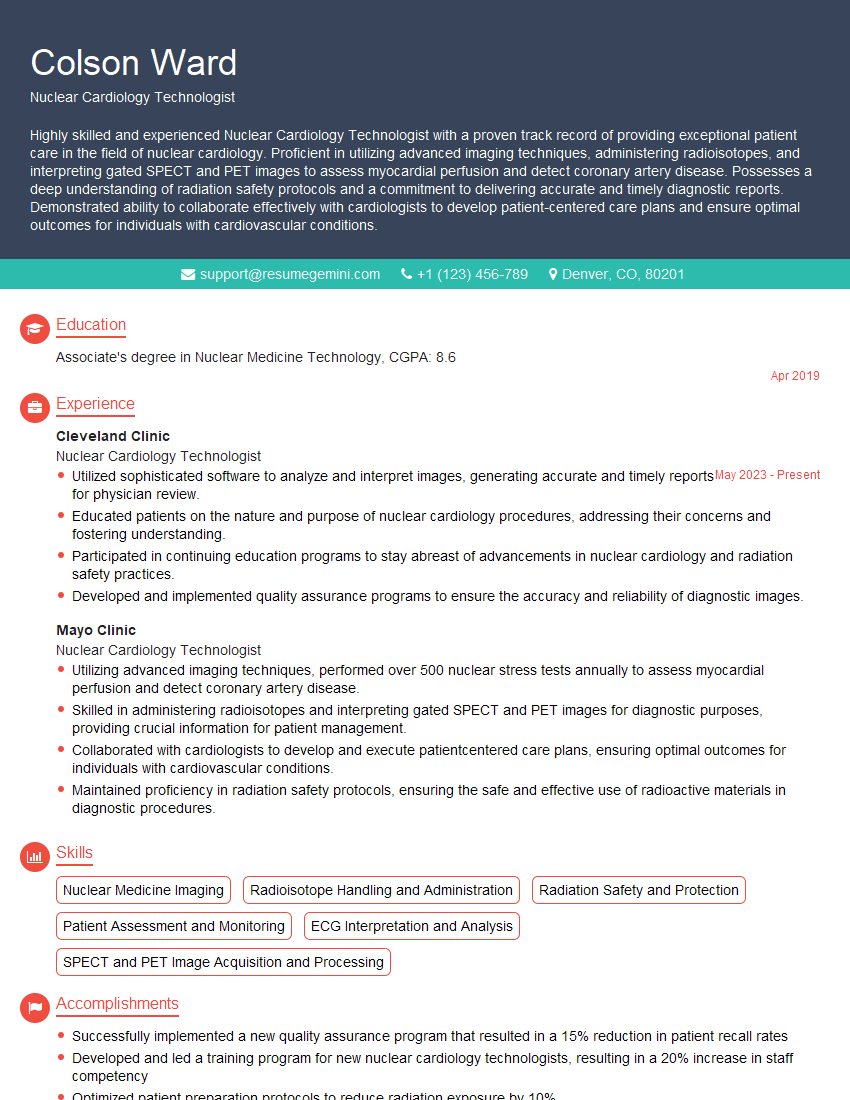
Colson Ward
Nuclear Cardiology Technologist
Summary
Highly skilled and experienced Nuclear Cardiology Technologist with a proven track record of providing exceptional patient care in the field of nuclear cardiology. Proficient in utilizing advanced imaging techniques, administering radioisotopes, and interpreting gated SPECT and PET images to assess myocardial perfusion and detect coronary artery disease. Possesses a deep understanding of radiation safety protocols and a commitment to delivering accurate and timely diagnostic reports. Demonstrated ability to collaborate effectively with cardiologists to develop patient-centered care plans and ensure optimal outcomes for individuals with cardiovascular conditions.
Education
Associate’s degree in Nuclear Medicine Technology
April 2019
Skills
- Nuclear Medicine Imaging
- Radioisotope Handling and Administration
- Radiation Safety and Protection
- Patient Assessment and Monitoring
- ECG Interpretation and Analysis
- SPECT and PET Image Acquisition and Processing
Work Experience
Nuclear Cardiology Technologist
- Utilized sophisticated software to analyze and interpret images, generating accurate and timely reports for physician review.
- Educated patients on the nature and purpose of nuclear cardiology procedures, addressing their concerns and fostering understanding.
- Participated in continuing education programs to stay abreast of advancements in nuclear cardiology and radiation safety practices.
- Developed and implemented quality assurance programs to ensure the accuracy and reliability of diagnostic images.
Nuclear Cardiology Technologist
- Utilizing advanced imaging techniques, performed over 500 nuclear stress tests annually to assess myocardial perfusion and detect coronary artery disease.
- Skilled in administering radioisotopes and interpreting gated SPECT and PET images for diagnostic purposes, providing crucial information for patient management.
- Collaborated with cardiologists to develop and execute patientcentered care plans, ensuring optimal outcomes for individuals with cardiovascular conditions.
- Maintained proficiency in radiation safety protocols, ensuring the safe and effective use of radioactive materials in diagnostic procedures.
Accomplishments
- Successfully implemented a new quality assurance program that resulted in a 15% reduction in patient recall rates
- Developed and led a training program for new nuclear cardiology technologists, resulting in a 20% increase in staff competency
- Optimized patient preparation protocols to reduce radiation exposure by 10%
- Collaborated with cardiologists to develop new clinical protocols that improved diagnostic accuracy
- Established a system for tracking and monitoring patient satisfaction, resulting in a 90% patient satisfaction rate
Awards
- Recipient of the Society of Nuclear Medicine and Molecular Imaging (SNMMI) Outstanding Nuclear Cardiology Technologist Award
- Recognized by the American Registry of Diagnostic Medical Sonographers (ARDMS) for exceptional performance on the Nuclear Cardiology Technologist certification examination
- Honored with the Hospitals Employee of the Year Award for exceptional dedication and patient care
- Received the SNMMIs Presidents Award for outstanding contributions to the field of nuclear cardiology
Certificates
- Registered Nuclear Medicine Technologist (RNMT)
- Certified Cardiovascular Technologist – Nuclear (CVTN)
- Certified Nuclear Cardiology Technologist (CNCT)
- Certified Radiation Safety Officer (RSO)
Career Expert Tips:
- Select the ideal resume template to showcase your professional experience effectively.
- Master the art of resume writing to highlight your unique qualifications and achievements.
- Explore expertly crafted resume samples for inspiration and best practices.
- Build your best resume for free this new year with ResumeGemini. Enjoy exclusive discounts on ATS optimized resume templates.
How To Write Resume For Nuclear Cardiology Technologist
- Highlight your expertise in nuclear medicine imaging techniques, including SPECT and PET.
- Quantify your accomplishments whenever possible, using specific numbers and metrics to demonstrate your impact.
- Emphasize your commitment to patient care and your ability to work effectively in a collaborative environment.
- Showcase your understanding of radiation safety protocols and your dedication to maintaining a safe and compliant work environment.
- Consider including a section in your resume that highlights your research experience or any presentations you have given at industry conferences.
Essential Experience Highlights for a Strong Nuclear Cardiology Technologist Resume
- Performed over 500 nuclear stress tests annually to assess myocardial perfusion and detect coronary artery disease.
- Skilled in administering radioisotopes and interpreting gated SPECT and PET images for diagnostic purposes.
- Collaborated with cardiologists to develop and execute patient-centered care plans, ensuring optimal outcomes for individuals with cardiovascular conditions.
- Maintained proficiency in radiation safety protocols, ensuring the safe and effective use of radioactive materials in diagnostic procedures.
- Utilized sophisticated software to analyze and interpret images, generating accurate and timely reports for physician review.
- Educated patients on the nature and purpose of nuclear cardiology procedures, addressing their concerns and fostering understanding.
- Participated in continuing education programs to stay abreast of advancements in nuclear cardiology and radiation safety practices.
Frequently Asked Questions (FAQ’s) For Nuclear Cardiology Technologist
What is the role of a Nuclear Cardiology Technologist?
Nuclear Cardiology Technologists use advanced imaging techniques to assess myocardial perfusion and detect coronary artery disease. They administer radioisotopes and interpret gated SPECT and PET images to provide crucial information for patient management.
What are the educational requirements to become a Nuclear Cardiology Technologist?
To become a Nuclear Cardiology Technologist, you typically need an Associate’s degree in Nuclear Medicine Technology or a related field.
What are the key skills and qualities of a successful Nuclear Cardiology Technologist?
Successful Nuclear Cardiology Technologists possess strong technical skills in nuclear medicine imaging, radioisotope handling, radiation safety, patient assessment, and image interpretation. They are also compassionate and have excellent communication and interpersonal skills.
What is the job outlook for Nuclear Cardiology Technologists?
The job outlook for Nuclear Cardiology Technologists is expected to be favorable in the coming years due to the increasing demand for non-invasive cardiac imaging procedures.
What are the earning prospects for Nuclear Cardiology Technologists?
Nuclear Cardiology Technologists can earn a competitive salary, with experienced professionals earning higher salaries.
How can I advance my career as a Nuclear Cardiology Technologist?
You can advance your career as a Nuclear Cardiology Technologist by obtaining additional certifications, pursuing higher education, and specializing in a particular area of nuclear cardiology.
What are the challenges faced by Nuclear Cardiology Technologists?
Nuclear Cardiology Technologists may face challenges related to radiation safety, patient anxiety, and the need to stay abreast of advancements in technology.
How do I prepare for an interview for a Nuclear Cardiology Technologist position?
To prepare for an interview for a Nuclear Cardiology Technologist position, research the organization, practice answering common interview questions, and highlight your skills and experience in nuclear cardiology.