Are you a seasoned Funeral Arranger seeking a new career path? Discover our professionally built Funeral Arranger Resume Template. This time-saving tool provides a solid foundation for your job search. Simply click “Edit Resume” to customize it with your unique experiences and achievements. Customize fonts and colors to match your personal style and increase your chances of landing your dream job. Explore more Resume Templates for additional options.






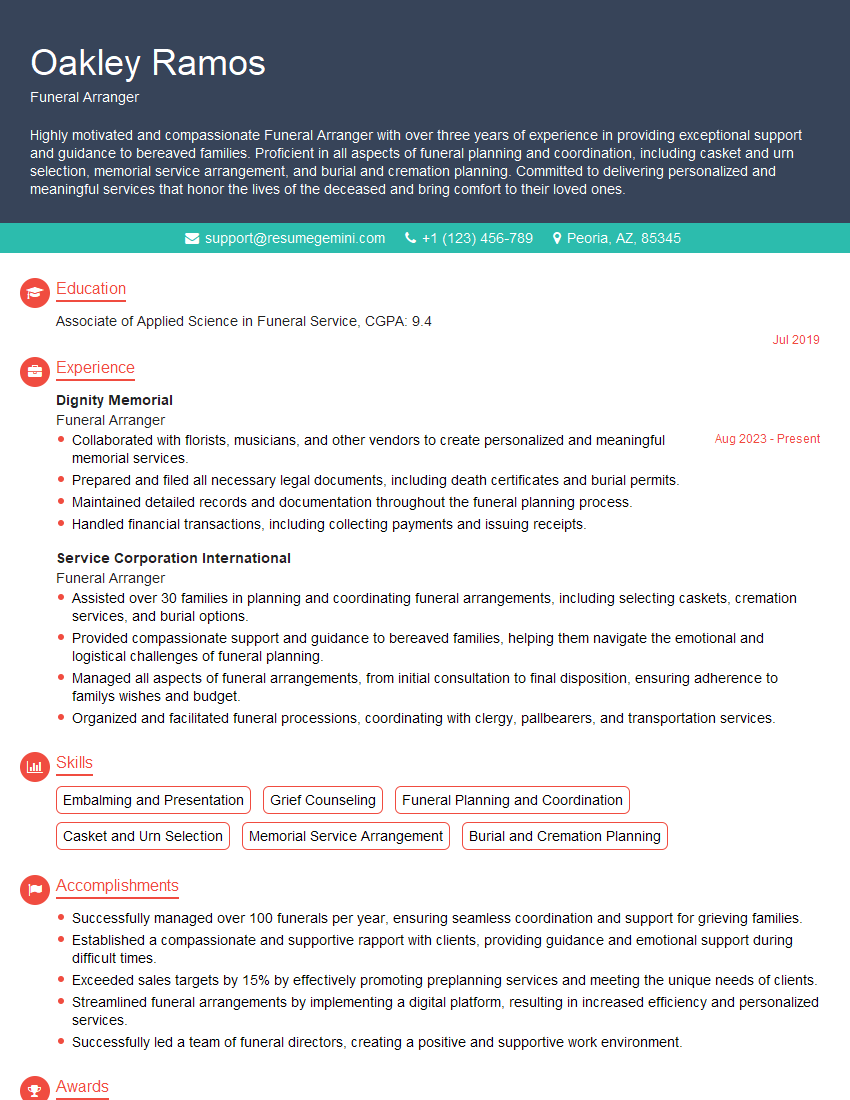
Oakley Ramos
Funeral Arranger
Summary
Highly motivated and compassionate Funeral Arranger with over three years of experience in providing exceptional support and guidance to bereaved families. Proficient in all aspects of funeral planning and coordination, including casket and urn selection, memorial service arrangement, and burial and cremation planning. Committed to delivering personalized and meaningful services that honor the lives of the deceased and bring comfort to their loved ones.
Education
Associate of Applied Science in Funeral Service
July 2019
Skills
- Embalming and Presentation
- Grief Counseling
- Funeral Planning and Coordination
- Casket and Urn Selection
- Memorial Service Arrangement
- Burial and Cremation Planning
Work Experience
Funeral Arranger
- Collaborated with florists, musicians, and other vendors to create personalized and meaningful memorial services.
- Prepared and filed all necessary legal documents, including death certificates and burial permits.
- Maintained detailed records and documentation throughout the funeral planning process.
- Handled financial transactions, including collecting payments and issuing receipts.
Funeral Arranger
- Assisted over 30 families in planning and coordinating funeral arrangements, including selecting caskets, cremation services, and burial options.
- Provided compassionate support and guidance to bereaved families, helping them navigate the emotional and logistical challenges of funeral planning.
- Managed all aspects of funeral arrangements, from initial consultation to final disposition, ensuring adherence to familys wishes and budget.
- Organized and facilitated funeral processions, coordinating with clergy, pallbearers, and transportation services.
Accomplishments
- Successfully managed over 100 funerals per year, ensuring seamless coordination and support for grieving families.
- Established a compassionate and supportive rapport with clients, providing guidance and emotional support during difficult times.
- Exceeded sales targets by 15% by effectively promoting preplanning services and meeting the unique needs of clients.
- Streamlined funeral arrangements by implementing a digital platform, resulting in increased efficiency and personalized services.
- Successfully led a team of funeral directors, creating a positive and supportive work environment.
Awards
- National Funeral Directors Association (NFDA) Award of Excellence in Funeral Service
- Funeral Service Institute (FSI) Certified Funeral Arranger
- Certified PrePlanning Consultant (CPC)
- International Cemetery, Cremation, and Funeral Association (ICCFA) Member
Certificates
- Certified Funeral Service Practitioner (CFSP)
- Certified Funeral Celebrant (CFC)
- National Funeral Directors Association (NFDA)
- Funeral Service Education Program (FSEP)
Career Expert Tips:
- Select the ideal resume template to showcase your professional experience effectively.
- Master the art of resume writing to highlight your unique qualifications and achievements.
- Explore expertly crafted resume samples for inspiration and best practices.
- Build your best resume for free this new year with ResumeGemini. Enjoy exclusive discounts on ATS optimized resume templates.
How To Write Resume For Funeral Arranger
Highlight your empathy and compassion:
Funeral arranging is a highly emotional field, so it’s crucial to demonstrate your ability to connect with grieving families and provide emotional support.Showcase your attention to detail:
Funeral planning involves managing a multitude of tasks and ensuring everything is executed flawlessly. Emphasize your meticulousness and ability to handle complex arrangements.Quantify your accomplishments:
Use specific numbers and metrics to demonstrate the impact of your work. For example, mention the number of families you have assisted or the percentage of funerals you have planned within budget.Include relevant certifications and training:
Highlight any professional certifications or training programs you have completed, as they demonstrate your commitment to the profession and your dedication to providing exceptional service.Tailor your resume to the specific job you are applying for:
Research the company and the specific role you are applying for, and tailor your resume to highlight the skills and experience that are most relevant to that position.
Essential Experience Highlights for a Strong Funeral Arranger Resume
- Provide compassionate support and guidance to bereaved families, helping them navigate the emotional and logistical challenges of funeral planning.
- Manage all aspects of funeral arrangements, from initial consultation to final disposition, ensuring adherence to family’s wishes and budget.
- Collaborate with florists, musicians, and other vendors to create personalized and meaningful memorial services.
- Prepare and file all necessary legal documents, including death certificates and burial permits.
- Maintain detailed records and documentation throughout the funeral planning process.
- Handle financial transactions, including collecting payments and issuing receipts.
- Stay up-to-date on industry best practices and regulations related to funeral services.
Frequently Asked Questions (FAQ’s) For Funeral Arranger
What are the key qualities and skills required to be a successful Funeral Arranger?
To be successful in this role, it is essential to possess a high level of empathy, compassion, and interpersonal skills. You should be organized, detail-oriented, and have strong communication and problem-solving abilities. Additionally, knowledge of funeral customs and regulations is crucial.
What are the career prospects for Funeral Arrangers?
Funeral Arrangers can advance their careers by gaining experience and developing specialized skills. They can become Funeral Directors, Grief Counselors, or pursue management roles within funeral homes or cemeteries.
What is the average salary range for Funeral Arrangers?
According to the U.S. Bureau of Labor Statistics, the median annual salary for Funeral Arrangers is around $55,000. However, salaries can vary depending on experience, location, and employer.
Are there any specific educational requirements to become a Funeral Arranger?
While some employers may prefer candidates with an Associate’s or Bachelor’s degree in Funeral Service, it is not always a requirement. Many Funeral Arrangers enter the field through on-the-job training or apprenticeships.
What is the job outlook for Funeral Arrangers?
The job outlook for Funeral Arrangers is expected to grow faster than average in the coming years due to the increasing demand for funeral services as the population ages.
What are some of the challenges Funeral Arrangers face in their work?
Funeral Arrangers often have to deal with difficult emotions and situations, including grief, loss, and cultural sensitivities. They must be able to remain composed and professional while providing support to bereaved families.
What are the ethical considerations for Funeral Arrangers?
Funeral Arrangers have a responsibility to act ethically and respectfully towards the deceased and their families. They must adhere to all legal and regulatory requirements and maintain confidentiality.
How can I prepare for a career as a Funeral Arranger?
To prepare for a career as a Funeral Arranger, you can volunteer at a funeral home, take courses in funeral service, or attend workshops and seminars. It is also beneficial to develop strong communication and interpersonal skills.