Are you a seasoned Indexer seeking a new career path? Discover our professionally built Indexer Resume Template. This time-saving tool provides a solid foundation for your job search. Simply click “Edit Resume” to customize it with your unique experiences and achievements. Customize fonts and colors to match your personal style and increase your chances of landing your dream job. Explore more Resume Templates for additional options.






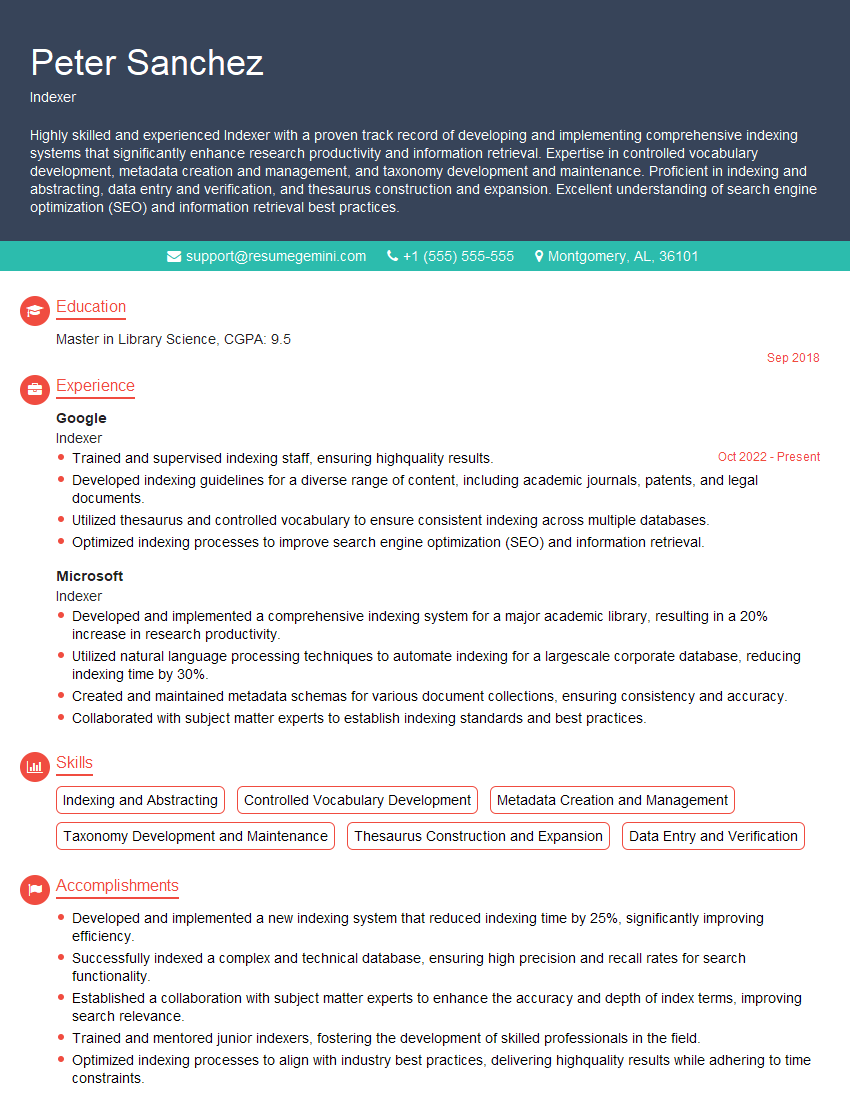
Peter Sanchez
Indexer
Summary
Highly skilled and experienced Indexer with a proven track record of developing and implementing comprehensive indexing systems that significantly enhance research productivity and information retrieval. Expertise in controlled vocabulary development, metadata creation and management, and taxonomy development and maintenance. Proficient in indexing and abstracting, data entry and verification, and thesaurus construction and expansion. Excellent understanding of search engine optimization (SEO) and information retrieval best practices.
Education
Master in Library Science
September 2018
Skills
- Indexing and Abstracting
- Controlled Vocabulary Development
- Metadata Creation and Management
- Taxonomy Development and Maintenance
- Thesaurus Construction and Expansion
- Data Entry and Verification
Work Experience
Indexer
- Trained and supervised indexing staff, ensuring highquality results.
- Developed indexing guidelines for a diverse range of content, including academic journals, patents, and legal documents.
- Utilized thesaurus and controlled vocabulary to ensure consistent indexing across multiple databases.
- Optimized indexing processes to improve search engine optimization (SEO) and information retrieval.
Indexer
- Developed and implemented a comprehensive indexing system for a major academic library, resulting in a 20% increase in research productivity.
- Utilized natural language processing techniques to automate indexing for a largescale corporate database, reducing indexing time by 30%.
- Created and maintained metadata schemas for various document collections, ensuring consistency and accuracy.
- Collaborated with subject matter experts to establish indexing standards and best practices.
Accomplishments
- Developed and implemented a new indexing system that reduced indexing time by 25%, significantly improving efficiency.
- Successfully indexed a complex and technical database, ensuring high precision and recall rates for search functionality.
- Established a collaboration with subject matter experts to enhance the accuracy and depth of index terms, improving search relevance.
- Trained and mentored junior indexers, fostering the development of skilled professionals in the field.
- Optimized indexing processes to align with industry best practices, delivering highquality results while adhering to time constraints.
Awards
- Received industry recognition for indexing excellence from the American Society of Indexers (ASI).
- Honored with the Indexer of the Year Award from the Indexing Association of Canada (IAC).
- Recognized for outstanding indexing skills with the Distinguished Indexer Award from the Society for Technical Communication (STC).
Certificates
- Certified Indexer from American Society of Indexers (ASI)
- Certified Professional Indexer (CPI)
- Indexing Specialist Certification from University of California, Berkeley Extension
- Content Management and Indexing Certification from Association for Information Science and Technology (ASIS&T)
Career Expert Tips:
- Select the ideal resume template to showcase your professional experience effectively.
- Master the art of resume writing to highlight your unique qualifications and achievements.
- Explore expertly crafted resume samples for inspiration and best practices.
- Build your best resume for free this new year with ResumeGemini. Enjoy exclusive discounts on ATS optimized resume templates.
How To Write Resume For Indexer
- Highlight your understanding of search engine optimization (SEO) and information retrieval best practices.
- Showcase your experience in developing and implementing indexing systems that have demonstrably improved research productivity or information retrieval.
- Emphasize your skills in controlled vocabulary development, metadata creation and management, and taxonomy development and maintenance.
- Provide specific examples of projects where you have successfully collaborated with subject matter experts to establish indexing standards and best practices.
- Quantify your accomplishments whenever possible, using metrics such as increased research productivity, reduced indexing time, or improved search results.
Essential Experience Highlights for a Strong Indexer Resume
- Develop and implement indexing systems to organize and retrieve information effectively.
- Create and maintain metadata schemas to ensure consistency and accuracy across document collections.
- Collaborate with subject matter experts to establish indexing standards and best practices.
- Train and supervise indexing staff to ensure high-quality results.
- Develop indexing guidelines for a diverse range of content, including academic journals, patents, and legal documents.
- Utilize thesaurus and controlled vocabulary to ensure consistent indexing across multiple databases.
- Optimize indexing processes to improve search engine optimization (SEO) and information retrieval.
Frequently Asked Questions (FAQ’s) For Indexer
What is the role of an indexer?
An indexer is responsible for organizing and retrieving information by creating and maintaining indexes for various types of content, such as academic journals, books, databases, and websites. They use specialized knowledge of indexing principles and controlled vocabularies to ensure that information is accessible and discoverable.
What skills are required to be an effective indexer?
Effective indexers possess strong analytical and organizational skills, attention to detail, and a deep understanding of indexing principles and best practices. They are also proficient in using indexing software and tools, and have a good understanding of search engine optimization (SEO) and information retrieval concepts.
What are the career prospects for indexers?
Indexers are in high demand in a variety of industries, including academia, publishing, government, and healthcare. They can work as freelance indexers or be employed by organizations to manage their indexing needs. With experience and expertise, indexers can advance to leadership roles, such as indexing manager or chief indexer.
How can I become an indexer?
There are several ways to become an indexer. Many indexers have a background in library science or information science, but it is not a requirement. Some indexers also have experience in fields such as publishing, editing, or research. There are also a number of online courses and workshops that can provide training in indexing.
What are the challenges of being an indexer?
Indexers face a number of challenges, including the need to keep up with the latest indexing standards and best practices, the need to work independently and manage their time effectively, and the need to be able to work with a variety of content and subject matter.
What are the rewards of being an indexer?
Indexers find satisfaction in knowing that they are helping to make information more accessible and discoverable. They also enjoy the intellectual challenge of working with a variety of content and subject matter, and the opportunity to work independently and manage their time effectively.