Are you a seasoned Regulator Mechanic seeking a new career path? Discover our professionally built Regulator Mechanic Resume Template. This time-saving tool provides a solid foundation for your job search. Simply click “Edit Resume” to customize it with your unique experiences and achievements. Customize fonts and colors to match your personal style and increase your chances of landing your dream job. Explore more Resume Templates for additional options.






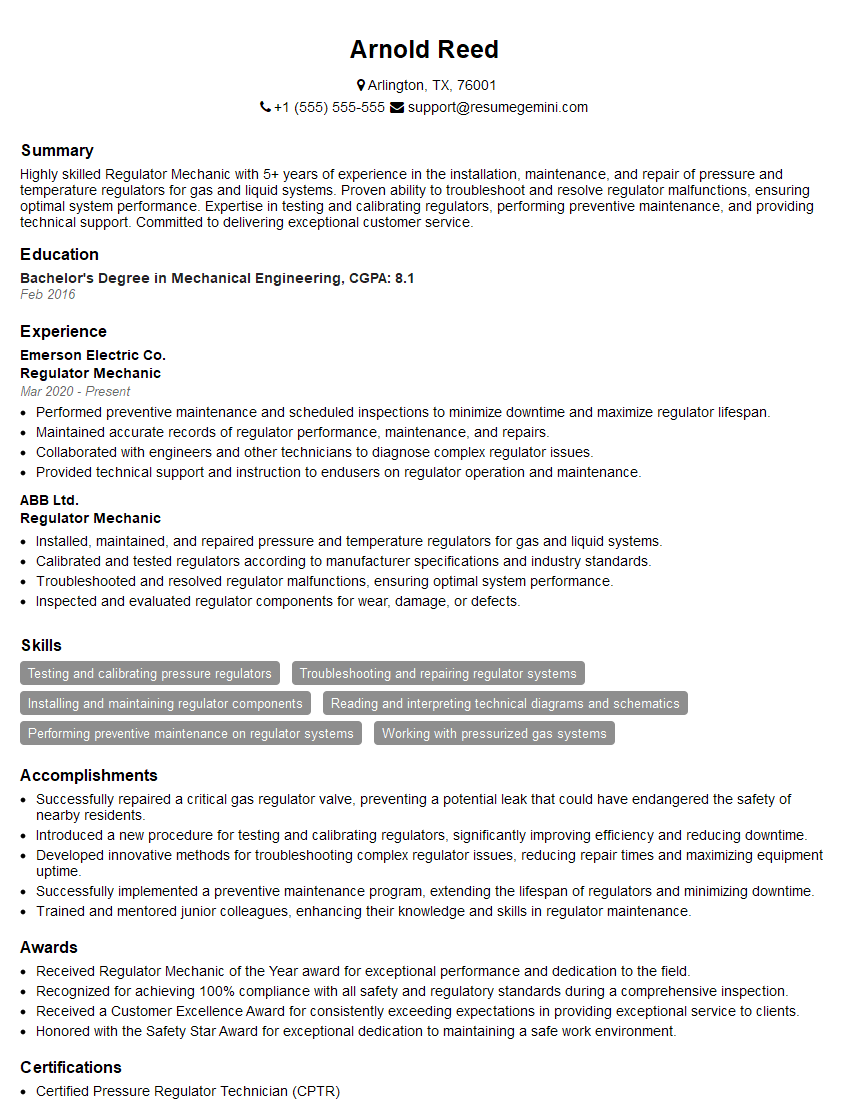
Arnold Reed
Regulator Mechanic
Summary
Highly skilled Regulator Mechanic with 5+ years of experience in the installation, maintenance, and repair of pressure and temperature regulators for gas and liquid systems. Proven ability to troubleshoot and resolve regulator malfunctions, ensuring optimal system performance. Expertise in testing and calibrating regulators, performing preventive maintenance, and providing technical support. Committed to delivering exceptional customer service.
Education
Bachelor’s Degree in Mechanical Engineering
February 2016
Skills
- Testing and calibrating pressure regulators
- Troubleshooting and repairing regulator systems
- Installing and maintaining regulator components
- Reading and interpreting technical diagrams and schematics
- Performing preventive maintenance on regulator systems
- Working with pressurized gas systems
Work Experience
Regulator Mechanic
- Performed preventive maintenance and scheduled inspections to minimize downtime and maximize regulator lifespan.
- Maintained accurate records of regulator performance, maintenance, and repairs.
- Collaborated with engineers and other technicians to diagnose complex regulator issues.
- Provided technical support and instruction to endusers on regulator operation and maintenance.
Regulator Mechanic
- Installed, maintained, and repaired pressure and temperature regulators for gas and liquid systems.
- Calibrated and tested regulators according to manufacturer specifications and industry standards.
- Troubleshooted and resolved regulator malfunctions, ensuring optimal system performance.
- Inspected and evaluated regulator components for wear, damage, or defects.
Accomplishments
- Successfully repaired a critical gas regulator valve, preventing a potential leak that could have endangered the safety of nearby residents.
- Introduced a new procedure for testing and calibrating regulators, significantly improving efficiency and reducing downtime.
- Developed innovative methods for troubleshooting complex regulator issues, reducing repair times and maximizing equipment uptime.
- Successfully implemented a preventive maintenance program, extending the lifespan of regulators and minimizing downtime.
- Trained and mentored junior colleagues, enhancing their knowledge and skills in regulator maintenance.
Awards
- Received Regulator Mechanic of the Year award for exceptional performance and dedication to the field.
- Recognized for achieving 100% compliance with all safety and regulatory standards during a comprehensive inspection.
- Received a Customer Excellence Award for consistently exceeding expectations in providing exceptional service to clients.
- Honored with the Safety Star Award for exceptional dedication to maintaining a safe work environment.
Certificates
- Certified Pressure Regulator Technician (CPTR)
- Certified Gas Measurement Technician (CGMT)
- OSHA 30-Hour Construction Safety Certification
- NFPA 704 Standard for the Identification of the Hazards of Materials for Emergency Response
Career Expert Tips:
- Select the ideal resume template to showcase your professional experience effectively.
- Master the art of resume writing to highlight your unique qualifications and achievements.
- Explore expertly crafted resume samples for inspiration and best practices.
- Build your best resume for free this new year with ResumeGemini. Enjoy exclusive discounts on ATS optimized resume templates.
How To Write Resume For Regulator Mechanic
- Highlight your technical skills and experience in regulator maintenance and repair.
- Showcase your ability to troubleshoot and resolve complex regulator issues.
- Demonstrate your understanding of industry standards and regulations.
- Emphasize your commitment to safety and customer satisfaction.
- Provide specific examples of your work and accomplishments as a Regulator Mechanic.
Essential Experience Highlights for a Strong Regulator Mechanic Resume
- Installed, maintained, and repaired pressure and temperature regulators for gas and liquid systems.
- Calibrated and tested regulators according to manufacturer specifications and industry standards.
- Troubleshooted and resolved regulator malfunctions, ensuring optimal system performance.
- Inspected and evaluated regulator components for wear, damage, or defects.
- Performed preventive maintenance and scheduled inspections to minimize downtime and maximize regulator lifespan.
- Maintained accurate records of regulator performance, maintenance, and repairs.
- Collaborated with engineers and other technicians to diagnose complex regulator issues.
Frequently Asked Questions (FAQ’s) For Regulator Mechanic
What are the primary responsibilities of a Regulator Mechanic?
Regulator Mechanics are responsible for installing, maintaining, and repairing pressure and temperature regulators for gas and liquid systems. They also calibrate and test regulators, troubleshoot malfunctions, and perform preventive maintenance.
What skills are required to be a successful Regulator Mechanic?
Successful Regulator Mechanics have a strong understanding of mechanical systems, fluid dynamics, and instrumentation. They are also skilled in troubleshooting, repair, and maintenance. Additionally, they must be able to work independently and as part of a team.
What are the career prospects for Regulator Mechanics?
Regulator Mechanics can advance their careers by becoming supervisors, engineers, or technical specialists. They can also pursue additional training and certifications to enhance their skills and knowledge.
What is the work environment of a Regulator Mechanic like?
Regulator Mechanics typically work in industrial settings, such as power plants, refineries, and manufacturing facilities. They may work indoors or outdoors, and may be exposed to hazardous materials or environments.