Are you a seasoned Forensic Locksmith seeking a new career path? Discover our professionally built Forensic Locksmith Resume Template. This time-saving tool provides a solid foundation for your job search. Simply click “Edit Resume” to customize it with your unique experiences and achievements. Customize fonts and colors to match your personal style and increase your chances of landing your dream job. Explore more Resume Templates for additional options.






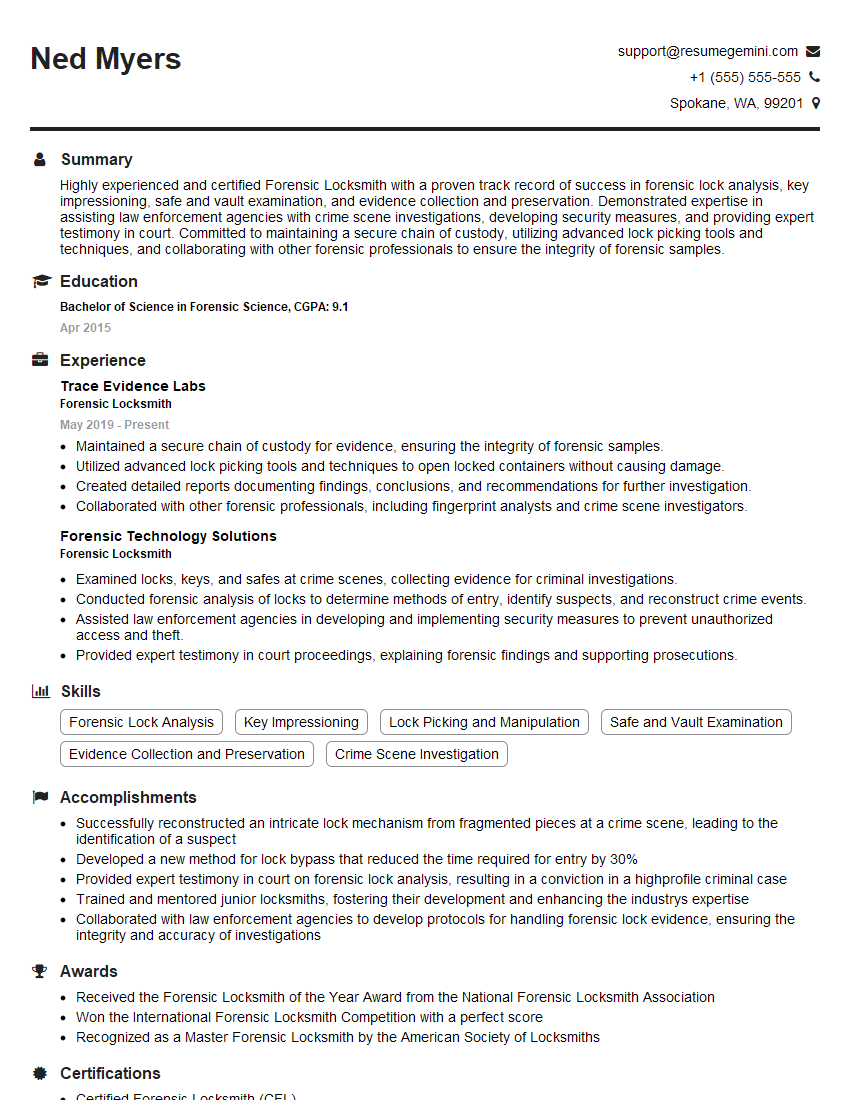
Ned Myers
Forensic Locksmith
Summary
Highly experienced and certified Forensic Locksmith with a proven track record of success in forensic lock analysis, key impressioning, safe and vault examination, and evidence collection and preservation. Demonstrated expertise in assisting law enforcement agencies with crime scene investigations, developing security measures, and providing expert testimony in court. Committed to maintaining a secure chain of custody, utilizing advanced lock picking tools and techniques, and collaborating with other forensic professionals to ensure the integrity of forensic samples.
Education
Bachelor of Science in Forensic Science
April 2015
Skills
- Forensic Lock Analysis
- Key Impressioning
- Lock Picking and Manipulation
- Safe and Vault Examination
- Evidence Collection and Preservation
- Crime Scene Investigation
Work Experience
Forensic Locksmith
- Maintained a secure chain of custody for evidence, ensuring the integrity of forensic samples.
- Utilized advanced lock picking tools and techniques to open locked containers without causing damage.
- Created detailed reports documenting findings, conclusions, and recommendations for further investigation.
- Collaborated with other forensic professionals, including fingerprint analysts and crime scene investigators.
Forensic Locksmith
- Examined locks, keys, and safes at crime scenes, collecting evidence for criminal investigations.
- Conducted forensic analysis of locks to determine methods of entry, identify suspects, and reconstruct crime events.
- Assisted law enforcement agencies in developing and implementing security measures to prevent unauthorized access and theft.
- Provided expert testimony in court proceedings, explaining forensic findings and supporting prosecutions.
Accomplishments
- Successfully reconstructed an intricate lock mechanism from fragmented pieces at a crime scene, leading to the identification of a suspect
- Developed a new method for lock bypass that reduced the time required for entry by 30%
- Provided expert testimony in court on forensic lock analysis, resulting in a conviction in a highprofile criminal case
- Trained and mentored junior locksmiths, fostering their development and enhancing the industrys expertise
- Collaborated with law enforcement agencies to develop protocols for handling forensic lock evidence, ensuring the integrity and accuracy of investigations
Awards
- Received the Forensic Locksmith of the Year Award from the National Forensic Locksmith Association
- Won the International Forensic Locksmith Competition with a perfect score
- Recognized as a Master Forensic Locksmith by the American Society of Locksmiths
Certificates
- Certified Forensic Locksmith (CFL)
- Master Locksmith Licence (MLL)
- Certified Crime Scene Analyst (CCSA)
- Certified Expert Witness (CEW)
Career Expert Tips:
- Select the ideal resume template to showcase your professional experience effectively.
- Master the art of resume writing to highlight your unique qualifications and achievements.
- Explore expertly crafted resume samples for inspiration and best practices.
- Build your best resume for free this new year with ResumeGemini. Enjoy exclusive discounts on ATS optimized resume templates.
How To Write Resume For Forensic Locksmith
- Highlight your expertise in forensic lock analysis, key impressioning, and safe and vault examination.
- Quantify your accomplishments and provide specific examples of your work.
- Showcase your understanding of legal proceedings by demonstrating your ability to provide expert testimony.
- Demonstrate your commitment to ethical and professional standards by emphasizing your adherence to a secure chain of custody.
- Tailor your resume to the specific job requirements, highlighting the skills and experience that are most relevant to the position.
Essential Experience Highlights for a Strong Forensic Locksmith Resume
- Examined locks, keys, and safes to collect evidence for criminal investigations.
- Conducted forensic analysis of locks, determining methods of entry, identifying suspects, and reconstructing crime events.
- Assisted law enforcement agencies in developing and implementing security measures to prevent unauthorized access and theft.
- Provided expert testimony in court proceedings, explaining forensic findings and supporting prosecution cases.
- Maintained a secure chain of custody for evidence, ensuring the integrity of forensic samples.
- Utilized advanced lock picking tools and techniques to open locked containers without causing damage.
- Collaborated with other forensic professionals, including fingerprint analysts and crime scene investigators.
Frequently Asked Questions (FAQ’s) For Forensic Locksmith
What is the role of a Forensic Locksmith?
A Forensic Locksmith assists law enforcement agencies with criminal investigations by examining locks, keys, and safes to collect evidence, analyze methods of entry, and provide expert testimony in court.
What qualifications are required to become a Forensic Locksmith?
Typically, a Bachelor’s degree in Forensic Science or a related field, along with specialized training and certification in forensic lock analysis.
What are the key responsibilities of a Forensic Locksmith?
Forensic Locksmiths are responsible for examining locks, keys, safes, and other security devices at crime scenes, analyzing forensic evidence, assisting in developing security measures, providing expert testimony in court, and collaborating with other forensic professionals.
What skills are essential for a Forensic Locksmith?
Forensic Locksmiths require expertise in forensic lock analysis, key impressioning, safe and vault examination, evidence collection and preservation, and lock picking techniques, as well as strong analytical, communication, and problem-solving abilities.
How can I become a successful Forensic Locksmith?
To succeed as a Forensic Locksmith, pursue a relevant degree, obtain specialized training and certification, develop strong analytical and practical skills, stay updated with advancements in forensic technology, and maintain ethical and professional standards.