Are you a seasoned Poultry Killer seeking a new career path? Discover our professionally built Poultry Killer Resume Template. This time-saving tool provides a solid foundation for your job search. Simply click “Edit Resume” to customize it with your unique experiences and achievements. Customize fonts and colors to match your personal style and increase your chances of landing your dream job. Explore more Resume Templates for additional options.






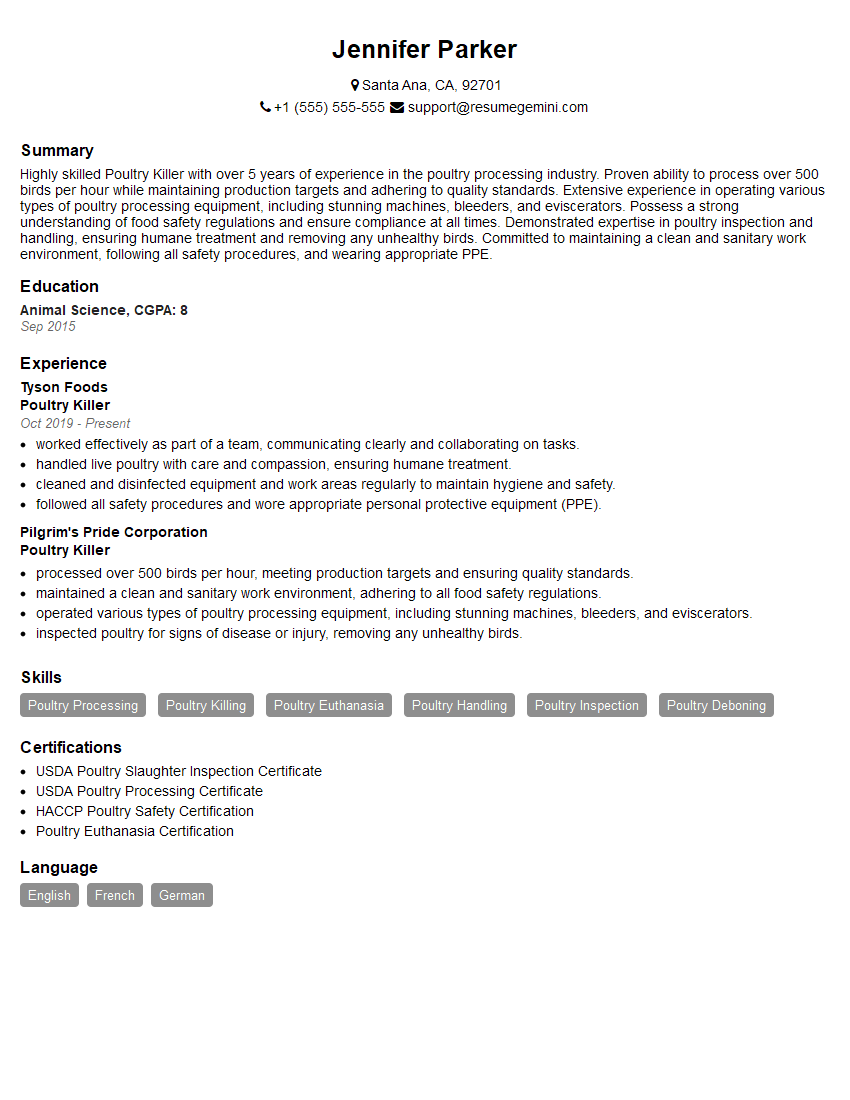
Jennifer Parker
Poultry Killer
Summary
Highly skilled Poultry Killer with over 5 years of experience in the poultry processing industry. Proven ability to process over 500 birds per hour while maintaining production targets and adhering to quality standards. Extensive experience in operating various types of poultry processing equipment, including stunning machines, bleeders, and eviscerators. Possess a strong understanding of food safety regulations and ensure compliance at all times. Demonstrated expertise in poultry inspection and handling, ensuring humane treatment and removing any unhealthy birds. Committed to maintaining a clean and sanitary work environment, following all safety procedures, and wearing appropriate PPE.
Education
Animal Science
September 2015
Skills
- Poultry Processing
- Poultry Killing
- Poultry Euthanasia
- Poultry Handling
- Poultry Inspection
- Poultry Deboning
Work Experience
Poultry Killer
- worked effectively as part of a team, communicating clearly and collaborating on tasks.
- handled live poultry with care and compassion, ensuring humane treatment.
- cleaned and disinfected equipment and work areas regularly to maintain hygiene and safety.
- followed all safety procedures and wore appropriate personal protective equipment (PPE).
Poultry Killer
- processed over 500 birds per hour, meeting production targets and ensuring quality standards.
- maintained a clean and sanitary work environment, adhering to all food safety regulations.
- operated various types of poultry processing equipment, including stunning machines, bleeders, and eviscerators.
- inspected poultry for signs of disease or injury, removing any unhealthy birds.
Certificates
- USDA Poultry Slaughter Inspection Certificate
- USDA Poultry Processing Certificate
- HACCP Poultry Safety Certification
- Poultry Euthanasia Certification
Languages
- English
- French
- German
Career Expert Tips:
- Select the ideal resume template to showcase your professional experience effectively.
- Master the art of resume writing to highlight your unique qualifications and achievements.
- Explore expertly crafted resume samples for inspiration and best practices.
- Build your best resume for free this new year with ResumeGemini. Enjoy exclusive discounts on ATS optimized resume templates.
How To Write Resume For Poultry Killer
- Quantify your accomplishments by using specific numbers and metrics whenever possible.
- Highlight your experience and skills in poultry processing, inspection, and evisceration.
- Demonstrate your commitment to food safety by mentioning your knowledge of and adherence to relevant regulations.
- Emphasize your ability to work effectively as part of a team and your dedication to humane animal treatment.
Essential Experience Highlights for a Strong Poultry Killer Resume
- Process poultry at a high speed, typically over 500 birds per hour, ensuring production targets are met and quality standards are upheld.
- Operate and maintain various types of poultry processing equipment, such as stunning machines, bleeders, and eviscerators.
- Inspect poultry for signs of disease or injury, promptly removing any unhealthy birds to maintain the health and safety of the flock.
- Effectively work as part of a team, communicating clearly, collaborating on tasks, and contributing to a productive and efficient work environment.
- Handle live poultry with utmost care and compassion, ensuring humane treatment and minimizing any distress to the animals.
- Adhere to all company and industry safety procedures, wear appropriate personal protective equipment (PPE), and maintain a clean and sanitary work area.
- Stay up-to-date on the latest poultry processing techniques and best practices to ensure efficient and effective operations.
Frequently Asked Questions (FAQ’s) For Poultry Killer
What are the primary duties and responsibilities of a Poultry Killer?
The primary duties and responsibilities of a Poultry Killer involve processing poultry at a high speed, operating and maintaining poultry processing equipment, inspecting poultry for signs of disease or injury, working effectively as part of a team, handling live poultry with care and compassion, adhering to safety procedures, and maintaining a clean and sanitary work environment.
What qualifications and experience are typically required for a Poultry Killer position?
Most Poultry Killer positions require a high school diploma or equivalent, with some employers preferring candidates with a degree in Animal Science or a related field. Prior experience in the poultry processing industry, particularly in poultry killing and processing, is highly valued. Additionally, a strong understanding of food safety regulations and commitment to humane animal treatment are essential.
What are the key skills and abilities needed to excel as a Poultry Killer?
To excel as a Poultry Killer, strong knife skills, speed, and accuracy are essential. Attention to detail, the ability to work in a fast-paced environment, and the physical stamina to stand for long periods are also important. Furthermore, a commitment to food safety, humane animal treatment, and teamwork are crucial for success in this role.
What is the career path and potential for advancement for a Poultry Killer?
The career path for a Poultry Killer typically involves starting as a Production Worker and gradually advancing to more skilled roles, such as Line Supervisor or Quality Control Inspector. With experience and additional training, individuals may also move into management positions, such as Production Manager or Plant Manager. The poultry processing industry offers opportunities for advancement for those who demonstrate strong performance and a commitment to the field.
What are the safety precautions and regulations that Poultry Killers must follow?
Poultry Killers must adhere to strict safety precautions and regulations to ensure their safety and the quality of the poultry products. These include wearing appropriate personal protective equipment (PPE), such as gloves, aprons, and safety glasses, maintaining a clean and sanitary work environment, following proper knife handling techniques, and being aware of potential hazards and risks in the workplace. Additionally, Poultry Killers must comply with all food safety regulations and industry standards to prevent contamination and ensure the safety of consumers.
What are the ethical considerations and animal welfare practices involved in poultry killing?
Poultry killing involves ethical considerations and animal welfare practices that must be followed to ensure humane treatment of the birds. These include handling the birds with care and minimizing stress, using sharp and properly maintained knives to ensure a clean and quick kill, and adhering to stunning or anesthesia procedures to minimize pain and distress. Additionally, Poultry Killers must follow proper disposal procedures for dead birds and offal to prevent contamination and maintain a sanitary work environment.
What are the physical and mental demands of being a Poultry Killer?
Being a Poultry Killer involves both physical and mental demands. Physically, the job requires standing for long periods, performing repetitive motions, and handling heavy equipment. It also requires the ability to work in cold and wet conditions. Mentally, Poultry Killers must be able to handle the fast-paced and often stressful environment of a poultry processing plant. They must also be able to make quick decisions and work well under pressure.
What are the job market trends and employment outlook for Poultry Killers?
The job market for Poultry Killers is expected to remain stable in the coming years. The poultry processing industry is a major employer in many regions, and the demand for skilled Poultry Killers is expected to continue. However, automation and technological advancements may lead to changes in the job market, so Poultry Killers may need to adapt and develop new skills to stay competitive.