Are you a seasoned Weaving Loom Operator seeking a new career path? Discover our professionally built Weaving Loom Operator Resume Template. This time-saving tool provides a solid foundation for your job search. Simply click “Edit Resume” to customize it with your unique experiences and achievements. Customize fonts and colors to match your personal style and increase your chances of landing your dream job. Explore more Resume Templates for additional options.






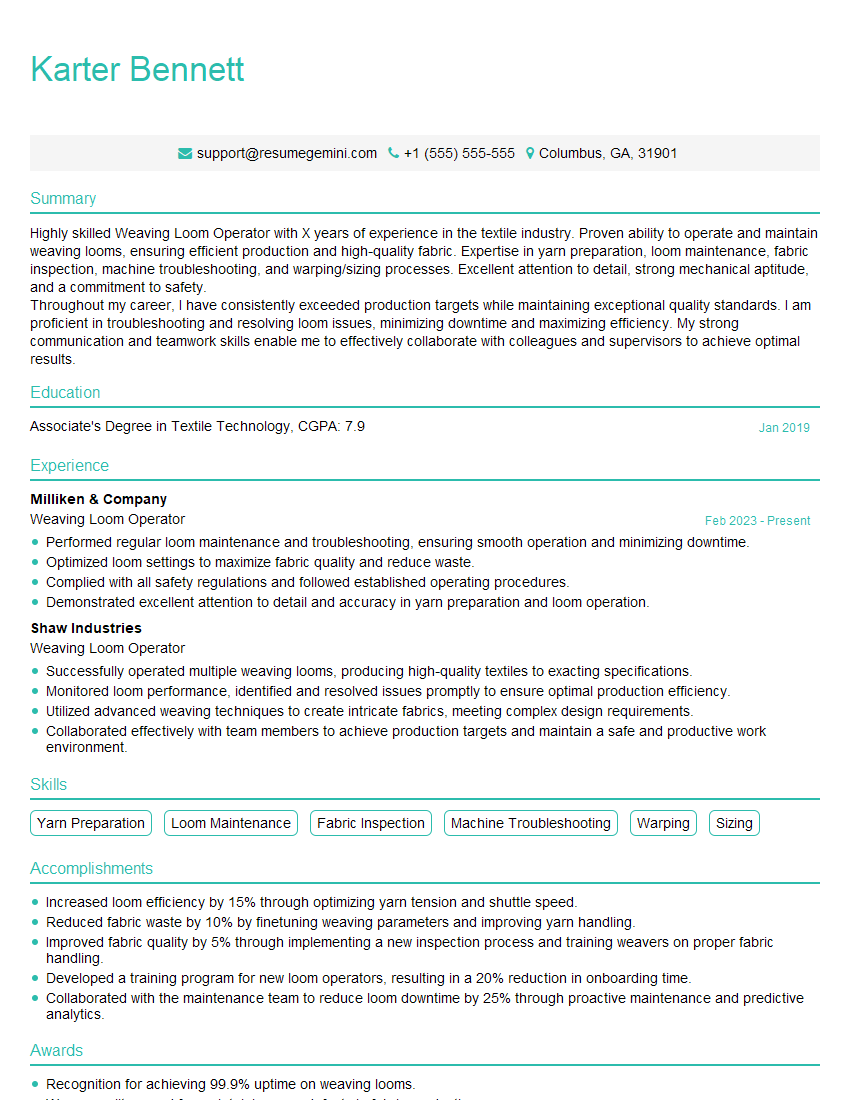
Karter Bennett
Weaving Loom Operator
Summary
Highly skilled Weaving Loom Operator with X years of experience in the textile industry. Proven ability to operate and maintain weaving looms, ensuring efficient production and high-quality fabric. Expertise in yarn preparation, loom maintenance, fabric inspection, machine troubleshooting, and warping/sizing processes. Excellent attention to detail, strong mechanical aptitude, and a commitment to safety.
Throughout my career, I have consistently exceeded production targets while maintaining exceptional quality standards. I am proficient in troubleshooting and resolving loom issues, minimizing downtime and maximizing efficiency. My strong communication and teamwork skills enable me to effectively collaborate with colleagues and supervisors to achieve optimal results.
Education
Associate’s Degree in Textile Technology
January 2019
Skills
- Yarn Preparation
- Loom Maintenance
- Fabric Inspection
- Machine Troubleshooting
- Warping
- Sizing
Work Experience
Weaving Loom Operator
- Performed regular loom maintenance and troubleshooting, ensuring smooth operation and minimizing downtime.
- Optimized loom settings to maximize fabric quality and reduce waste.
- Complied with all safety regulations and followed established operating procedures.
- Demonstrated excellent attention to detail and accuracy in yarn preparation and loom operation.
Weaving Loom Operator
- Successfully operated multiple weaving looms, producing high-quality textiles to exacting specifications.
- Monitored loom performance, identified and resolved issues promptly to ensure optimal production efficiency.
- Utilized advanced weaving techniques to create intricate fabrics, meeting complex design requirements.
- Collaborated effectively with team members to achieve production targets and maintain a safe and productive work environment.
Accomplishments
- Increased loom efficiency by 15% through optimizing yarn tension and shuttle speed.
- Reduced fabric waste by 10% by finetuning weaving parameters and improving yarn handling.
- Improved fabric quality by 5% through implementing a new inspection process and training weavers on proper fabric handling.
- Developed a training program for new loom operators, resulting in a 20% reduction in onboarding time.
- Collaborated with the maintenance team to reduce loom downtime by 25% through proactive maintenance and predictive analytics.
Awards
- Recognition for achieving 99.9% uptime on weaving looms.
- Won a quality award for maintaining zero defects in fabric production.
- Received a safety award for implementing innovative safety measures in the weaving department.
- Recognized for mentoring junior loom operators and fostering a positive work environment.
Certificates
- Certified Weaving Loom Operator (CWLO)
- Textile Manufacturing Technician (TMT)
Career Expert Tips:
- Select the ideal resume template to showcase your professional experience effectively.
- Master the art of resume writing to highlight your unique qualifications and achievements.
- Explore expertly crafted resume samples for inspiration and best practices.
- Build your best resume for free this new year with ResumeGemini. Enjoy exclusive discounts on ATS optimized resume templates.
How To Write Resume For Weaving Loom Operator
- Quantify your experience by providing specific examples of your contributions and achievements.
- Highlight your technical skills, including proficiency in loom operation, troubleshooting, and maintenance.
- Emphasize your attention to detail and ability to identify and resolve fabric defects.
- Showcase your commitment to safety and adherence to industry regulations.
- Consider including relevant certifications or training programs to demonstrate your expertise.
Essential Experience Highlights for a Strong Weaving Loom Operator Resume
- Operate and monitor weaving looms to produce high-quality fabric.
- Prepare yarn for weaving, ensuring proper tension and alignment.
- Inspect fabric regularly to identify defects and ensure quality standards.
- Troubleshoot and resolve loom malfunctions promptly to minimize downtime.
- Perform routine maintenance and cleaning of looms to ensure proper functioning.
- Warp and size fabric to prepare it for weaving.
- Follow safety regulations and maintain a clean and organized work area.
- Collaborate with other team members to achieve production targets.
Frequently Asked Questions (FAQ’s) For Weaving Loom Operator
What are the key skills required to be a successful Weaving Loom Operator?
The key skills for a successful Weaving Loom Operator include loom operation, yarn preparation, fabric inspection, machine troubleshooting, warping, sizing, and a strong mechanical aptitude.
What is the typical work environment for a Weaving Loom Operator?
Weaving Loom Operators typically work in textile mills or manufacturing facilities. The work environment can be noisy and repetitive, but it is also essential to the production of high-quality fabrics.
What are the career advancement opportunities for a Weaving Loom Operator?
Experienced Weaving Loom Operators may advance to supervisory roles, such as Loom Fixer or Production Supervisor. They may also specialize in a particular type of weaving or fabric production.
What is the job outlook for Weaving Loom Operators?
The job outlook for Weaving Loom Operators is expected to remain stable in the coming years. The demand for skilled operators is driven by the growing textile industry, particularly in developing countries.
What are the safety precautions that Weaving Loom Operators should follow?
Weaving Loom Operators should follow all safety regulations, including wearing protective clothing and eyewear, keeping work areas clean and organized, and being aware of potential hazards such as moving machinery.