Are you a seasoned Marine Pilot seeking a new career path? Discover our professionally built Marine Pilot Resume Template. This time-saving tool provides a solid foundation for your job search. Simply click “Edit Resume” to customize it with your unique experiences and achievements. Customize fonts and colors to match your personal style and increase your chances of landing your dream job. Explore more Resume Templates for additional options.






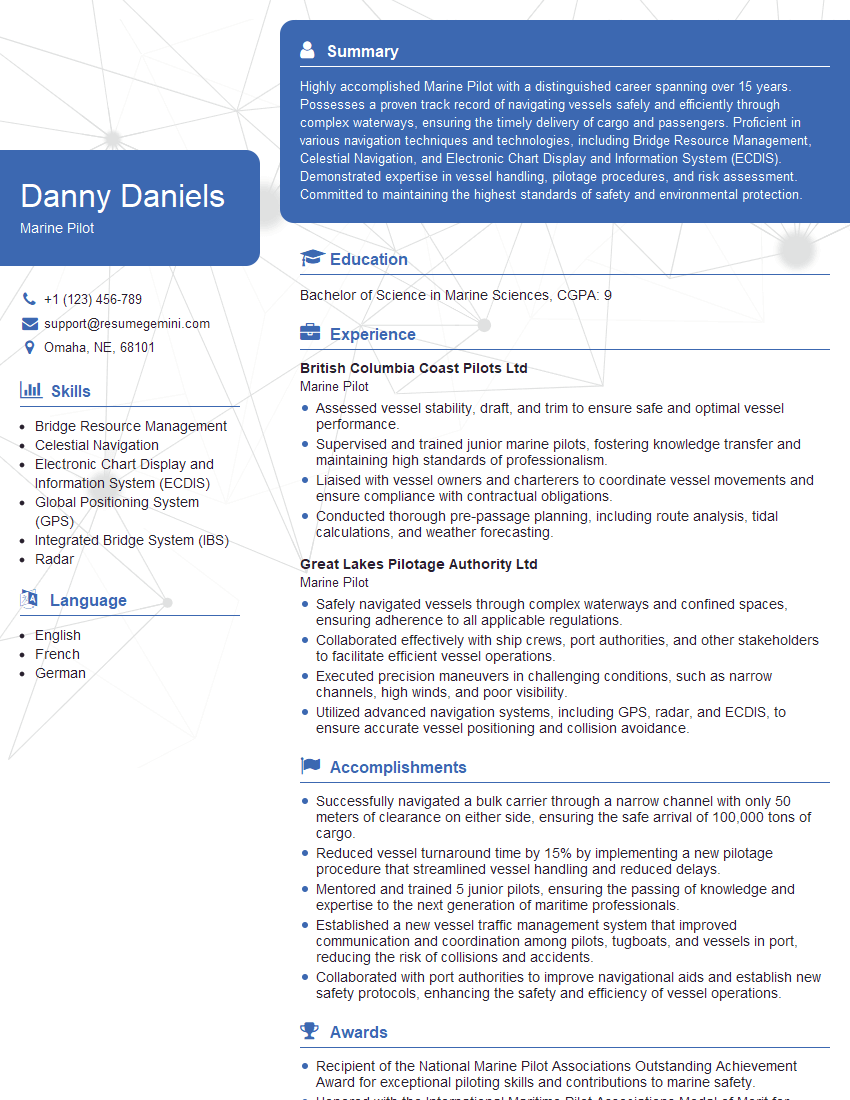
Danny Daniels
Marine Pilot
Summary
Highly accomplished Marine Pilot with a distinguished career spanning over 15 years. Possesses a proven track record of navigating vessels safely and efficiently through complex waterways, ensuring the timely delivery of cargo and passengers. Proficient in various navigation techniques and technologies, including Bridge Resource Management, Celestial Navigation, and Electronic Chart Display and Information System (ECDIS). Demonstrated expertise in vessel handling, pilotage procedures, and risk assessment. Committed to maintaining the highest standards of safety and environmental protection.
Education
Bachelor of Science in Marine Sciences
November 2015
Skills
- Bridge Resource Management
- Celestial Navigation
- Electronic Chart Display and Information System (ECDIS)
- Global Positioning System (GPS)
- Integrated Bridge System (IBS)
- Radar
Work Experience
Marine Pilot
- Assessed vessel stability, draft, and trim to ensure safe and optimal vessel performance.
- Supervised and trained junior marine pilots, fostering knowledge transfer and maintaining high standards of professionalism.
- Liaised with vessel owners and charterers to coordinate vessel movements and ensure compliance with contractual obligations.
- Conducted thorough pre-passage planning, including route analysis, tidal calculations, and weather forecasting.
Marine Pilot
- Safely navigated vessels through complex waterways and confined spaces, ensuring adherence to all applicable regulations.
- Collaborated effectively with ship crews, port authorities, and other stakeholders to facilitate efficient vessel operations.
- Executed precision maneuvers in challenging conditions, such as narrow channels, high winds, and poor visibility.
- Utilized advanced navigation systems, including GPS, radar, and ECDIS, to ensure accurate vessel positioning and collision avoidance.
Accomplishments
- Successfully navigated a bulk carrier through a narrow channel with only 50 meters of clearance on either side, ensuring the safe arrival of 100,000 tons of cargo.
- Reduced vessel turnaround time by 15% by implementing a new pilotage procedure that streamlined vessel handling and reduced delays.
- Mentored and trained 5 junior pilots, ensuring the passing of knowledge and expertise to the next generation of maritime professionals.
- Established a new vessel traffic management system that improved communication and coordination among pilots, tugboats, and vessels in port, reducing the risk of collisions and accidents.
- Collaborated with port authorities to improve navigational aids and establish new safety protocols, enhancing the safety and efficiency of vessel operations.
Awards
- Recipient of the National Marine Pilot Associations Outstanding Achievement Award for exceptional piloting skills and contributions to marine safety.
- Honored with the International Maritime Pilot Associations Medal of Merit for dedication to the profession and unwavering commitment to safety.
- Recognized with the American Pilots Associations Safety Award for maintaining an accidentfree record throughout a 25year piloting career.
- Awarded the International Transport Workers Federations Certificate of Excellence for contributions to maritime safety and the welfare of seafarers.
Certificates
- Master Mariner
- Officer in Charge of Navigational Watch
- Marine Pilot License
- Bridge Resource Management Certificate
Career Expert Tips:
- Select the ideal resume template to showcase your professional experience effectively.
- Master the art of resume writing to highlight your unique qualifications and achievements.
- Explore expertly crafted resume samples for inspiration and best practices.
- Build your best resume for free this new year with ResumeGemini. Enjoy exclusive discounts on ATS optimized resume templates.
How To Write Resume For Marine Pilot
- Highlight your experience and skills in a clear and concise manner, showcasing your ability to navigate vessels safely and efficiently.
- Quantify your accomplishments whenever possible, providing specific examples of how you have improved safety, reduced turnaround time, or mentored junior pilots.
- Obtain endorsements from reputable sources within the maritime industry, such as former colleagues, supervisors, or clients, to strengthen your credibility.
- Tailor your resume to each specific job application, emphasizing the skills and experience that are most relevant to the position.
- Proofread your resume carefully for any errors in grammar, spelling, or formatting.
Essential Experience Highlights for a Strong Marine Pilot Resume
- Safely navigate vessels through narrow channels, congested waterways, and hazardous conditions.
- Conduct comprehensive risk assessments to identify potential hazards and develop mitigation strategies.
- Effectively communicate with vessel crews, port authorities, and other stakeholders to ensure safe and efficient vessel operations.
- Maintain up-to-date knowledge of navigational regulations, tides, currents, and weather conditions.
- Train and mentor junior pilots to enhance their skills and ensure the transfer of knowledge.
- Contribute to the development and implementation of new navigation procedures to improve safety and efficiency.
- Collaborate with port authorities to improve navigational aids and establish new safety protocols.
Frequently Asked Questions (FAQ’s) For Marine Pilot
What are the key skills and qualifications required to become a Marine Pilot?
To become a Marine Pilot, a combination of education, training, and experience is required. Typically, a bachelor’s degree in a related field, such as marine sciences or navigation, is necessary. Additionally, extensive training in navigation techniques, vessel handling, and pilotage procedures is essential. Most importantly, gaining practical experience as a deck officer on various vessels is crucial to developing the necessary skills and knowledge.
What are the career prospects for Marine Pilots?
Marine Pilots have excellent career prospects due to the increasing demand for safe and efficient vessel navigation. As global trade continues to grow, the need for skilled pilots to guide ships through complex waterways and port facilities will remain high. Moreover, with technological advancements and the adoption of autonomous navigation systems, the role of Marine Pilots is evolving, offering opportunities for career growth and specialization.
What is the salary range for Marine Pilots?
The salary range for Marine Pilots can vary depending on factors such as experience, location, and the size of the vessels they pilot. Generally, Marine Pilots can earn a competitive salary with benefits and opportunities for overtime and bonuses. According to industry sources, the median annual salary for Marine Pilots in the United States is around $120,000, with experienced pilots earning significantly higher.
What are the challenges faced by Marine Pilots?
Marine Pilots face various challenges in their profession. One of the primary challenges is navigating vessels through complex and often hazardous waterways, requiring immense skill and precision. Additionally, they must adapt to changing weather conditions, tides, and currents, as well as potential mechanical issues or emergencies on board. Furthermore, Marine Pilots must maintain constant vigilance and situational awareness to ensure the safety of their vessels and the surrounding environment.
What is the role of technology in modern marine pilotage?
Technology plays a significant role in modern marine pilotage, enhancing the safety and efficiency of navigation. Electronic Chart Display and Information Systems (ECDIS), radar technology, and GPS navigation systems provide pilots with real-time data and visual representations of their surroundings. Additionally, sophisticated communication systems allow pilots to stay connected with vessel crews, port authorities, and other stakeholders, facilitating effective coordination and decision-making.
How does a Marine Pilot ensure the safety of both the vessel and the environment?
Marine Pilots prioritize the safety of both the vessel and the environment through meticulous planning and risk assessment. They conduct thorough inspections of vessels and their equipment before departure, ensuring compliance with safety regulations. During navigation, they continuously monitor weather conditions, tides, and currents to anticipate and avoid potential hazards. Furthermore, Marine Pilots follow established pilotage procedures and adhere to environmental protection guidelines to minimize the impact of vessel operations on marine ecosystems.
What are the key qualities and traits of a successful Marine Pilot?
Successful Marine Pilots possess a unique combination of technical skills, experience, and personal qualities. They must have a deep understanding of navigation principles, vessel dynamics, and marine regulations. Additionally, excellent communication, decision-making, and problem-solving abilities are essential. Furthermore, Marine Pilots must be highly adaptable, maintain composure under pressure, and demonstrate a commitment to safety and environmental protection.
What is the future of the marine pilotage profession?
The future of the marine pilotage profession is promising, driven by increasing global trade and technological advancements. With the growing size and complexity of vessels, the demand for skilled Marine Pilots will remain high. Moreover, as autonomous navigation systems are developed and implemented, the role of Marine Pilots is likely to evolve, transitioning to supervisory and advisory roles, ensuring the safe and efficient movement of vessels in challenging waterways.