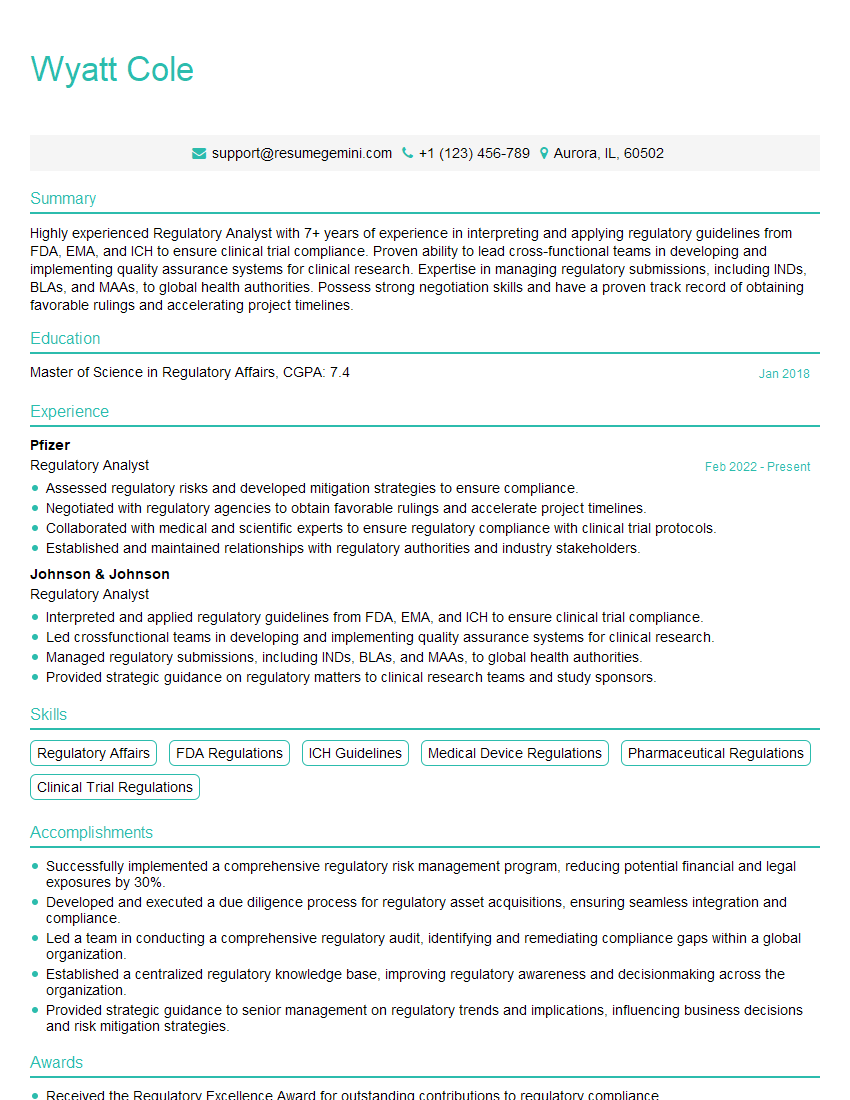
Are you gearing up for an interview for a Regulatory Analyst position? Whether you’re a seasoned professional or just stepping into the role, understanding what’s expected can make all the difference. In this blog, we dive deep into the essential interview questions for Regulatory Analyst and break down the key responsibilities of the role. By exploring these insights, you’ll gain a clearer picture of what employers are looking for and how you can stand out. Read on to equip yourself with the knowledge and confidence needed to ace your next interview and land your dream job!
Acing the interview is crucial, but landing one requires a compelling resume that gets you noticed. Crafting a professional document that highlights your skills and experience is the first step toward interview success. ResumeGemini can help you build a standout resume that gets you called in for that dream job.






Essential Interview Questions For Regulatory Analyst
1. Describe the regulatory landscape for the pharmaceutical industry in the US and Europe.
The pharmaceutical industry is heavily regulated in both the US and Europe. In the US, the Food and Drug Administration (FDA) is responsible for regulating the development, manufacture, and marketing of drugs and biologics. The FDA’s regulations are designed to ensure that drugs are safe and effective, and that they are manufactured and marketed in accordance with good manufacturing practices (GMPs).
In Europe, the European Medicines Agency (EMA) is responsible for regulating the development, manufacture, and marketing of drugs and biologics. The EMA’s regulations are similar to those of the FDA, but there are some differences in the way that the two agencies operate. For example, the EMA has a more centralized review process than the FDA, and it also has a greater role in the post-marketing surveillance of drugs.
2. What are the key differences between the FDA and the EMA?
EMA’s centralized review process
- The EMA has a more centralized review process than the FDA.
- This means that all applications for marketing authorization (MAs) for new drugs are submitted to the EMA, which then reviews them and makes a decision on whether or not to grant MA.
- The FDA, on the other hand, has a more decentralized review process.
- This means that applications for marketing approval (NDAs) for new drugs can be submitted to any of the FDA’s regional offices.
EMA’s greater role in the post-marketing surveillance of drugs
- The EMA has a greater role in the post-marketing surveillance of drugs than the FDA.
- This means that the EMA actively monitors the safety and efficacy of drugs after they have been approved for marketing.
- The FDA, on the other hand, does not have as active a role in the post-marketing surveillance of drugs.
3. What are the challenges facing the pharmaceutical industry in the current regulatory environment?
The pharmaceutical industry is facing a number of challenges in the current regulatory environment. These challenges include:
- Increasing regulatory complexity:
- The regulatory landscape is becoming increasingly complex, with new regulations being introduced all the time.
- This can make it difficult for companies to stay compliant with all of the applicable regulations.
- Increasing globalization:
- The pharmaceutical industry is becoming increasingly globalized, with companies operating in multiple countries.
- This can lead to challenges in complying with the different regulatory requirements in each country.
- Increasing patient expectations:
- Patients are becoming more demanding and are expecting new drugs and treatments to be available quickly.
- This can put pressure on companies to accelerate the development and approval process, which can lead to increased risks.
- Increasing competition from generics and biosimilars:
- The generic and biosimilar markets are growing rapidly, which is putting pressure on companies to reduce prices.
- This can make it difficult for companies to justify the costs of developing and marketing new drugs.
4. What are the key trends in the regulatory landscape for the pharmaceutical industry?
The key trends in the regulatory landscape for the pharmaceutical industry include:
- Increasing use of risk-based approaches:
- Regulators are increasingly using risk-based approaches to regulation.
- This means that they are focusing their resources on the areas of greatest risk.
- Increasing use of technology:
- Regulators are increasingly using technology to improve their efficiency and effectiveness.
- This includes the use of electronic submissions, data mining, and other tools.
- Increasing emphasis on patient involvement:
- Regulators are increasingly emphasizing the importance of patient involvement in the regulatory process.
- This includes involving patients in the development of clinical trials and in the review of new drugs.
- Increasing focus on global harmonization:
- Regulators are increasingly working together to harmonize their requirements.
- This is aimed at reducing the burden on companies and facilitating the development and approval of new drugs.
5. What are the key skills and qualities of a successful Regulatory Analyst?
The key skills and qualities of a successful Regulatory Analyst include:
- Excellent knowledge of the regulatory landscape for the pharmaceutical industry
- Strong analytical and problem-solving skills
- Excellent communication and interpersonal skills
- Ability to work independently and as part of a team
- Attention to detail
- Ability to meet deadlines
6. What is the role of a Regulatory Analyst in the development and approval of a new drug?
The role of a Regulatory Analyst in the development and approval of a new drug includes:
- Providing regulatory advice to the development team
- Preparing and submitting regulatory submissions
- Interacting with regulators
- Monitoring the regulatory landscape
- Ensuring compliance with all applicable regulations
7. What is the importance of regulatory compliance in the pharmaceutical industry?
Regulatory compliance is essential in the pharmaceutical industry for the following reasons:
- It ensures that drugs are safe and effective
- It protects patients from harm
- It helps to maintain public confidence in the pharmaceutical industry
- It can help companies to avoid fines and other penalties
8. What are the consequences of non-compliance with regulatory requirements?
The consequences of non-compliance with regulatory requirements can include:
- Fines
- Imprisonment
- Loss of license
- Product recalls
- Damage to reputation
9. What are the key ethical considerations for Regulatory Analysts?
The key ethical considerations for Regulatory Analysts include:
- Protecting the public health
- Ensuring that drugs are safe and effective
- Avoiding conflicts of interest
- Maintaining confidentiality
- Acting with integrity and professionalism
10. What is the future of the Regulatory Analyst profession?
The future of the Regulatory Analyst profession is bright. The demand for Regulatory Analysts is expected to grow in the coming years as the pharmaceutical industry continues to develop new drugs and treatments.
Interviewers often ask about specific skills and experiences. With ResumeGemini‘s customizable templates, you can tailor your resume to showcase the skills most relevant to the position, making a powerful first impression. Also check out Resume Template specially tailored for Regulatory Analyst.
Career Expert Tips:
- Ace those interviews! Prepare effectively by reviewing the Top 50 Most Common Interview Questions on ResumeGemini.
- Navigate your job search with confidence! Explore a wide range of Career Tips on ResumeGemini. Learn about common challenges and recommendations to overcome them.
- Craft the perfect resume! Master the Art of Resume Writing with ResumeGemini’s guide. Showcase your unique qualifications and achievements effectively.
- Great Savings With New Year Deals and Discounts! In 2025, boost your job search and build your dream resume with ResumeGemini’s ATS optimized templates.
Researching the company and tailoring your answers is essential. Once you have a clear understanding of the Regulatory Analyst‘s requirements, you can use ResumeGemini to adjust your resume to perfectly match the job description.
Key Job Responsibilities
Regulatory Analysts are responsible for ensuring that their company’s products and services comply with all applicable regulations. They work closely with other departments, such as legal and quality assurance, to develop and implement compliance strategies. Regulatory Analysts must have a strong understanding of the regulatory landscape and be able to interpret and apply complex regulations to their company’s operations.
1. Monitor Regulatory Changes
Regulatory Analysts must stay up-to-date on all regulatory changes that could impact their company. They must be able to identify and understand new regulations and assess their potential impact on the company’s operations.
- Review regulatory publications and news sources
- Attend conferences and webinars on regulatory topics
- Consult with legal counsel and other experts on regulatory matters
2. Develop and Implement Compliance Strategies
Regulatory Analysts must develop and implement compliance strategies to ensure that their company complies with all applicable regulations. These strategies may include:
- Developing and implementing policies and procedures
- Conducting training for employees
- Monitoring compliance and reporting on findings
3. Work with Other Departments
Regulatory Analysts must work closely with other departments, such as legal and quality assurance, to ensure that the company is compliant with all applicable regulations. They must be able to communicate effectively with these departments and to provide them with the information they need to make informed decisions.
- Collaborate with legal counsel to develop and interpret regulations
- Work with quality assurance to ensure that products and services meet regulatory requirements
- Provide training to other departments on regulatory compliance
4. Stay Abreast of Industry Trends
Regulatory Analysts must stay abreast of industry trends and best practices in regulatory compliance. They must be able to identify and assess new technologies and approaches to compliance and to recommend them to their company.
- Read industry publications and attend conferences
- Network with other Regulatory Analysts
- Participate in professional development activities
Interview Tips
Preparing for a Regulatory Analyst interview can be daunting, but there are a few things you can do to increase your chances of success.
1. Research the Company and the Position
Before your interview, take the time to research the company and the specific position you are applying for. This will help you to understand the company’s culture, its business goals, and the specific responsibilities of the position. You can find this information on the company’s website, in press releases, and in articles about the company.
- Visit the company’s website to learn about its history, mission, and values.
- Read press releases and news articles about the company to learn about its recent accomplishments and challenges.
- Look for articles and blog posts written by the company’s employees to get an insider’s perspective on the company’s culture.
2. Practice Answering Common Interview Questions
There are a few common interview questions that you are likely to be asked in a Regulatory Analyst interview. It is helpful to practice answering these questions in advance so that you can deliver clear and concise responses. Some common interview questions include:
- Tell me about your experience in regulatory compliance.
- What are your strengths and weaknesses as a Regulatory Analyst?
- Why are you interested in this position?
- What are your salary expectations?
- Do you have any questions for me?
3. Prepare Questions to Ask the Interviewer
Asking thoughtful questions at the end of an interview shows that you are engaged and interested in the position. It also gives you an opportunity to learn more about the company and the position. Some good questions to ask include:
- What are the biggest challenges facing the company right now?
- What are the company’s goals for the next year?
- What is the company’s culture like?
- What are the opportunities for advancement within the company?
- Do you have any concerns about my qualifications for this position?
4. Dress Professionally and Arrive on Time
First impressions matter, so it is important to dress professionally for your interview. You should also arrive on time for your interview. This shows that you are respectful of the interviewer’s time and that you are serious about the position.
Next Step:
Now that you’re armed with the knowledge of Regulatory Analyst interview questions and responsibilities, it’s time to take the next step. Build or refine your resume to highlight your skills and experiences that align with this role. Don’t be afraid to tailor your resume to each specific job application. Finally, start applying for Regulatory Analyst positions with confidence. Remember, preparation is key, and with the right approach, you’ll be well on your way to landing your dream job. Build an amazing resume with ResumeGemini