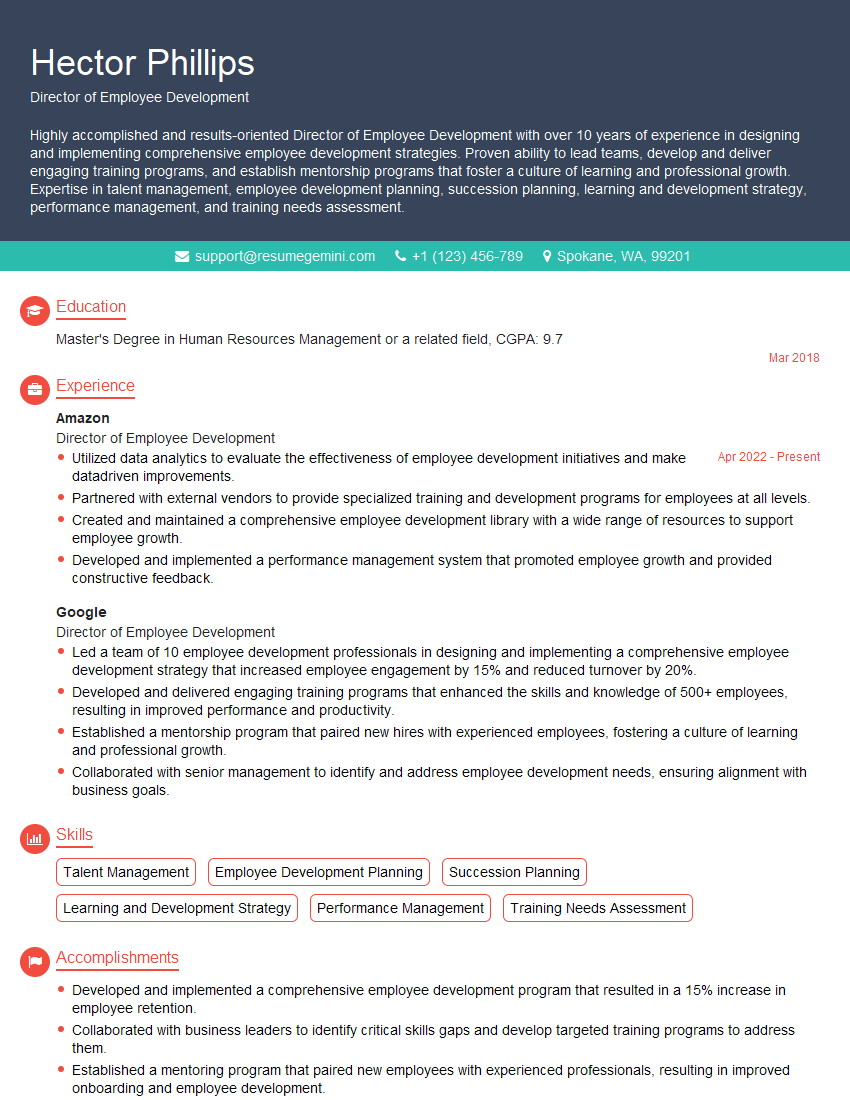
Ever felt underprepared for that crucial job interview? Or perhaps you’ve landed the interview but struggled to articulate your skills and experiences effectively? Fear not! We’ve got you covered. In this blog post, we’re diving deep into the Director of Employee Development interview questions that you’re most likely to encounter. But that’s not all. We’ll also provide expert insights into the key responsibilities of a Director of Employee Development so you can tailor your answers to impress potential employers.
Acing the interview is crucial, but landing one requires a compelling resume that gets you noticed. Crafting a professional document that highlights your skills and experience is the first step toward interview success. ResumeGemini can help you build a standout resume that gets you called in for that dream job.






Essential Interview Questions For Director of Employee Development
1. What are the key responsibilities of a Director of Employee Development?
As a Director of Employee Development, my primary responsibilities include:
- Leading the development and implementation of employee training and development programs
- Assessing training needs and identifying opportunities for employee growth
- Collaborating with senior leadership to align employee development initiatives with business goals
- Evaluating the effectiveness of training programs and making data-driven recommendations for improvement
- Mentoring and coaching employees to support their professional development
2. How do you assess training needs within an organization?
Conducting Needs Assessments
- Conducting surveys and questionnaires to gather feedback from employees
- Reviewing performance evaluations and employee feedback
- Observing employees’ work and identifying areas for improvement
Leveraging Data and Analytics
- Analyzing data on employee performance, turnover, and customer satisfaction
- Identifying trends and patterns that indicate areas where training is needed
- Using learning management systems to track employee training progress and identify gaps
3. What techniques do you use to design and develop effective training programs?
I employ various techniques to design and develop engaging and effective training programs, including:
- Needs Assessment: Conducting thorough assessments to identify specific training requirements
- Learning Objectives: Clearly defining learning objectives to guide the development of training content
- Varied Training Methods: Utilizing a mix of training methods such as lectures, simulations, and hands-on exercises
- Active Learning: Encouraging active participation and engagement through discussions, case studies, and role-playing
- Technology Integration: Incorporating technology into training programs to enhance interactivity and accessibility
4. How do you measure the effectiveness of employee development initiatives?
I employ a multi-faceted approach to measure the effectiveness of employee development initiatives:
- Participant Feedback: Gathering feedback through surveys and evaluations to assess the participants’ satisfaction and learning outcomes
- Performance Improvement: Tracking employee performance before and after training to identify improvements in skills, knowledge, and on-the-job performance
- Business Impact: Evaluating the impact of training programs on organizational metrics such as productivity, customer satisfaction, and profitability
- Stakeholder Interviews: Interviewing managers and stakeholders to gather their insights on the effectiveness of training initiatives
- Return on Investment: Analyzing the cost of training programs and comparing it to the benefits gained in terms of improved performance and business outcomes
5. What are the current trends in employee development?
The current trends in employee development include:
- Personalized Learning: Tailoring training programs to individual employee needs and career goals
- Technology-Enabled Learning: Leveraging technology to deliver immersive and accessible training experiences
- Continuous Learning: Promoting a culture of ongoing learning and development throughout an employee’s career
- Data-Driven Decision-Making: Using data and analytics to inform training decisions and measure program effectiveness
- Social and Collaborative Learning: Encouraging collaboration and peer-to-peer learning through social media platforms and online communities
6. How do you stay up-to-date on the latest employee development best practices?
I stay up-to-date on the latest employee development best practices through:
- Professional Development: Attending conferences, workshops, and webinars to enhance my knowledge and skills
- Research and Reading: Reading industry publications, journals, and books to stay informed about emerging trends
- Networking: Connecting with other professionals in the field to share ideas and learn about innovative approaches
- Online Resources: Utilizing online platforms and websites to access thought leadership and best practices
- Mentorship: Seeking guidance and mentorship from experienced professionals in the field
7. What are the challenges you anticipate in the role of Director of Employee Development?
Some potential challenges I anticipate in the role include:
- Limited Resources: Balancing training needs with available resources and budget constraints
- Changing Business Environment: Adapting training programs to meet the evolving needs of the business and industry
- Employee Resistance to Change: Overcoming resistance and encouraging employee buy-in for training initiatives
- Measurement and Evaluation: Accurately measuring the effectiveness of training programs and demonstrating their impact on business outcomes
- Staying Ahead of Trends: Keeping up with rapid changes in technology and learning methodologies
8. What are your goals as the Director of Employee Development for this organization?
My goals as the Director of Employee Development for this organization are:
- Align Training with Business Objectives: Ensure that training programs are aligned with the strategic goals and priorities of the organization
- Foster a Culture of Continuous Learning: Create a culture where employees are encouraged and supported in their ongoing professional development
- Develop High-Performing Employees: Design and deliver training programs that enable employees to develop the skills and knowledge necessary for success
- Optimize Training Investment: Maximize the return on investment in employee development by ensuring that programs are cost-effective and produce tangible results
- Build a Strong Team: Lead and develop a team of talented and passionate professionals committed to employee growth and development
9. Tell me about a successful employee development initiative you implemented in a previous role.
In my previous role as Director of Employee Development at XYZ Company, I implemented a comprehensive employee development program that significantly improved employee performance and retention:
- Needs Assessment: Conducted a thorough needs assessment to identify specific skill gaps and training requirements
- Customized Training Programs: Developed a series of tailored training programs addressing the identified needs
- Blended Learning Approach: Utilized a blended learning approach combining online modules, instructor-led sessions, and on-the-job training
- Mentorship and Coaching: Provided mentorship and coaching opportunities to support employees in applying their newly acquired skills
- Results: The program resulted in a 15% increase in employee performance and a 20% reduction in employee turnover
10. Why are you the best candidate for this role?
I am confident that I am the best candidate for the role of Director of Employee Development due to my:
- Proven Track Record: Demonstrated success in leading employee development initiatives and achieving tangible results
- Strategic Mindset: Ability to align training programs with business objectives and drive organizational growth
- Expertise in Training Design and Delivery: Deep understanding of learning theories and experience in developing and delivering engaging training content
- Commitment to Employee Development: Passionate about empowering employees to reach their full potential and contribute to the organization’s success
- Strong Leadership and Communication Skills: Proven ability to lead and motivate a team, as well as effectively communicate with stakeholders at all levels
Interviewers often ask about specific skills and experiences. With ResumeGemini‘s customizable templates, you can tailor your resume to showcase the skills most relevant to the position, making a powerful first impression. Also check out Resume Template specially tailored for Director of Employee Development.
Career Expert Tips:
- Ace those interviews! Prepare effectively by reviewing the Top 50 Most Common Interview Questions on ResumeGemini.
- Navigate your job search with confidence! Explore a wide range of Career Tips on ResumeGemini. Learn about common challenges and recommendations to overcome them.
- Craft the perfect resume! Master the Art of Resume Writing with ResumeGemini’s guide. Showcase your unique qualifications and achievements effectively.
- Great Savings With New Year Deals and Discounts! In 2025, boost your job search and build your dream resume with ResumeGemini’s ATS optimized templates.
Researching the company and tailoring your answers is essential. Once you have a clear understanding of the Director of Employee Development‘s requirements, you can use ResumeGemini to adjust your resume to perfectly match the job description.
Key Job Responsibilities
The Director of Employee Development is responsible for leading the organization’s efforts to develop and implement employee development programs and initiatives. The key job responsibilities include:
1. Develop and implement a comprehensive employee development strategy
This includes identifying the organization’s employee development needs, developing and implementing employee development programs, and evaluating the effectiveness of those programs.
2. Create and deliver training and development programs
This includes developing and delivering training programs, workshops, and other learning opportunities for employees at all levels of the organization.
3. Provide career counseling and guidance to employees
This includes helping employees identify their career goals, develop career plans, and make career decisions.
4. Manage the employee development budget
This includes developing and managing the budget for employee development programs, including training, development, and career counseling.
Interview Tips
Here are some interview tips for a Director of Employee Development role:
1. Research the company and the role
Take some time to learn about the company’s culture, values, and goals. This will help you understand the company’s needs and how you can contribute to their success.
2. Prepare for behavioral questions
Behavioral questions are often used in interviews to assess your skills and experience. Be prepared to answer questions about your experience in employee development, training, and career counseling.
Example Outline:
a. Tell me about a time when you successfully developed and implemented an employee development program.
b. Describe a time when you provided career counseling to an employee.
3. Be enthusiastic and passionate about employee development
The Director of Employee Development should be someone who is passionate about helping employees learn and grow. Be sure to convey your enthusiasm for employee development during your interview.
4. Be prepared to talk about your experience with diversity and inclusion
Diversity and inclusion are important aspects of employee development. Be prepared to talk about your experience with diversity and inclusion, and how you would promote diversity and inclusion in the workplace.
Next Step:
Now that you’re armed with a solid understanding of what it takes to succeed as a Director of Employee Development, it’s time to turn that knowledge into action. Take a moment to revisit your resume, ensuring it highlights your relevant skills and experiences. Tailor it to reflect the insights you’ve gained from this blog and make it shine with your unique qualifications. Don’t wait for opportunities to come to you—start applying for Director of Employee Development positions today and take the first step towards your next career milestone. Your dream job is within reach, and with a polished resume and targeted applications, you’ll be well on your way to achieving your career goals! Build your resume now with ResumeGemini.