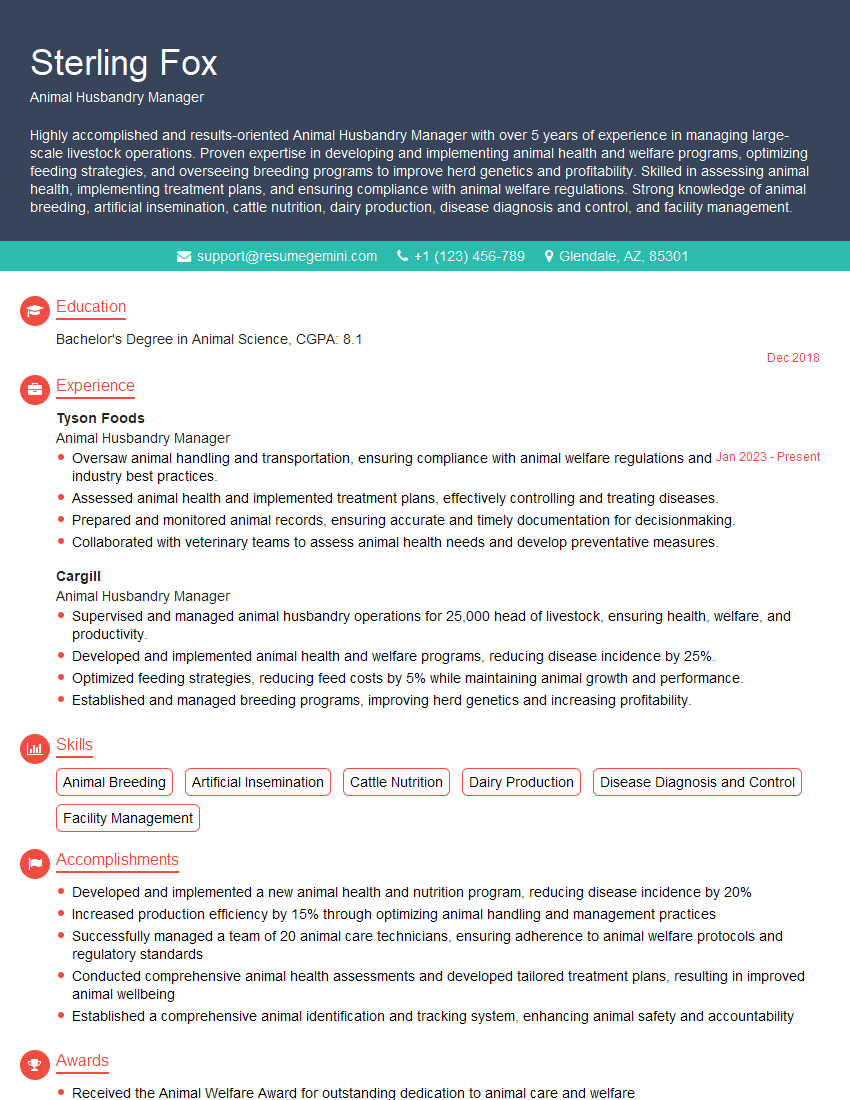
Feeling lost in a sea of interview questions? Landed that dream interview for Animal Husbandry Manager but worried you might not have the answers? You’re not alone! This blog is your guide for interview success. We’ll break down the most common Animal Husbandry Manager interview questions, providing insightful answers and tips to leave a lasting impression. Plus, we’ll delve into the key responsibilities of this exciting role, so you can walk into your interview feeling confident and prepared.
Acing the interview is crucial, but landing one requires a compelling resume that gets you noticed. Crafting a professional document that highlights your skills and experience is the first step toward interview success. ResumeGemini can help you build a standout resume that gets you called in for that dream job.






Essential Interview Questions For Animal Husbandry Manager
1. What are the key performance indicators (KPIs) you use to measure the success of an animal husbandry operation?
To provide a comprehensive answer, one could mention a variety of performance indicators, such as:
- Animal health and welfare indicators, including mortality rates, disease incidence, and body condition scores
- Production indicators, such as average daily gain, feed conversion ratio, and milk yield
- Financial indicators, such as profit margin, return on investment, and cost per unit of production
- Environmental indicators, such as manure management practices and water usage
2. Describe the different types of animal husbandry systems.
Intensive systems
- Characterized by high stocking densities and a high level of management
- Animals are typically housed in confinement, with limited access to outdoor space
- This system is often used for commercial production of animals for food
Extensive systems
- Characterized by low stocking densities and a low level of management
- Animals are typically able to roam freely on pasture or rangeland
- This system is often used for the production of animals for fiber or meat
Semi-intensive systems
- A combination of intensive and extensive systems
- Animals are typically housed in confinement for part of the year, and allowed to graze on pasture for the rest of the year
- This system is often used for the production of animals for both food and fiber
3. How do you develop and implement a breeding program for a livestock operation?
To answer this question, one could mention the following steps:
- Define the breeding goals
- Select the breeding stock
- Implement a breeding plan
- Monitor the breeding program and make adjustments as needed
4. What are the different types of animal feed and how do you determine the appropriate diet for a particular animal?
There are many different types of animal feed, each with its own unique nutritional profile. The appropriate diet for a particular animal will depend on its age, species, and production goals. Some common types of animal feed include:
- Forage (e.g., hay, silage, pasture)
- Concentrates (e.g., grains, oilseeds, protein supplements)
- Mineral and vitamin supplements
5. How do you manage animal health and welfare on a livestock operation?
To manage animal health and welfare, one could mention the following practices:
- Providing animals with a clean and comfortable environment
- Providing animals with a nutritious diet
- Implementing a vaccination program
- Monitoring animals for signs of disease
- Treating sick animals promptly
6. What are the different types of animal housing systems and how do you choose the appropriate system for a particular operation?
There are many different types of animal housing systems, each with its own advantages and disadvantages. The appropriate system for a particular operation will depend on factors such as the type of animal, the climate, and the available resources.
- Confinement housing
- Pasture-based housing
- Mixed housing systems
7. How do you manage animal waste on a livestock operation?
To manage animal waste, one could mention the following practices:
- Collecting the waste
- Storing the waste
- Treating the waste
- Applying the waste to land
8. What are the different types of animal identification systems and how do you choose the appropriate system for a particular operation?
There are many different types of animal identification systems, each with its own advantages and disadvantages. The appropriate system for a particular operation will depend on factors such as the type of animal, the size of the operation, and the level of security required.
- Ear tags
- Cattle tags
- RFID tags
9. How do you market livestock and livestock products?
To market livestock and livestock products, one could mention the following strategies:
- Developing a marketing plan
- Identifying target markets
- Developing marketing materials
- Promoting products and services
- Building relationships with customers
10. What are the challenges facing the animal husbandry industry and how do you propose to address them?
Some of the challenges facing the animal husbandry industry include:
- Increasing demand for food
- Climate change
- Disease outbreaks
- Antibiotic resistance
To address these challenges, one could propose the following solutions:
- Investing in research and development
- Improving animal health and welfare
- Protecting the environment
- Educating consumers
Interviewers often ask about specific skills and experiences. With ResumeGemini‘s customizable templates, you can tailor your resume to showcase the skills most relevant to the position, making a powerful first impression. Also check out Resume Template specially tailored for Animal Husbandry Manager.
Career Expert Tips:
- Ace those interviews! Prepare effectively by reviewing the Top 50 Most Common Interview Questions on ResumeGemini.
- Navigate your job search with confidence! Explore a wide range of Career Tips on ResumeGemini. Learn about common challenges and recommendations to overcome them.
- Craft the perfect resume! Master the Art of Resume Writing with ResumeGemini’s guide. Showcase your unique qualifications and achievements effectively.
- Great Savings With New Year Deals and Discounts! In 2025, boost your job search and build your dream resume with ResumeGemini’s ATS optimized templates.
Researching the company and tailoring your answers is essential. Once you have a clear understanding of the Animal Husbandry Manager‘s requirements, you can use ResumeGemini to adjust your resume to perfectly match the job description.
Key Job Responsibilities
The Animal Husbandry Manager is responsible for the overall management of the animal husbandry program. This includes planning, organizing, directing, and controlling the activities of the animal husbandry department. The manager is also responsible for the health, safety, and welfare of the animals in the program.
1. Planning and Organizing
The manager is responsible for developing and implementing a comprehensive animal husbandry plan. This plan should include goals, objectives, and strategies for achieving the desired outcomes. The manager must also organize the department’s resources to ensure that the plan is implemented effectively.
- Develop and implement a comprehensive animal husbandry plan.
- Organize the department’s resources to ensure that the plan is implemented effectively.
2. Directing and Controlling
The manager is responsible for directing and controlling the activities of the animal husbandry department. This includes supervising staff, assigning tasks, and ensuring that the department’s goals and objectives are met.
- Supervise staff and assign tasks.
- Ensure that the department’s goals and objectives are met.
3. Health, Safety, and Welfare
The manager is responsible for the health, safety, and welfare of the animals in the program. This includes providing proper nutrition, housing, and veterinary care. The manager must also ensure that the animals are handled humanely and that the department is in compliance with all applicable laws and regulations.
- Provide proper nutrition, housing, and veterinary care for the animals.
- Ensure that the animals are handled humanely.
- Ensure that the department is in compliance with all applicable laws and regulations.
4. Other Responsibilities
The manager may also be responsible for other tasks, such as budgeting, marketing, and public relations. The specific responsibilities of the manager will vary depending on the size and scope of the animal husbandry program.
- Budgeting
- Marketing
- Public relations
Interview Tips
Preparing for an interview for an Animal Husbandry Manager position can be a daunting task. However, by taking the time to prepare, you can increase your chances of success. Here are a few tips to help you ace your interview:
1. Research the Company
Before you go on your interview, take some time to research the company. This will help you learn about the company’s culture, values, and goals. You should also research the specific position you are applying for. This will help you understand the role and responsibilities of the position.
- Visit the company’s website.
- Read the company’s annual report.
- Talk to people who work at the company.
2. Practice Your Answers
Once you have researched the company, you should practice your answers to common interview questions. This will help you feel more confident and prepared during your interview. Some common interview questions include:
- Tell me about yourself.
- Why are you interested in this position?
- What are your strengths and weaknesses?
- What are your goals for the future?
3. Dress Professionally
First impressions matter, so it is important to dress professionally for your interview. This means wearing a suit or dress pants and a button-down shirt. You should also make sure your shoes are clean and polished.
4. Be Yourself
The most important thing is to be yourself during your interview. The interviewer wants to get to know the real you, so don’t try to be someone you’re not. Be honest and genuine, and let your personality shine through.
Next Step:
Armed with this knowledge, you’re now well-equipped to tackle the Animal Husbandry Manager interview with confidence. Remember, preparation is key. So, start crafting your resume, highlighting your relevant skills and experiences. Don’t be afraid to tailor your application to each specific job posting. With the right approach and a bit of practice, you’ll be well on your way to landing your dream job. Build your resume now from scratch or optimize your existing resume with ResumeGemini. Wish you luck in your career journey!