Are you gearing up for a career shift or aiming to ace your next interview? Look no further! We’ve curated a comprehensive guide to help you crack the interview for the coveted Exhibitor position. From understanding the key responsibilities to mastering the most commonly asked questions, this blog has you covered. So, buckle up and let’s embark on this journey together
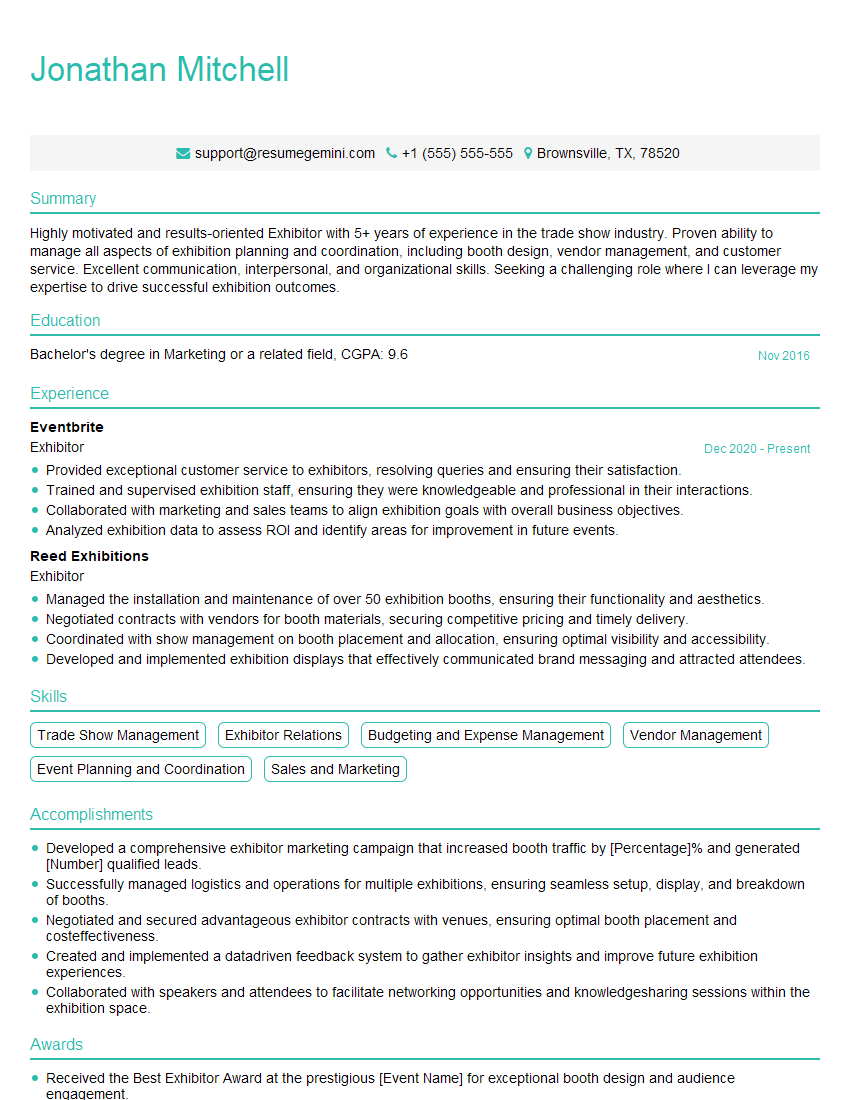
Acing the interview is crucial, but landing one requires a compelling resume that gets you noticed. Crafting a professional document that highlights your skills and experience is the first step toward interview success. ResumeGemini can help you build a standout resume that gets you called in for that dream job.






Essential Interview Questions For Exhibitor
1. Describe the key responsibilities of an Exhibitor at a trade show.
As an Exhibitor, my primary responsibilities at a trade show would include:
- Representing my company and its products or services to potential customers and industry professionals.
- Engaging with attendees, answering their questions, and providing them with valuable information.
- Generating leads and building relationships with prospective clients.
- Monitoring booth traffic, analyzing attendee data, and reporting on show results.
- Collaborating with other members of the exhibiting team to ensure a successful show experience.
2. How do you plan and execute a successful trade show booth?
Planning
- Establish clear goals and objectives for the trade show.
- Research the target audience and tailor the booth design and messaging accordingly.
- Plan the booth layout, including interactive elements and product displays.
- Order necessary equipment, materials, and giveaways.
- Train and prepare the booth staff on product knowledge and sales techniques.
Execution
- Set up the booth professionally and on time.
- Greet attendees warmly and engage them in conversations.
- Demonstrate products or services and answer questions effectively.
- Collect lead information and follow up promptly after the show.
- Monitor booth traffic and adjust strategies as needed.
3. How do you handle difficult or uninterested attendees?
When encountering difficult or uninterested attendees, I would employ the following strategies:
- Stay calm and respectful: Even if the attendee is rude or disengaged, it’s important to maintain a professional demeanor.
- Listen attentively: Allow the attendee to express their concerns or disinterest without interrupting.
- Reframe the conversation: Try to find common ground or alternative ways to engage them.
- Offer value: Provide helpful information or insights that could pique their interest.
- Respect their decision: If the attendee remains uninterested, politely thank them for their time and wish them well.
4. How do you measure the success of a trade show exhibition?
To measure the success of a trade show exhibition, I would use the following metrics:
- Lead generation: The number and quality of leads generated.
- Booth traffic: The total number of attendees who visited the booth.
- Sales: The amount of revenue generated at the show.
- Brand awareness: The increase in brand recognition and visibility.
- Customer feedback: The number of positive interactions and testimonials received.
5. Describe the latest trends in trade show exhibitions.
The latest trends in trade show exhibitions include:
- Interactive and immersive experiences: Booths that offer interactive games, VR demonstrations, or personalized experiences.
- Data and analytics: Using technology to track booth traffic, collect lead information, and analyze show results.
- Sustainability: Emphasizing environmentally friendly practices and sustainable booth materials.
- Virtual and hybrid events: Embracing a combination of physical and virtual exhibits to reach a wider audience.
- Personalization: Tailoring booth experiences and messaging to specific attendee segments.
6. How do you stay up-to-date on industry trends and best practices?
To stay up-to-date on industry trends and best practices, I would:
- Attend industry conferences and workshops.
- Read industry publications and blogs.
- Network with other professionals in the field.
- Participate in online forums and discussions.
- Research case studies and success stories.
7. What software or tools do you use to manage trade show exhibitions?
I am proficient in using a variety of software and tools to manage trade show exhibitions, including:
- CRM systems: Salesforce, HubSpot
- Lead generation tools: Leadpages, Marketo
- Analytics dashboards: Google Analytics, Tableau
- Booth design software: AutoCAD, SketchUp
- Social media management tools: Hootsuite, Buffer
8. How do you handle booth setup and breakdown?
For booth setup, I would:
- Arrive at the venue well in advance.
- Unpack and assemble all booth materials.
- Set up displays, lighting, and equipment.
- Ensure that all materials are secure and in place.
For booth breakdown, I would:
- Pack up all materials and displays carefully.
- Clean the booth area.
- Return rented equipment and materials.
- Leave the booth in a clean and orderly condition.
9. What are your strengths and weaknesses as an Exhibitor?
My strengths as an Exhibitor include:
- Excellent communication and interpersonal skills.
- Strong product knowledge and ability to answer questions effectively.
- Proven ability to generate leads and close sales.
- Experience in managing booth setup, breakdown, and logistics.
- Ability to work independently and as part of a team.
My weaknesses include:
- Lack of experience in managing large-scale exhibitions.
- Some unfamiliarity with the latest exhibition technologies.
10. Why are you interested in this particular Exhibitor role?
I am interested in this particular Exhibitor role because:
- I am passionate about trade shows and the opportunity to represent companies and their products.
- I believe my skills and experience in sales, marketing, and event management make me an ideal candidate for this role.
- I am eager to learn from industry experts and contribute to the success of your team.
- I am confident that I can leverage my strengths to generate leads, build relationships, and make a significant impact at your trade shows.
Interviewers often ask about specific skills and experiences. With ResumeGemini‘s customizable templates, you can tailor your resume to showcase the skills most relevant to the position, making a powerful first impression. Also check out Resume Template specially tailored for Exhibitor.
Career Expert Tips:
- Ace those interviews! Prepare effectively by reviewing the Top 50 Most Common Interview Questions on ResumeGemini.
- Navigate your job search with confidence! Explore a wide range of Career Tips on ResumeGemini. Learn about common challenges and recommendations to overcome them.
- Craft the perfect resume! Master the Art of Resume Writing with ResumeGemini’s guide. Showcase your unique qualifications and achievements effectively.
- Great Savings With New Year Deals and Discounts! In 2025, boost your job search and build your dream resume with ResumeGemini’s ATS optimized templates.
Researching the company and tailoring your answers is essential. Once you have a clear understanding of the Exhibitor‘s requirements, you can use ResumeGemini to adjust your resume to perfectly match the job description.
Key Job Responsibilities
An Exhibitor is a professional responsible for representing and promoting a company or organization at trade shows and exhibitions. Their primary objective is to attract potential customers, generate leads, and enhance the company’s brand image. Key job responsibilities include:
1. Trade Show Planning and Preparation
Exhibitors work closely with event organizers to plan and prepare for trade shows. They determine booth size and location, design and order exhibit materials, and coordinate logistics, such as shipping and setup.
2. Booth Management
During the show, Exhibitors are responsible for managing the company’s booth. They greet attendees, provide product demonstrations, answer questions, and gather lead information. They also ensure that the booth is well-maintained and stocked with marketing materials.
3. Lead Generation and Qualification
Exhibitors play a crucial role in lead generation and qualification. They engage with attendees, identify potential customers, and collect contact information. Exhibitors then qualify these leads by assessing their needs and determining whether they align with the company’s products or services.
4. Relationship Building
Exhibitions provide an excellent opportunity to build relationships with potential customers, industry peers, and partners. Exhibitors nurture these relationships through networking, attending industry events, and providing ongoing support.
5. Brand Advocacy
Exhibitors serve as brand ambassadors for their company. They represent the company’s values, products, and services to attendees. They are passionate about the company and enthusiastically promote its offerings.
Interview Tips
Preparing for an Exhibitor interview requires understanding the role’s responsibilities and highlighting your relevant skills. Here are some interview tips to help you ace the interview:
1. Research the Company and Industry
Before the interview, thoroughly research the company you’re applying to and the industry in which they operate. This will demonstrate your interest in the position and understanding of the market.
2. Practice Your Pitch
As an Exhibitor, your ability to engage and inform potential customers is crucial. Practice delivering a brief and compelling pitch that highlights your key selling points and value proposition.
3. Highlight Your Sales and Marketing Skills
Exhibitors must possess strong sales and marketing skills. Emphasize your experience in lead generation, customer relationship management, and audience engagement.
4. Showcase Your Event Experience
If you have previous experience in event planning or management, highlight it during the interview. Exhibitors need to manage booth logistics, interact with attendees, and coordinate event details.
5. Prepare Questions for the Interviewer
Asking thoughtful questions shows your interest and engagement. Prepare questions about the company’s trade show strategy, target audience, and expectations for the role.
Next Step:
Armed with this knowledge, you’re now well-equipped to tackle the Exhibitor interview with confidence. Remember, preparation is key. So, start crafting your resume, highlighting your relevant skills and experiences. Don’t be afraid to tailor your application to each specific job posting. With the right approach and a bit of practice, you’ll be well on your way to landing your dream job. Build your resume now from scratch or optimize your existing resume with ResumeGemini. Wish you luck in your career journey!