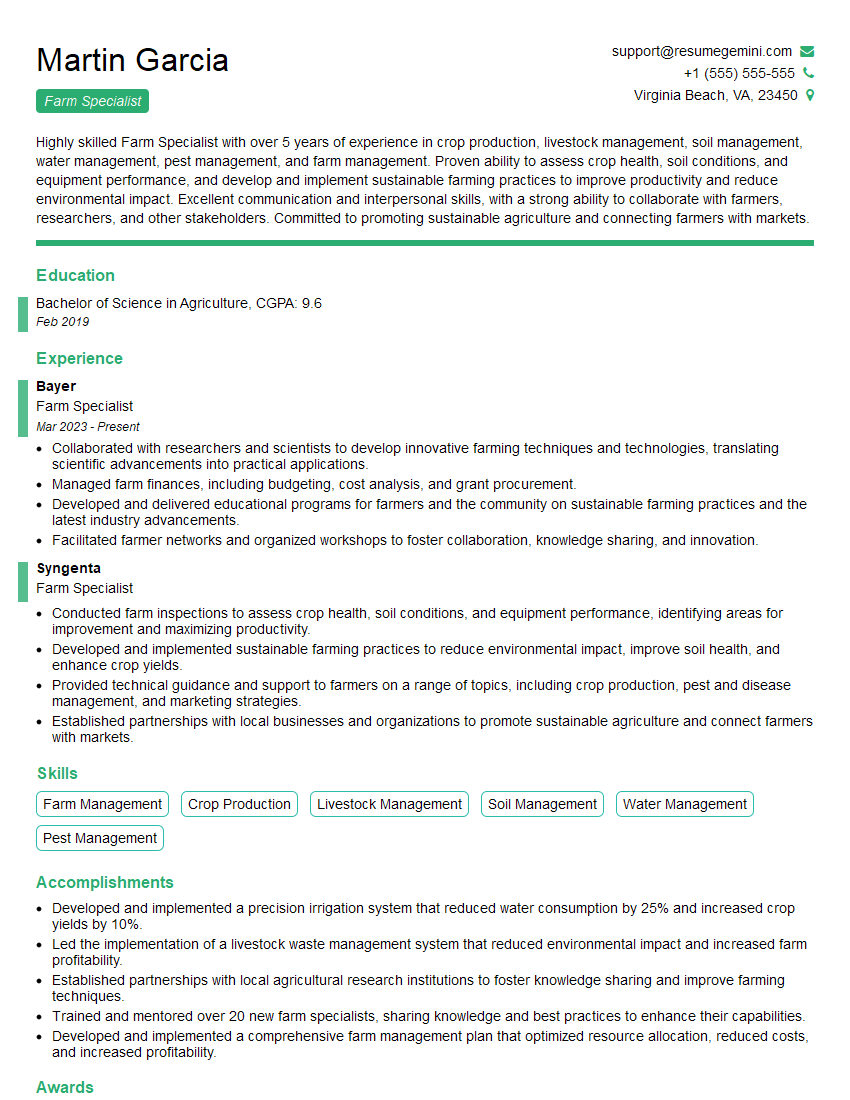
Are you gearing up for a career shift or aiming to ace your next interview? Look no further! We’ve curated a comprehensive guide to help you crack the interview for the coveted Farm Specialist position. From understanding the key responsibilities to mastering the most commonly asked questions, this blog has you covered. So, buckle up and let’s embark on this journey together
Acing the interview is crucial, but landing one requires a compelling resume that gets you noticed. Crafting a professional document that highlights your skills and experience is the first step toward interview success. ResumeGemini can help you build a standout resume that gets you called in for that dream job.






Essential Interview Questions For Farm Specialist
1. Describe the key factors you consider when developing a crop production plan for a large-scale farm?
When developing a crop production plan for a large-scale farm, I consider the following key factors:
- Climate and soil conditions: These factors determine the types of crops that can be grown and the yields that can be expected.
- Market demand: I research market trends to identify crops that are in high demand and will generate a profit.
- Crop rotation: I plan crop rotations to maintain soil health, reduce pests and diseases, and increase yields.
- Water availability: I assess the availability of water for irrigation and develop plans to conserve water.
- Labor and equipment needs: I determine the labor and equipment requirements for each crop and develop a plan to meet those needs.
2. Explain the process of implementing precision agriculture technologies on a farm.
Implementing precision agriculture technologies on a farm involves the following steps:
Data collection:
- Collect data on soil conditions, crop health, and yields using sensors, drones, and other tools.
Data analysis:
- Analyze the collected data to identify areas of improvement and make informed decisions.
Variable rate application:
- Use precision equipment to apply inputs (e.g., fertilizers, pesticides) at variable rates based on the data collected.
Monitoring and evaluation:
- Continuously monitor the results of precision agriculture practices and make adjustments as needed.
3. How do you approach pest and disease management in an integrated manner?
I approach pest and disease management in an integrated manner by combining multiple strategies to minimize their impact on crop production:
- Cultural practices: Implement cultural practices that make the farm less favorable to pests and diseases, such as crop rotation, sanitation, and planting resistant varieties.
- Biological control: Introduce natural enemies (e.g., predators, parasites) to control pests.
- Chemical control: Use pesticides judiciously and only when necessary to control pests and diseases.
- Monitoring and scouting: Regularly monitor crops for pests and diseases and take early action when necessary.
4. Describe your experience in managing soil health and fertility.
I have extensive experience in managing soil health and fertility through the following practices:
- Soil testing: Conduct regular soil tests to monitor soil pH, nutrient levels, and organic matter content.
- Crop rotation: Implement crop rotations that include legumes and cover crops to improve soil health and reduce nutrient depletion.
- Cover cropping: Plant cover crops to protect the soil from erosion, add organic matter, and suppress weeds.
- Organic matter management: Incorporate organic matter into the soil through compost, manure, or crop residues to improve soil structure and fertility.
5. Explain how you use technology to improve farm efficiency and productivity.
I leverage technology to improve farm efficiency and productivity in the following ways:
- Data collection and analysis: Use sensors, drones, and other tools to collect data on crop health, soil conditions, and yields. Analyze this data to identify areas for improvement.
- Precision agriculture: Implement precision agriculture practices such as variable rate application and GPS-guided equipment to optimize input use and increase yields.
- Farm management software: Use farm management software to track expenses, manage inventory, and monitor crop progress.
- Automation: Implement automated systems for tasks such as irrigation, feeding, and milking to reduce labor costs and improve efficiency.
6. Describe your approach to managing livestock nutrition and health.
I manage livestock nutrition and health through the following practices:
- Feed ration formulation: Develop balanced feed rations that meet the nutritional requirements of each livestock class.
- Feed quality control: Monitor feed quality and ensure that livestock are consuming safe and nutritious feed.
- Health management: Implement a comprehensive health management program that includes vaccinations, parasite control, and disease prevention measures.
- Animal welfare: Provide adequate housing, nutrition, and care to ensure the well-being of livestock.
7. Explain how you ensure the safety and quality of agricultural products.
I ensure the safety and quality of agricultural products through the following practices:
- Good agricultural practices (GAPs): Implement GAPs throughout the production process to minimize food safety risks.
- Traceability: Establish a traceability system to track products from farm to fork.
- Quality control: Conduct regular quality checks on agricultural products to ensure they meet safety and quality standards.
- Compliance with regulations: Comply with all applicable food safety regulations and standards.
8. Describe your experience in managing a team of farm workers.
I have extensive experience in managing a team of farm workers through the following strategies:
- Effective communication: Establish clear communication channels and provide regular updates to team members.
- Training and development: Provide training and development opportunities to enhance team members’ skills and knowledge.
- Motivation and recognition: Motivate team members by recognizing their contributions and providing opportunities for advancement.
- Teamwork and collaboration: Foster a collaborative work environment where team members support each other and work towards common goals.
9. Explain how you stay up-to-date with advancements in agricultural technology and best practices.
I stay up-to-date with advancements in agricultural technology and best practices through the following strategies:
- Industry conferences and workshops: Attend industry conferences and workshops to learn about new technologies and best practices.
- Research and development: Engage in research and development activities to explore innovative solutions.
- Collaboration with experts: Network with experts in the field to exchange knowledge and learn about emerging trends.
- Trade publications and online resources: Read trade publications and access online resources to stay informed about the latest advancements.
10. Describe your approach to sustainability in agricultural management.
I approach sustainability in agricultural management through the following strategies:
- Environmental stewardship: Implement practices that protect and enhance the environment, such as soil conservation, water management, and biodiversity conservation.
- Economic viability: Ensure that agricultural practices are economically sustainable and provide a fair return to farmers.
- Social responsibility: Promote social responsibility by providing safe and healthy working conditions for farm workers and contributing to the local community.
Interviewers often ask about specific skills and experiences. With ResumeGemini‘s customizable templates, you can tailor your resume to showcase the skills most relevant to the position, making a powerful first impression. Also check out Resume Template specially tailored for Farm Specialist.
Career Expert Tips:
- Ace those interviews! Prepare effectively by reviewing the Top 50 Most Common Interview Questions on ResumeGemini.
- Navigate your job search with confidence! Explore a wide range of Career Tips on ResumeGemini. Learn about common challenges and recommendations to overcome them.
- Craft the perfect resume! Master the Art of Resume Writing with ResumeGemini’s guide. Showcase your unique qualifications and achievements effectively.
- Great Savings With New Year Deals and Discounts! In 2025, boost your job search and build your dream resume with ResumeGemini’s ATS optimized templates.
Researching the company and tailoring your answers is essential. Once you have a clear understanding of the Farm Specialist‘s requirements, you can use ResumeGemini to adjust your resume to perfectly match the job description.
Key Job Responsibilities
Farm Specialists serve as vital resources for farmers, providing them with expert advice and support to help improve their agricultural operations.
1. Provide Technical Assistance
Farm Specialists provide farmers with up-to-date information on the latest farming techniques, best practices, and advancements in agricultural technology. They conduct on-farm visits to assess farmers’ needs, identify opportunities for improvement, and develop customized solutions.
- Conduct soil and tissue testing to determine nutrient needs
- Develop and implement crop production plans
2. Manage and Conduct Research Trials
Farm Specialists design and conduct research trials to evaluate new farming methods, products, and technologies. They collect and analyze data to determine their effectiveness and potential benefits to farmers.
- Design and conduct field experiments
- Collect and analyze data to evaluate results
- Disseminate research findings to farmers and other stakeholders
3. Provide Education and Outreach
Farm Specialists provide educational programs, workshops, and other outreach activities to help farmers adopt best practices. They develop and distribute educational materials, organize field days and tours, and participate in community events.
- Develop and deliver training programs
- Organize field days and demonstrations
- Communicate with farmers through newsletters, social media, and other channels
4. Support Policy Development
Farm Specialists provide input to policymakers on issues related to agriculture. They conduct research, analyze data, and make recommendations based on their expertise. They also participate in legislative and regulatory processes to ensure that the needs of farmers are considered.
- Conduct research and analysis on agricultural issues
- Develop and communicate policy recommendations
- Participate in legislative and regulatory processes
Interview Tips
Preparing for a Farm Specialist interview requires a combination of technical knowledge, research, and interview skills. Here are some tips to help candidates ace the interview:
1. Research the Organization and Position
Before the interview, thoroughly research the organization you are applying to and the specific Farm Specialist position. Understand their mission, values, and current projects. This knowledge will demonstrate your interest and enthusiasm for the role.
- Visit the organization’s website and social media pages
- Review their annual reports and other publications
- Network with people who work at the organization or have knowledge of the position
2. Highlight Your Technical Expertise
Farm Specialists are expected to have a strong foundation in agricultural sciences. During the interview, emphasize your knowledge of crop production, soil management, animal husbandry, and agricultural technology. Provide specific examples of your experience and accomplishments.
- Quantify your accomplishments using specific metrics
- Describe your experience with different farming systems and technologies
- Share your knowledge of best practices and innovative approaches
3. Showcase Your Communication and Interpersonal Skills
Farm Specialists interact with a diverse group of stakeholders, including farmers, researchers, policymakers, and the general public. Strong communication and interpersonal skills are essential. In the interview, demonstrate your ability to clearly articulate complex technical information, actively listen to others, and build rapport.
- Use clear and concise language
- Be patient and respectful when communicating with farmers
- Show empathy and understanding for the challenges faced by farmers
4. Emphasize Your Passion for Agriculture
Farm Specialists are driven by a passion for agriculture and a desire to make a positive impact on the industry. During the interview, express your enthusiasm for the field and your commitment to supporting farmers. Share examples of your involvement in agricultural organizations or initiatives, and explain how your values align with the mission of the organization.
- Describe your experiences in agricultural clubs or organizations
- Share examples of how you have supported farmers in the past
- Explain how your personal values align with the organization’s mission
Next Step:
Armed with this knowledge, you’re now well-equipped to tackle the Farm Specialist interview with confidence. Remember, preparation is key. So, start crafting your resume, highlighting your relevant skills and experiences. Don’t be afraid to tailor your application to each specific job posting. With the right approach and a bit of practice, you’ll be well on your way to landing your dream job. Build your resume now from scratch or optimize your existing resume with ResumeGemini. Wish you luck in your career journey!