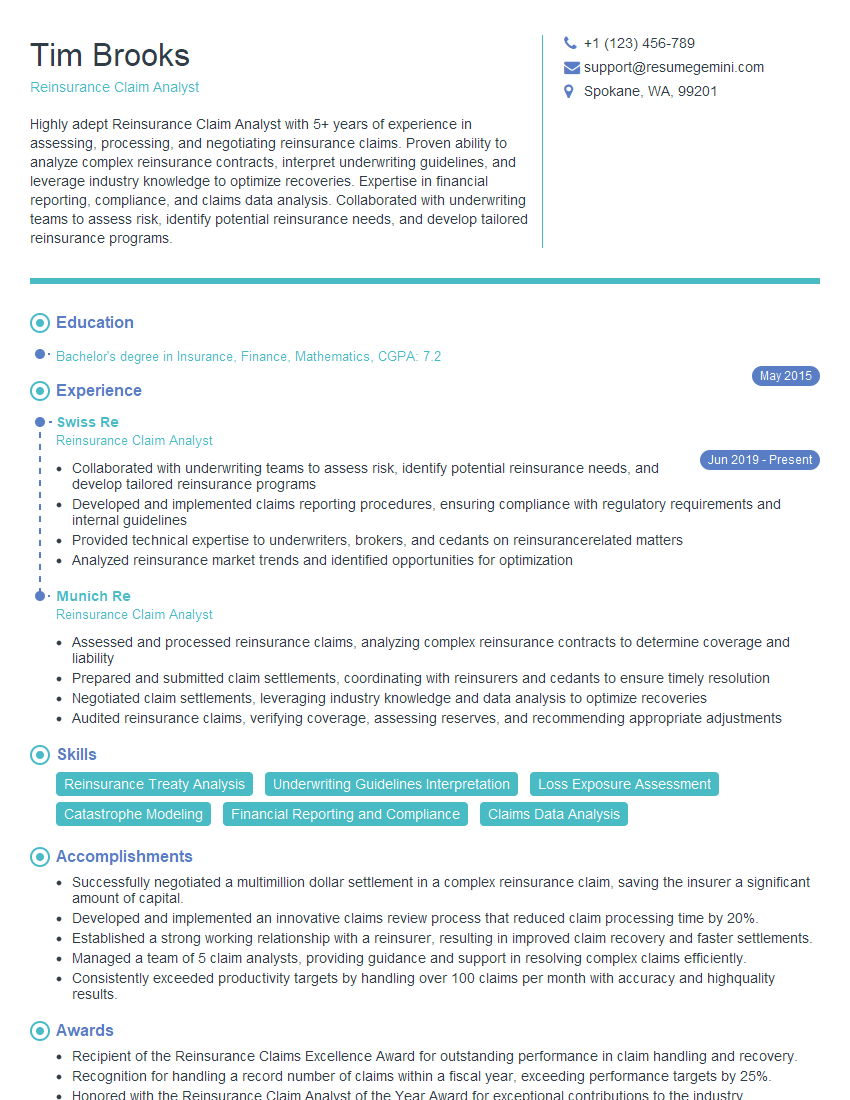
Ever felt underprepared for that crucial job interview? Or perhaps you’ve landed the interview but struggled to articulate your skills and experiences effectively? Fear not! We’ve got you covered. In this blog post, we’re diving deep into the Reinsurance Claim Analyst interview questions that you’re most likely to encounter. But that’s not all. We’ll also provide expert insights into the key responsibilities of a Reinsurance Claim Analyst so you can tailor your answers to impress potential employers.
Acing the interview is crucial, but landing one requires a compelling resume that gets you noticed. Crafting a professional document that highlights your skills and experience is the first step toward interview success. ResumeGemini can help you build a standout resume that gets you called in for that dream job.






Essential Interview Questions For Reinsurance Claim Analyst
1. What are the key elements of a reinsurance contract?
A reinsurance contract is a legal agreement between a reinsurer and a ceding insurer, in which the reinsurer agrees to share the risk of a loss with the ceding insurer.
- The subject matter of the insurance: This is the risk or peril that is being insured.
- The amount of coverage: This is the maximum amount that the reinsurer will pay in the event of a loss.
- The premium: This is the amount that the ceding insurer pays to the reinsurer for the coverage.
- The deductible: This is the amount that the ceding insurer must pay before the reinsurer will begin to pay.
- The coinsurance: This is the percentage of the loss that the ceding insurer must pay before the reinsurer will begin to pay.
- The term: This is the length of time that the reinsurance contract will be in effect.
2. What are the different types of reinsurance contracts?
Proportional Reinsurance
- Quota Share Treaty: The reinsurer assumes a certain percentage of all premiums and losses incurred by the ceding insurer.
- Surplus Share Treaty: The reinsurer assumes a certain percentage of all premiums and losses incurred by the ceding insurer that exceed a specified amount.
Non-Proportional Reinsurance
- Excess of Loss Treaty: The reinsurer assumes the losses that exceed a certain amount, known as the attachment point.
- Stop Loss Treaty: The reinsurer assumes the losses that exceed a certain amount, known as the retention limit.
- Catastrophe Treaty: The reinsurer assumes the losses that exceed a certain amount, known as the catastrophe limit.
3. What are the advantages and disadvantages of reinsurance?
Advantages
- Spreads risk: Reinsurance allows the ceding insurer to spread the risk of a loss across multiple reinsurers.
- Provides capacity: Reinsurance can provide the ceding insurer with additional capacity to write more business.
- Improves financial stability: Reinsurance can help the ceding insurer to improve its financial stability by providing a source of funds to cover claims.
- Access to expertise: Reinsurance can give the ceding insurer access to the expertise of the reinsurer in underwriting and claims handling.
Disadvantages
- Cost: Reinsurance can be expensive, as the ceding insurer must pay a premium to the reinsurer.
- Loss of control: Reinsurance can lead to the ceding insurer losing some control over its underwriting and claims handling.
- Complexity: Reinsurance contracts can be complex and difficult to understand.
4. What are the key factors to consider when evaluating a reinsurance contract?
- The financial strength of the reinsurer.
- The terms and conditions of the reinsurance contract.
- The cost of the reinsurance.
- The impact of the reinsurance on the ceding insurer’s financial stability.
5. How do you calculate the premium for a reinsurance contract?
The premium for a reinsurance contract is calculated using a variety of factors, including the following:
- The type of reinsurance contract.
- The amount of coverage.
- The risk profile of the ceding insurer.
- The financial strength of the reinsurer.
6. How do you assess the financial strength of a reinsurer?
To assess the financial strength of a reinsurer, you should consider the following factors:
- The reinsurer’s financial statements.
- The reinsurer’s credit rating.
- The reinsurer’s history of claims payments.
- The reinsurer’s regulatory compliance.
7. What are the different types of reinsurance claims?
- Loss claims: These are claims for losses that have already occurred.
- Loss adjustment expenses (LAE) claims: These are claims for expenses that are incurred in adjusting and settling claims.
- Retrospective premium claims: These are claims for additional premiums that are due to the reinsurer based on the actual loss experience of the ceding insurer.
- Unearned premium claims: These are claims for premiums that have been paid but not yet earned.
8. What are the steps involved in the reinsurance claims process?
- The ceding insurer notifies the reinsurer of the claim.
- The reinsurer investigates the claim.
- The reinsurer adjusts the claim and agrees to pay a certain amount to the ceding insurer.
- The reinsurer pays the claim to the ceding insurer.
9. What are the most common disputes that arise in the reinsurance claims process?
- Coverage disputes: These disputes arise over whether the claim is covered under the reinsurance contract.
- Amount of loss disputes: These disputes arise over the amount of the loss that is payable under the reinsurance contract.
- Payment disputes: These disputes arise over the timing and method of payment of the claim.
10. How do you resolve disputes in the reinsurance claims process?
Disputes in the reinsurance claims process can be resolved through negotiation, mediation, or arbitration.
- Negotiation: This is the most common method of resolving disputes. In negotiation, the parties involved in the dispute try to reach an agreement on their own.
- Mediation: This is a process in which a neutral third party helps the parties involved in the dispute to reach an agreement.
- Arbitration: This is a process in which a neutral third party makes a binding decision on the dispute.
Interviewers often ask about specific skills and experiences. With ResumeGemini‘s customizable templates, you can tailor your resume to showcase the skills most relevant to the position, making a powerful first impression. Also check out Resume Template specially tailored for Reinsurance Claim Analyst.
Career Expert Tips:
- Ace those interviews! Prepare effectively by reviewing the Top 50 Most Common Interview Questions on ResumeGemini.
- Navigate your job search with confidence! Explore a wide range of Career Tips on ResumeGemini. Learn about common challenges and recommendations to overcome them.
- Craft the perfect resume! Master the Art of Resume Writing with ResumeGemini’s guide. Showcase your unique qualifications and achievements effectively.
- Great Savings With New Year Deals and Discounts! In 2025, boost your job search and build your dream resume with ResumeGemini’s ATS optimized templates.
Researching the company and tailoring your answers is essential. Once you have a clear understanding of the Reinsurance Claim Analyst‘s requirements, you can use ResumeGemini to adjust your resume to perfectly match the job description.
Key Job Responsibilities
Reinsurance Claim Analyst is a critical role within the insurance industry, supporting the analysis of reinsurance claims for various types of losses and coverages. Here’s a breakdown of the key responsibilities associated with this position:
1. Claim Evaluation and Analysis
Evaluate and assess reinsurance claims submitted by policyholders, interpreting the provisions of reinsurance contracts and coverage.
- Determine the validity and scope of claims, ensuring accuracy and compliance with contractual obligations.
- Analyze claim documentation, including loss reports, financial statements, and other relevant materials.
2. Claim Resolution and Negotiation
Negotiate and settle reinsurance claims with ceding companies, presenting technical expertise and defending the reinsurer’s position.
- Calculate claim reserves and make recommendations on claim payments, considering reinsurance agreements and coverage limits.
- Proactively resolve disputes and maintain positive relationships with ceding companies.
3. Coverage Interpretation and Risk Assessment
Interpret reinsurance contracts to provide guidance on coverage and claim handling, assessing potential risks and liabilities.
- Analyze policy language, endorsements, and exclusions to determine the scope of coverage.
- Identify potential claim vulnerabilities and recommend underwriting strategies to mitigate risks.
4. Data Management and Reporting
Manage claim-related data and prepare reports for internal and external stakeholders, ensuring compliance and transparency.
- Track claim status, manage claim files, and maintain databases.
- Provide regular updates and reports on claim activity, trends, and financial performance.
Interview Tips
To effectively prepare for your Reinsurance Claim Analyst interview, consider the following tips and strategies:
1. Research the Company and Industry
Thoroughly research the insurance company and the reinsurance industry, particularly in relation to their products, market position, and claim handling practices.
- Visit the company website and read industry news and publications.
- Look up the company’s financial performance and review their annual reports.
2. Highlight Your Technical Expertise
Demonstrate your strong understanding of reinsurance principles, contract interpretation, and claim evaluation techniques.
- Quantify your experience in handling complex claims and negotiating settlements.
- Provide specific examples of your ability to identify coverage issues and resolve disputes.
3. Showcase Your Communication Skills
Emphasize your ability to communicate effectively with both internal and external stakeholders, including policyholders, brokers, and ceding companies.
- Highlight your experience in presenting technical information clearly and persuasively.
- Discuss your ability to build strong relationships and negotiate effectively.
4. Prepare for Industry-Specific Questions
Expect questions related to your understanding of reinsurance contracts, claim types, and underwriting practices.
- Review common reinsurance contract clauses and their implications.
- Be familiar with industry trends and best practices in claim handling.
Next Step:
Now that you’re armed with the knowledge of Reinsurance Claim Analyst interview questions and responsibilities, it’s time to take the next step. Build or refine your resume to highlight your skills and experiences that align with this role. Don’t be afraid to tailor your resume to each specific job application. Finally, start applying for Reinsurance Claim Analyst positions with confidence. Remember, preparation is key, and with the right approach, you’ll be well on your way to landing your dream job. Build an amazing resume with ResumeGemini