Are you gearing up for an interview for a Deep Sea Diver position? Whether you’re a seasoned professional or just stepping into the role, understanding what’s expected can make all the difference. In this blog, we dive deep into the essential interview questions for Deep Sea Diver and break down the key responsibilities of the role. By exploring these insights, you’ll gain a clearer picture of what employers are looking for and how you can stand out. Read on to equip yourself with the knowledge and confidence needed to ace your next interview and land your dream job!
Acing the interview is crucial, but landing one requires a compelling resume that gets you noticed. Crafting a professional document that highlights your skills and experience is the first step toward interview success. ResumeGemini can help you build a standout resume that gets you called in for that dream job.






Essential Interview Questions For Deep Sea Diver
1. Describe the pre-dive safety checks you typically perform before a deep sea dive?
- Inspect dive equipment for any damage or malfunction, including the diving suit, regulator, buoyancy compensator, and dive computer.
- Check air tanks for proper pressure and connect them securely to the regulator.
- Ensure all communication equipment is functioning properly, including the underwater communication device and hand signals.
- Review the dive plan with the dive team and ensure everyone understands their roles and responsibilities.
- Perform a buddy check to ensure both divers are properly equipped and ready to dive.
2. Explain the different types of decompression sickness and how to recognize and treat them?
Types of Decompression Sickness
- Type I: Joint pain, skin rashes, and itching
- Type II: Neurological symptoms such as numbness, tingling, and paralysis
- Type III: Serious neurological symptoms such as seizures, loss of consciousness, and death
Recognition and Treatment
- Recognize symptoms of decompression sickness by monitoring divers closely after a dive.
- Administer first aid by stopping the dive immediately and providing oxygen.
- Transport the diver to a recompression chamber as soon as possible for hyperbaric oxygen therapy.
3. How do you handle emergencies underwater, such as equipment failure or a lost buddy?
- Maintain calmness and assess the situation.
- Signal for assistance to the dive team using emergency hand signals.
- If equipment failure occurs, attempt to repair or replace the faulty equipment if possible.
- In the case of a lost buddy, stay calm and follow established search and rescue protocols.
- Communicate with the dive team regularly to update on the situation and coordinate rescue efforts.
4. Describe the techniques you use to navigate underwater effectively?
- Use a compass for direction and orientation.
- Follow natural landmarks underwater, such as reefs or rock formations.
- Use a depth gauge to monitor depth and avoid exceeding safe limits.
- Plan and follow a dive profile that includes ascent and descent rates.
- Stay within the designated dive area and communicate with the dive team regularly to ensure safety.
5. Explain the role of buoyancy control in deep sea diving and how you maintain neutral buoyancy?
- Buoyancy control is crucial for maintaining a neutral position underwater and avoiding uncontrolled ascent or descent.
- Divers can adjust their buoyancy by adding or releasing air into their buoyancy compensator device (BCD).
- Proper buoyancy control allows for efficient movement, minimizes energy consumption, and reduces the risk of decompression sickness.
- Divers must constantly monitor their buoyancy throughout the dive and make adjustments as needed.
6. How do you communicate effectively with other divers underwater?
- Use hand signals, which are standardized and universally recognized by divers.
- Carry a slate or underwater writing device for written communication.
- Signal for assistance using specific hand gestures or sounds from a dive bell or tapping on equipment.
- Maintain visual contact with dive buddies and stay within agreed-upon communication ranges.
- Use underwater communication devices such as sonar or radio systems when available.
7. Describe the potential hazards associated with deep sea diving and how to minimize risks?
- Decompression sickness caused by rapid ascent
- Nitrogen narcosis leading to impaired judgment
- Oxygen toxicity at high pressures
- Equipment failure or malfunction
- Lost or disoriented divers
Risk Minimization
- Follow established dive protocols and safety procedures
- Receive proper training and obtain necessary certifications
- Use high-quality equipment and maintain it regularly
- Plan dives carefully and stay within safe depth and time limits
- Monitor divers closely for signs of distress
8. How do you prepare for a deep sea dive and what equipment do you typically use?
- Assess the dive site, weather conditions, and potential hazards.
- Plan the dive profile, including depth, time, and decompression stops.
- Gather necessary equipment, including diving suit, regulator, buoyancy compensator, and communication devices.
- Check equipment thoroughly for proper functioning and ensure it is in good condition.
- Pack emergency supplies such as extra air tanks and a first aid kit.
9. Explain the decompression process and its importance in deep sea diving?
- Decompression is the gradual reduction of pressure to allow dissolved nitrogen to safely escape from the body.
- It involves ascending slowly and performing decompression stops at predetermined depths to allow for nitrogen release.
- Failure to decompress properly can lead to decompression sickness with serious health consequences.
- Decompression tables or dive computers are used to determine appropriate decompression schedules.
10. Discuss the use of dive computers in deep sea diving and their benefits?
- Dive computers monitor depth, time, and decompression status, providing real-time information to divers.
- They calculate decompression schedules based on the diver’s profile and personal parameters.
- Dive computers reduce the risk of decompression sickness by ensuring proper ascent rates and decompression stops.
- They enhance safety by providing early warnings of potential hazards such as rapid ascent or oxygen toxicity.
- Dive computers also record dive data for analysis and evaluation.
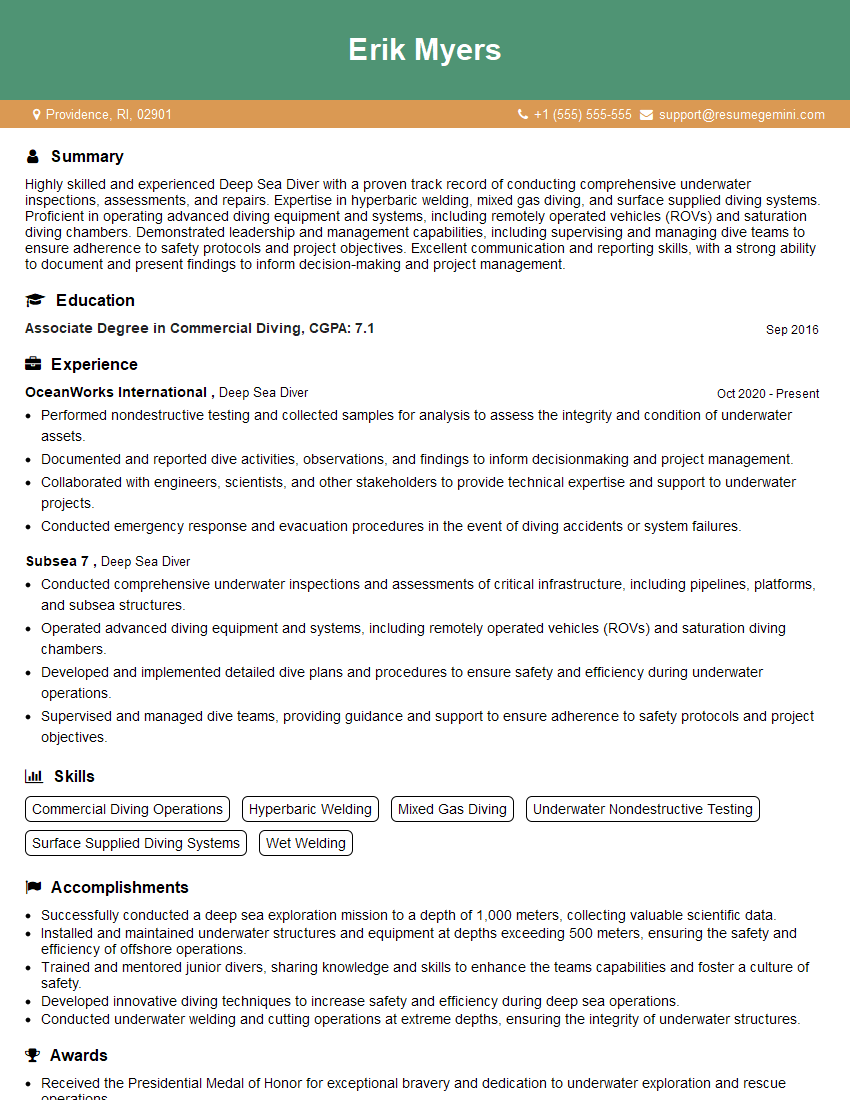
Interviewers often ask about specific skills and experiences. With ResumeGemini‘s customizable templates, you can tailor your resume to showcase the skills most relevant to the position, making a powerful first impression. Also check out Resume Template specially tailored for Deep Sea Diver.
Career Expert Tips:
- Ace those interviews! Prepare effectively by reviewing the Top 50 Most Common Interview Questions on ResumeGemini.
- Navigate your job search with confidence! Explore a wide range of Career Tips on ResumeGemini. Learn about common challenges and recommendations to overcome them.
- Craft the perfect resume! Master the Art of Resume Writing with ResumeGemini’s guide. Showcase your unique qualifications and achievements effectively.
- Great Savings With New Year Deals and Discounts! In 2025, boost your job search and build your dream resume with ResumeGemini’s ATS optimized templates.
Researching the company and tailoring your answers is essential. Once you have a clear understanding of the Deep Sea Diver‘s requirements, you can use ResumeGemini to adjust your resume to perfectly match the job description.
Key Job Responsibilities
Deep Sea Divers play a vital role in various industries, including oil and gas exploration, marine construction, and scientific research. Their responsibilities are essential for ensuring the safety and efficiency of underwater operations.
1. Diving Operations
Conduct underwater inspections, maintenance, and repair work on offshore structures, pipelines, and other submerged infrastructure.
- Operate diving equipment, including scuba gear, surface-supplied diving systems, and submersibles.
- Perform underwater welding, cutting, and other specialized tasks.
2. Underwater Inspection
Inspect underwater structures and equipment to assess their condition and identify potential hazards.
- Use specialized equipment, such as underwater cameras and sonar systems, to gather data and create detailed reports.
- Collect samples and conduct environmental monitoring to assess the impact of underwater activities.
3. Search and Recovery
Conduct search and recovery operations for lost objects, equipment, or individuals.
- Use sonar and other underwater search methods to locate targets.
- Work in collaboration with other team members to safely retrieve objects.
4. Safety Management
Ensure the safety of diving operations and personnel.
- Adhere to established safety protocols and procedures.
- Monitor weather conditions and diving environments to identify potential risks.
Interview Tips
Preparing for a Deep Sea Diver interview requires thorough research, practice, and a strong understanding of the industry and job requirements. Here are some effective tips to help you ace your interview:
1. Research the Industry and Company
Gain a comprehensive understanding of the deep-sea diving industry and the company you’re applying to. Review their website, industry reports, and recent news articles to demonstrate your knowledge and enthusiasm.
- Identify the company’s specific areas of expertise and how your skills align with their needs.
- Research the industry’s latest advancements and trends to show your commitment to staying up-to-date.
2. Highlight Your Technical Skills
Emphasize your technical diving skills and experience. Provide specific examples of underwater projects you’ve worked on, highlighting your proficiency in operating diving equipment and conducting underwater inspections and repairs.
- Quantify your accomplishments whenever possible, using numbers and metrics to demonstrate your impact.
- Be prepared to discuss your experience with different types of diving equipment and your ability to adapt to various underwater environments.
3. Demonstrate Safety Consciousness
Safety is paramount in deep-sea diving. Demonstrate your commitment to safety by discussing your knowledge of safety protocols and your adherence to industry best practices.
- Highlight your experience in conducting risk assessments and implementing safety measures.
- Emphasize your ability to work effectively in high-pressure and potentially hazardous underwater environments.
4. Showcase Your Teamwork Abilities
Deep-sea diving often involves working as part of a team. Emphasize your teamwork skills by providing examples of how you’ve collaborated with others to achieve project goals.
- Discuss your experience in coordinating with surface support personnel and other divers.
- Highlight your ability to communicate effectively and work harmoniously with individuals from diverse backgrounds.
Next Step:
Now that you’re armed with interview-winning answers and a deeper understanding of the Deep Sea Diver role, it’s time to take action! Does your resume accurately reflect your skills and experience for this position? If not, head over to ResumeGemini. Here, you’ll find all the tools and tips to craft a resume that gets noticed. Don’t let a weak resume hold you back from landing your dream job. Polish your resume, hit the “Build Your Resume” button, and watch your career take off! Remember, preparation is key, and ResumeGemini is your partner in interview success.