Are you gearing up for an interview for a Software Development Engineer position? Whether you’re a seasoned professional or just stepping into the role, understanding what’s expected can make all the difference. In this blog, we dive deep into the essential interview questions for Software Development Engineer and break down the key responsibilities of the role. By exploring these insights, you’ll gain a clearer picture of what employers are looking for and how you can stand out. Read on to equip yourself with the knowledge and confidence needed to ace your next interview and land your dream job!
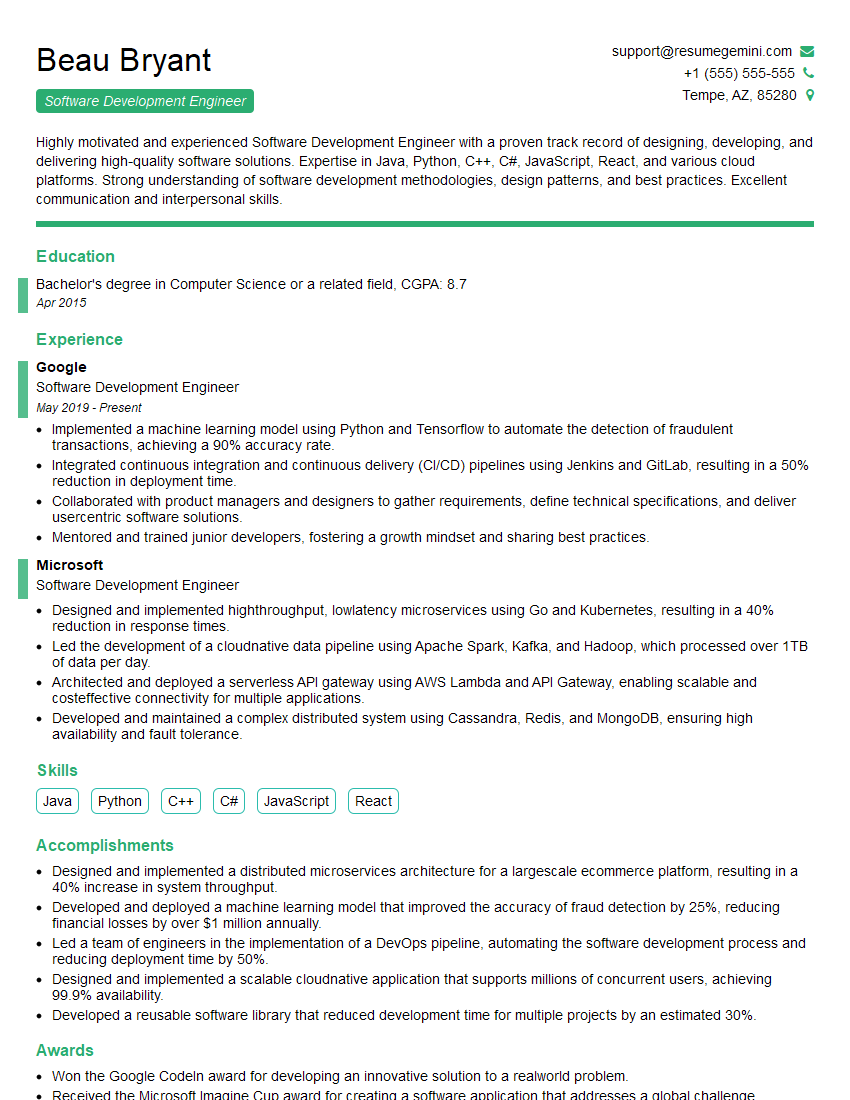
Acing the interview is crucial, but landing one requires a compelling resume that gets you noticed. Crafting a professional document that highlights your skills and experience is the first step toward interview success. ResumeGemini can help you build a standout resume that gets you called in for that dream job.






Essential Interview Questions For Software Development Engineer
1. How would you design a scalable system for a high-volume e-commerce platform?
In designing a scalable system for a high-volume e-commerce platform, I would consider the following factors:
- Identify performance bottlenecks and optimize the system accordingly.
- Implement load balancing and caching mechanisms to distribute traffic and reduce response times.
- Use a distributed database and NoSQL technologies to handle large amounts of data and ensure high availability.
- Implement a microservices architecture to break down the system into smaller, independent components for easier scaling and maintenance.
- Monitor the system’s performance continuously and make adjustments to optimize scalability and performance.
2. Describe your approach to debugging complex codebases.
Step-by-step Debugging
- Identify the root cause of the problem by analyzing the error messages and logs.
- Use debugging tools, such as breakpoints and logging, to pinpoint the exact location of the issue.
- Examine the code’s execution flow and data structures to understand how the error occurred.
Test-Driven Development
- Write unit tests to ensure that individual components of the codebase are functioning correctly.
- Use integration tests to verify the interactions between different components.
- Regularly run these tests to catch bugs early and prevent them from propagating.
Version Control
- Use version control systems to track changes to the codebase and revert to previous versions if necessary.
- Collaborate with team members to identify and resolve conflicts in the codebase.
3. How do you stay up-to-date with the latest technologies and best practices in your field?
I stay up-to-date with the latest technologies and best practices in my field through the following methods:
- Read technical blogs, articles, and whitepapers from industry experts.
- Attend conferences, workshops, and meetups to learn from other professionals.
- Contribute to open source projects and collaborate with other developers.
- Take online courses and certifications to enhance my skills and knowledge.
- Network with other professionals in my field and exchange ideas and experiences.
4. What is your experience with agile development methodologies?
I have experience with agile development methodologies, particularly Scrum and Kanban. In Scrum, I have played the roles of Scrum Master and Development Team member, where I was responsible for facilitating sprint planning, tracking progress, and ensuring continuous improvement. In Kanban, I have used the Kanban board to visualize workflow and limit work in progress, resulting in improved team efficiency and delivery cadence.
5. How do you approach code reviews and what value do you see in them?
I approach code reviews with a collaborative and constructive mindset. I focus on identifying areas for improvement, suggesting alternative solutions, and providing feedback to help the author enhance the quality of their code. I believe code reviews are valuable for:
- Detecting and resolving bugs early in the development process.
- Enforcing coding standards and best practices.
- Sharing knowledge and fostering a culture of continuous learning within the team.
- Improving the overall maintainability and readability of the codebase.
6. How do you handle working on multiple projects simultaneously?
When working on multiple projects simultaneously, I prioritize tasks based on their urgency and impact, and use a task management tool to keep track of my progress. I break down large tasks into smaller, manageable chunks and allocate time for each project accordingly. I also communicate regularly with stakeholders to provide updates and ensure project deadlines are met.
7. What is your understanding of data structures and algorithms?
Data structures are used to organize and store data efficiently, while algorithms are used to process and manipulate data. I have a strong understanding of common data structures such as arrays, linked lists, stacks, queues, and trees, as well as algorithms for sorting, searching, and graph traversal. I am also familiar with more advanced data structures and algorithms used in specialized applications, such as hash tables, bloom filters, and dynamic programming.
8. How do you ensure the security of software applications?
I follow secure coding practices and incorporate security measures into my development process to ensure the security of software applications. This includes:
- Input validation and sanitization to prevent malicious input from compromising the system.
- Implementing access controls and authentication mechanisms to protect sensitive data.
- Regular security audits and penetration testing to identify and address vulnerabilities.
- Staying up-to-date with the latest security threats and best practices.
9. What is your experience with cloud computing technologies?
I have experience with cloud computing technologies, particularly AWS and Azure. I have used these platforms to build and deploy scalable, fault-tolerant applications. I am familiar with cloud services such as EC2, S3, and RDS, and have experience with cloud-native technologies such as serverless computing and container orchestration.
10. How do you approach performance optimization in software development?
I approach performance optimization in software development by:
- Identifying performance bottlenecks through profiling and analysis.
- Optimizing algorithms and data structures to improve efficiency.
- Using appropriate caching mechanisms to reduce database queries and improve response times.
- Implementing lazy loading and pagination to minimize data transfer and improve user experience.
- Monitoring system performance and making adjustments as needed to ensure optimal performance.
Interviewers often ask about specific skills and experiences. With ResumeGemini‘s customizable templates, you can tailor your resume to showcase the skills most relevant to the position, making a powerful first impression. Also check out Resume Template specially tailored for Software Development Engineer.
Career Expert Tips:
- Ace those interviews! Prepare effectively by reviewing the Top 50 Most Common Interview Questions on ResumeGemini.
- Navigate your job search with confidence! Explore a wide range of Career Tips on ResumeGemini. Learn about common challenges and recommendations to overcome them.
- Craft the perfect resume! Master the Art of Resume Writing with ResumeGemini’s guide. Showcase your unique qualifications and achievements effectively.
- Great Savings With New Year Deals and Discounts! In 2025, boost your job search and build your dream resume with ResumeGemini’s ATS optimized templates.
Researching the company and tailoring your answers is essential. Once you have a clear understanding of the Software Development Engineer‘s requirements, you can use ResumeGemini to adjust your resume to perfectly match the job description.
Key Job Responsibilities
Software Development Engineers are responsible for designing, developing, and maintaining software systems. They work closely with other engineers, product managers, and business stakeholders to understand the requirements of the software and to ensure that it meets those requirements. Software Development Engineers typically have a strong understanding of computer science fundamentals, programming languages, and software development methodologies.
1. Design and develop software systems
Software Development Engineers are responsible for designing and developing software systems that meet the needs of users. This involves understanding the user requirements, designing the system architecture, and implementing the system using programming languages and software development tools.
- Understand user requirements and translate them into technical specifications
- Design and implement software systems using programming languages and software development tools
- Test and debug software systems to ensure they meet the requirements and are free of defects
2. Maintain and update software systems
Software Development Engineers are responsible for maintaining and updating software systems to ensure they continue to meet the needs of users. This involves fixing bugs, adding new features, and updating the system to new versions of software.
- Fix bugs and resolve issues in software systems
- Add new features and enhancements to software systems
- Update software systems to new versions and platforms
3. Work with other engineers and stakeholders
Software Development Engineers typically work with other engineers, product managers, and business stakeholders to understand the requirements of the software and to ensure that it meets those requirements. This involves communicating with stakeholders, gathering feedback, and incorporating that feedback into the software development process.
- Communicate with stakeholders to understand their needs and requirements
- Gather feedback from stakeholders on software designs and implementations
- Incorporate stakeholder feedback into the software development process
4. Stay up-to-date on software development trends and technologies
Software Development Engineers need to stay up-to-date on the latest software development trends and technologies. This involves reading technical journals, attending conferences, and participating in online communities. This knowledge helps them to develop better software systems and to keep their skills current.
- Read technical journals and articles to stay up-to-date on software development trends and technologies
- Attend conferences and meetups to learn about new software development tools and techniques
- Participate in online communities to connect with other Software Development Engineers and to share knowledge
Interview Tips
Preparing for a software development engineer interview can be daunting, but there are a few things you can do to increase your chances of success. Here are some tips:
1. Research the company and the position
Before you go into an interview, it’s important to do your research on the company and the position you’re applying for. This will help you to understand the company’s culture, values, and goals. It will also help you to tailor your answers to the specific requirements of the position.
- Visit the company’s website and read about their mission, vision, and values
- Read the job description carefully and identify the key skills and qualifications that the company is looking for
- Talk to people who work at the company or who have worked there in the past
2. Practice your answers to common interview questions
There are a number of common interview questions that you’re likely to be asked, such as “Tell me about yourself” and “Why are you interested in this position?”. It’s important to practice your answers to these questions so that you can deliver them confidently and concisely.
- Make a list of common interview questions and practice your answers out loud
- Ask a friend or family member to mock interview you
- Use online resources to find sample interview questions and answers
3. Be prepared to talk about your experience and skills
The interviewer will want to know about your experience and skills, so be prepared to talk about them in detail. Highlight your most relevant experience and skills, and be sure to quantify your accomplishments whenever possible.
- Create a resume that highlights your relevant experience and skills
- Prepare a portfolio of your work to showcase your skills
- Be able to articulate your skills and experience in a clear and concise way
4. Ask questions
Asking questions at the end of the interview shows that you’re interested in the position and that you’re taking the interview seriously. It also gives you an opportunity to learn more about the company and the position.
- Prepare a list of questions to ask the interviewer
- Ask questions about the company, the position, and the team
- Ask questions about the company’s culture and values
Next Step:
Armed with this knowledge, you’re now well-equipped to tackle the Software Development Engineer interview with confidence. Remember, preparation is key. So, start crafting your resume, highlighting your relevant skills and experiences. Don’t be afraid to tailor your application to each specific job posting. With the right approach and a bit of practice, you’ll be well on your way to landing your dream job. Build your resume now from scratch or optimize your existing resume with ResumeGemini. Wish you luck in your career journey!