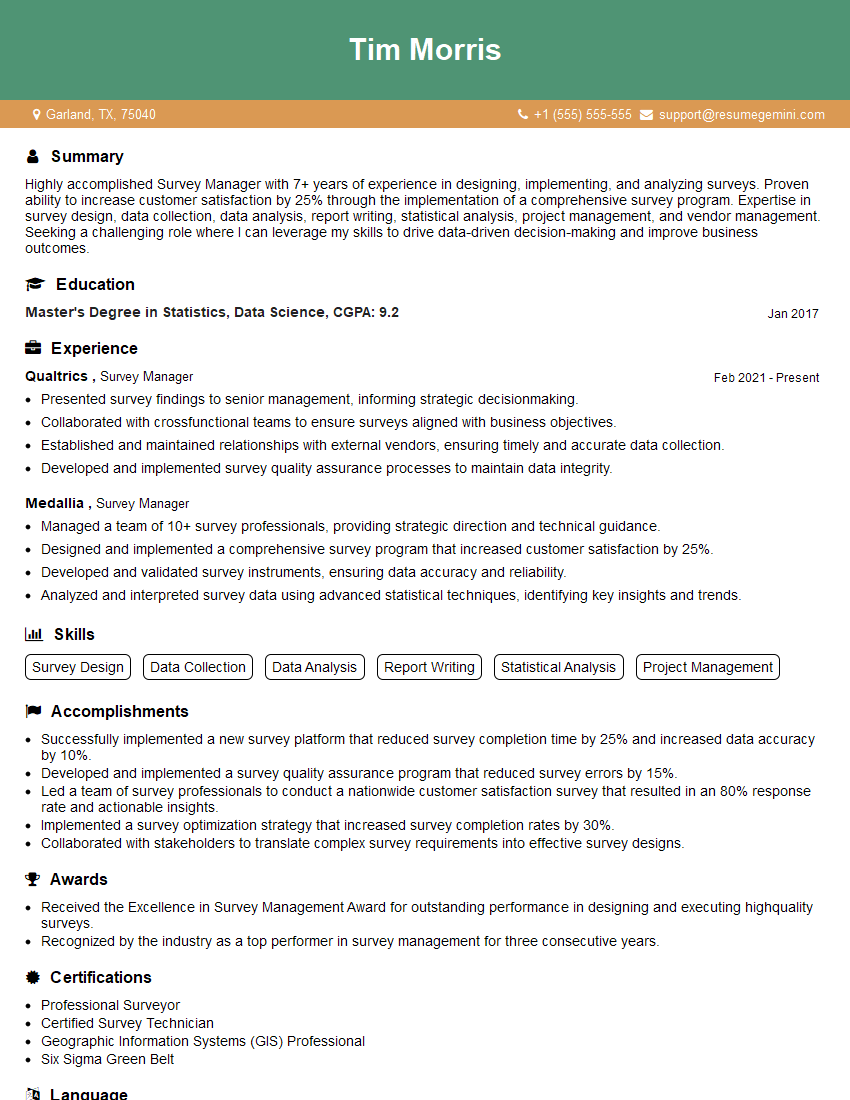
Are you gearing up for an interview for a Survey Manager position? Whether you’re a seasoned professional or just stepping into the role, understanding what’s expected can make all the difference. In this blog, we dive deep into the essential interview questions for Survey Manager and break down the key responsibilities of the role. By exploring these insights, you’ll gain a clearer picture of what employers are looking for and how you can stand out. Read on to equip yourself with the knowledge and confidence needed to ace your next interview and land your dream job!
Acing the interview is crucial, but landing one requires a compelling resume that gets you noticed. Crafting a professional document that highlights your skills and experience is the first step toward interview success. ResumeGemini can help you build a standout resume that gets you called in for that dream job.






Essential Interview Questions For Survey Manager
1. What is the difference between sampling error and non-sampling error?
- Sampling error is the difference between the results of a sample and the results of the population it represents.
- Non-sampling error is the difference between the results of a survey and the true value of the population it represents.
2. What are the different types of sampling methods?
Probability sampling
- Simple random sampling
- Systematic sampling
- Stratified sampling
- Cluster sampling
Non-probability sampling
- Convenience sampling
- Quota sampling
- Purposive sampling
- Snowball sampling
3. What are the steps involved in designing a survey?
- Define the research objectives
- Determine the target population
- Select a sampling method
- Develop the survey instrument
- Conduct the survey
- Analyze the data
- Report the results
4. What are the different types of survey instruments?
- Questionnaires
- Interviews
- Focus groups
- Observation
5. What are the different types of survey data?
- Quantitative data
- Qualitative data
6. What are the different types of survey analysis methods?
- Descriptive statistics
- Inferential statistics
7. What are the different types of survey reporting methods?
- Written reports
- Oral presentations
- Web reports
8. What are the ethical considerations involved in conducting surveys?
- Informed consent
- Confidentiality
- Protection from harm
- Objectivity
- Accuracy
9. What are the different types of survey software?
- Qualtrics
- SurveyMonkey
- SPSS
- R
10. What are the current trends in survey research?
- The use of online surveys
- The use of mobile surveys
- The use of data visualization
- The use of big data
Interviewers often ask about specific skills and experiences. With ResumeGemini‘s customizable templates, you can tailor your resume to showcase the skills most relevant to the position, making a powerful first impression. Also check out Resume Template specially tailored for Survey Manager.
Career Expert Tips:
- Ace those interviews! Prepare effectively by reviewing the Top 50 Most Common Interview Questions on ResumeGemini.
- Navigate your job search with confidence! Explore a wide range of Career Tips on ResumeGemini. Learn about common challenges and recommendations to overcome them.
- Craft the perfect resume! Master the Art of Resume Writing with ResumeGemini’s guide. Showcase your unique qualifications and achievements effectively.
- Great Savings With New Year Deals and Discounts! In 2025, boost your job search and build your dream resume with ResumeGemini’s ATS optimized templates.
Researching the company and tailoring your answers is essential. Once you have a clear understanding of the Survey Manager‘s requirements, you can use ResumeGemini to adjust your resume to perfectly match the job description.
Key Job Responsibilities
The Survey Manager is a highly skilled professional responsible for overseeing and executing all aspects of survey operations. They play a crucial role in ensuring the accuracy, reliability, and validity of survey data.
1. Survey Design and Planning
The Survey Manager is involved in all phases of survey design and planning. They work closely with stakeholders to define survey objectives, develop sampling strategies, and design survey instruments. They also ensure that the survey design meets all quality standards and ethical guidelines.
2. Data Collection and Management
The Survey Manager oversees the collection and management of survey data. They develop and implement data collection protocols, train data collectors, and monitor data quality. They also work with IT staff to ensure that data is securely stored and managed.
3. Data Analysis and Interpretation
The Survey Manager analyzes survey data to identify patterns, trends, and insights. They prepare reports and presentations that communicate the findings of the survey to stakeholders. They also work with stakeholders to develop action plans based on the survey results.
4. Quality Assurance and Control
The Survey Manager is responsible for ensuring the quality of survey data. They develop and implement quality assurance and control procedures to minimize errors and bias. They also work with stakeholders to ensure that the survey meets all quality standards.
Interview Tips
To ace an interview for a Survey Manager position, it is important to have a strong understanding of the key job responsibilities and to be able to demonstrate your skills and experience in these areas. Here are some tips to help you prepare for your interview:
1. Research the Company and the Position
Before your interview, be sure to research the company and the specific Survey Manager position you are applying for. This will help you to understand the company’s culture, values, and goals. It will also help you to tailor your answers to the specific requirements of the position.
2. Highlight Your Skills and Experience
In your interview, be sure to highlight your skills and experience in the key areas of survey management. Be specific and provide examples of your work. For example, you could talk about a time when you designed a survey that met all quality standards, or a time when you analyzed survey data to identify important trends.
3. Be Prepared to Discuss Your Knowledge of Survey Best Practices
Interviewers will be interested in your knowledge of survey best practices. Be prepared to discuss your understanding of sampling methods, survey design, data collection, and data analysis. You should also be familiar with the ethical guidelines for conducting surveys.
4. Be Enthusiastic and Passionate
Survey Managers should be enthusiastic and passionate about their work. In your interview, be sure to show your passion for survey research and your commitment to providing high-quality data.
Next Step:
Now that you’re armed with a solid understanding of what it takes to succeed as a Survey Manager, it’s time to turn that knowledge into action. Take a moment to revisit your resume, ensuring it highlights your relevant skills and experiences. Tailor it to reflect the insights you’ve gained from this blog and make it shine with your unique qualifications. Don’t wait for opportunities to come to you—start applying for Survey Manager positions today and take the first step towards your next career milestone. Your dream job is within reach, and with a polished resume and targeted applications, you’ll be well on your way to achieving your career goals! Build your resume now with ResumeGemini.