Are you gearing up for a career shift or aiming to ace your next interview? Look no further! We’ve curated a comprehensive guide to help you crack the interview for the coveted PI/Senior Research Associate position. From understanding the key responsibilities to mastering the most commonly asked questions, this blog has you covered. So, buckle up and let’s embark on this journey together
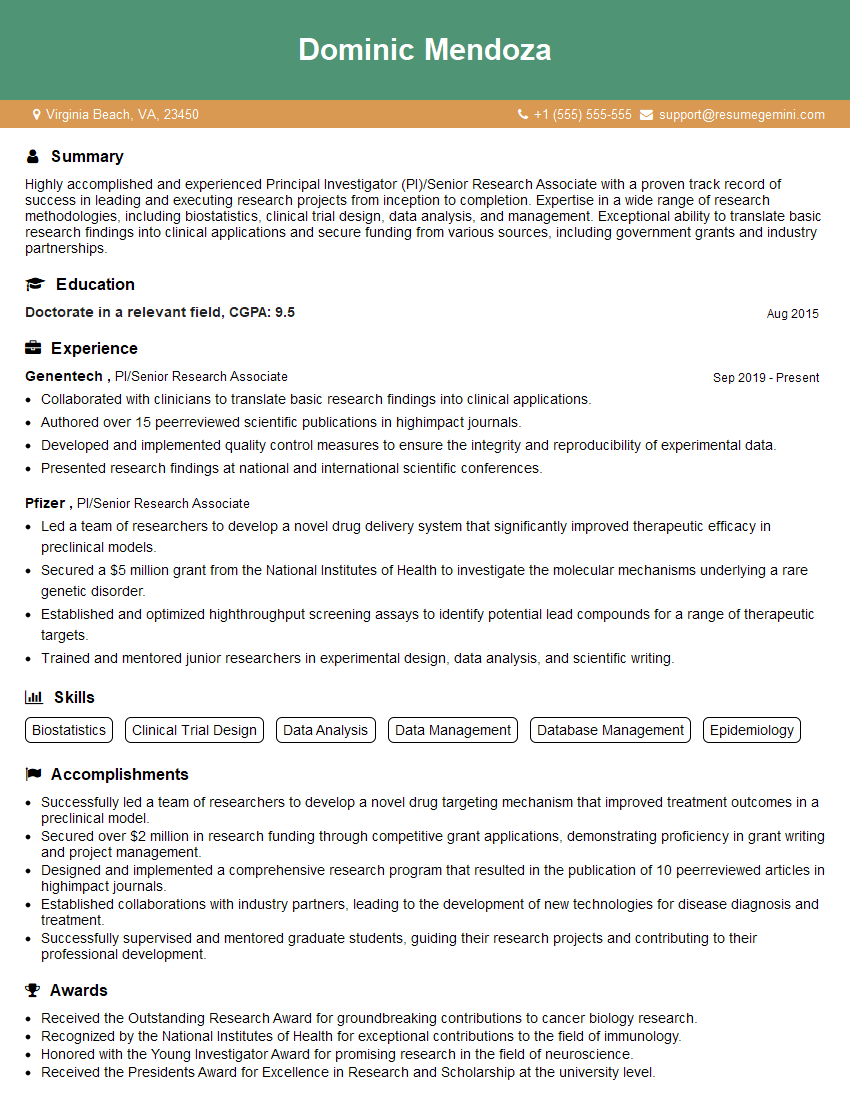
Acing the interview is crucial, but landing one requires a compelling resume that gets you noticed. Crafting a professional document that highlights your skills and experience is the first step toward interview success. ResumeGemini can help you build a standout resume that gets you called in for that dream job.






Essential Interview Questions For PI/Senior Research Associate
1. Describe your experience in designing and conducting research studies.
As a highly qualified PI and Senior Research Associate, I possess extensive experience in designing and conducting research studies. My expertise encompasses:
- Developing research proposals and obtaining funding
- Formulating research questions and hypotheses
- Selecting appropriate research methodologies and data collection techniques
- Managing and supervising research teams and collaborating with other researchers
- Analyzing and interpreting research data to draw meaningful conclusions
2. How do you ensure the validity and reliability of your research findings?
Triangulation of Data
- Utilize multiple data collection methods (e.g., surveys, interviews, observations) to cross-validate findings
Robust Sampling Techniques
- Employ random or stratified sampling to ensure representativeness and reduce sampling bias
Internal and External Validity
- Design studies that control for confounding variables and minimize potential biases
- Replicate findings in different contexts to enhance generalizability
3. Discuss your approach to analyzing and interpreting complex research data.
My approach to data analysis and interpretation involves:
- Using advanced statistical techniques (e.g., regression analysis, factor analysis)
- Applying qualitative analysis methods (e.g., grounded theory, thematic analysis) to uncover patterns and themes
- Triangulating results from different analyses to ensure a comprehensive understanding
- Interpreting findings in the context of existing literature and theoretical frameworks
- Communicating findings clearly and effectively through presentations, publications, and reports
4. How do you stay abreast of emerging research trends and methodologies?
- Attend conferences and workshops
- Read peer-reviewed journals and research publications
- Engage in collaborations and discussions with colleagues in the field
- Utilize online resources and databases
- Participate in professional development programs
5. Describe your experience in mentoring junior researchers.
- Providing guidance on research design, data analysis, and interpretation
- Offering constructive criticism and feedback
- Encouraging professional development and networking
- Collaborating on research projects and publications
- Creating a supportive and inclusive research environment
6. How do you handle ethical challenges that may arise in your research?
- Adhering to ethical guidelines and regulations
- Obtaining informed consent from participants
- Protecting privacy and confidentiality
- Avoiding conflicts of interest
- Seeking guidance from an institutional review board or ethics committee
7. Tell us about your most significant research accomplishment and its impact.
My most significant research accomplishment was developing and implementing an innovative intervention to improve mental health outcomes in a vulnerable population. The study, which was funded by a major federal grant, demonstrated:
- Reduced symptoms of depression and anxiety
- Increased access to mental health services
- Improved overall well-being and quality of life
- The findings were published in a high-impact peer-reviewed journal and have been cited extensively in the field.
8. How do you prioritize your research projects and manage your time effectively?
- Setting research goals and objectives
- Identifying available resources and constraints
- Developing a research plan and timeline
- Delegating tasks and collaborating with others
- Using project management tools and techniques
9. Describe your experience in developing and managing research budgets.
- Estimating project costs and securing funding
- Tracking expenses and managing financial resources
- Preparing financial reports and complying with funding agency regulations
- Negotiating contracts and managing vendor relationships
- Ensuring responsible and ethical management of research funds
10. How do you disseminate your research findings to a wider audience?
- Publishing in peer-reviewed journals
- Presenting at conferences and workshops
- Writing blog posts and articles for general audiences
- Collaborating with journalists and media outlets
- Engaging in outreach activities to educate the public about research findings
Interviewers often ask about specific skills and experiences. With ResumeGemini‘s customizable templates, you can tailor your resume to showcase the skills most relevant to the position, making a powerful first impression. Also check out Resume Template specially tailored for PI/Senior Research Associate.
Career Expert Tips:
- Ace those interviews! Prepare effectively by reviewing the Top 50 Most Common Interview Questions on ResumeGemini.
- Navigate your job search with confidence! Explore a wide range of Career Tips on ResumeGemini. Learn about common challenges and recommendations to overcome them.
- Craft the perfect resume! Master the Art of Resume Writing with ResumeGemini’s guide. Showcase your unique qualifications and achievements effectively.
- Great Savings With New Year Deals and Discounts! In 2025, boost your job search and build your dream resume with ResumeGemini’s ATS optimized templates.
Researching the company and tailoring your answers is essential. Once you have a clear understanding of the PI/Senior Research Associate‘s requirements, you can use ResumeGemini to adjust your resume to perfectly match the job description.
Key Job Responsibilities
The PI/Senior Research Associate is responsible for leading and managing a research team, developing and implementing research projects, and publishing research findings. This role requires a deep understanding of the research field, strong leadership skills, and effective communication and interpersonal abilities.
1. Research Design and Management
Define research objectives, develop research questions, and design research studies.
- Conduct literature reviews and identify research gaps.
- Develop research methodologies and protocols.
2. Team Leadership and Collaboration
Recruit, train, and supervise a research team.
- Foster a collaborative and productive work environment.
- Provide guidance and support to research assistants and students.
3. Data Collection and Analysis
Collect and analyze data using a variety of methods.
- Conduct experiments, surveys, and interviews.
- Use statistical and qualitative analysis techniques.
4. Publication and Dissemination
Prepare and publish research findings in peer-reviewed journals and conference proceedings.
- Present research findings at conferences and other professional gatherings.
- Secure funding for research projects.
Interview Tips
Preparing for an interview for the role of a PI/Senior Research Associate can be daunting, but with the right preparation, you can increase your chances of success. Here are some tips to help you ace the interview:
1. Research the Position and Organization
Thoroughly review the job description and research the organization’s mission and values. This will help you understand the specific requirements of the role and tailor your answers to the interviewer’s expectations.
- Identify the key responsibilities and skills required for the position.
- Learn about the organization’s research focus and areas of expertise.
2. Prepare Specific Examples
When answering interview questions, use specific examples to demonstrate your skills and experience. This will provide tangible evidence of your capabilities.
- Describe a successful research project you led, highlighting your role in design, implementation, and analysis.
- Share an example of how you effectively managed a research team and fostered collaboration.
3. Showcase Your Leadership and Communication Skills
Effective leadership and communication are crucial for a PI/Senior Research Associate. Provide examples that demonstrate your ability to motivate and guide a team, as well as your clarity and conciseness in presenting research findings.
- Describe a situation where you successfully led a team to achieve a research goal.
- Share an example of how you effectively communicated complex research concepts to a non-scientific audience.
4. Discuss Your Research Interests and Future Goals
The interviewer will be interested in your research interests and how they align with the organization’s mission. Be prepared to discuss your current research projects and your future research aspirations.
- Explain how your research interests align with the organization’s research focus.
- Share your plans for future research projects and how they could contribute to the field.
5. Ask Thoughtful Questions
Asking thoughtful questions at the end of the interview shows that you are engaged and interested in the position. Prepare questions that demonstrate your understanding of the role and the organization.
- Ask about the organization’s research priorities and how your skills could contribute to their goals.
- Inquire about opportunities for professional development and collaboration.
Next Step:
Now that you’re armed with the knowledge of PI/Senior Research Associate interview questions and responsibilities, it’s time to take the next step. Build or refine your resume to highlight your skills and experiences that align with this role. Don’t be afraid to tailor your resume to each specific job application. Finally, start applying for PI/Senior Research Associate positions with confidence. Remember, preparation is key, and with the right approach, you’ll be well on your way to landing your dream job. Build an amazing resume with ResumeGemini