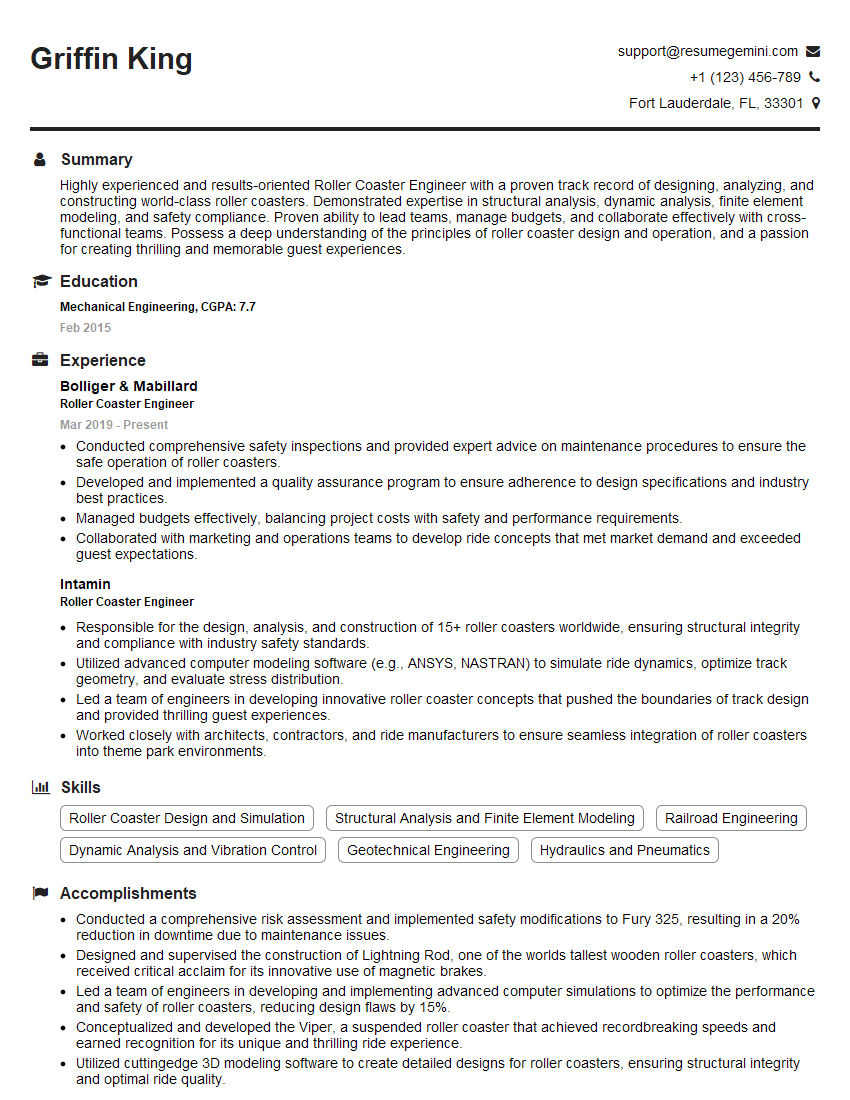
Ever felt underprepared for that crucial job interview? Or perhaps you’ve landed the interview but struggled to articulate your skills and experiences effectively? Fear not! We’ve got you covered. In this blog post, we’re diving deep into the Roller Coaster Engineer interview questions that you’re most likely to encounter. But that’s not all. We’ll also provide expert insights into the key responsibilities of a Roller Coaster Engineer so you can tailor your answers to impress potential employers.
Acing the interview is crucial, but landing one requires a compelling resume that gets you noticed. Crafting a professional document that highlights your skills and experience is the first step toward interview success. ResumeGemini can help you build a standout resume that gets you called in for that dream job.






Essential Interview Questions For Roller Coaster Engineer
1. What are the key factors you consider when designing a roller coaster?
- Passenger safety and comfort
- Track layout and geometry
- Materials selection and strength analysis
- Ride experience and thrill factor
- Park space constraints and environmental impact
2. Describe the different types of roller coaster track and explain their advantages and disadvantages.
Wooden track
- Advantages: Flexibility, natural aesthetics
- Disadvantages: Susceptible to rot and moisture damage
Steel track
- Advantages: Durability, smooth ride, customizable
- Disadvantages: Higher cost, less aesthetic appeal
Hyper-elevation track
- Advantages: Increased lateral G-forces
- Disadvantages: Can lead to discomfort or nausea
3. How do you calculate the forces acting on a roller coaster train?
- Utilize Newtonian physics principles
- Consider gravity, inertia, centrifugal force, and friction
- Use computer simulation or hand calculations
- Estimate passenger mass and train weight
- Apply force equations (e.g., F=ma, F=mv^2/r)
4. What are the different types of safety systems used in roller coasters?
- Seat belts and restraints
- Lap bars and over-the-shoulder harnesses
- Anti-rollback mechanisms
- Emergency stop systems
- Sensor arrays and control systems
5. How do you ensure the reliability and durability of roller coaster components?
- Rigorous material testing and quality control
- Regular inspections and maintenance
- Redundancy in critical systems
- Use of high-quality materials (e.g., steel alloys)
- Environmental protection and weatherproofing
6. Describe the process of designing and building a roller coaster from start to finish.
- Conceptualization and park planning
- Track design and engineering
- Materials procurement and manufacturing
- Construction and assembly
- Testing, certification, and inspection
7. What are the latest advancements in roller coaster design and technology?
- Virtual reality and augmented reality experiences
- Advanced control systems for smooth rides
- Ride systems with varying speeds and intensities
- Sensors and monitoring for predictive maintenance
- Sustainable and eco-friendly construction methods
8. How do you balance the thrill factor with safety considerations in your designs?
Safety is always paramount. I prioritize the following:
- Predicting and minimizing potential risks
- Applying industry standards and regulations
- Incorporating redundant safety systems
- Ensuring passenger comfort and minimizing discomfort
- Testing and evaluating designs thoroughly
9. What are the key challenges you face as a roller coaster engineer?
- Balancing safety and innovation
- Designing for extreme conditions and forces
- Collaborating with multiple stakeholders
- Staying abreast of industry advancements
- Meeting budget and time constraints
10. What is your favorite roller coaster that you’ve designed and why?
It’s difficult to choose one, but I’m particularly proud of [Roller Coaster Name]. It combines innovative elements, thrilling moments, and a high level of safety. The unique track layout provides an unforgettable experience, while the advanced control system ensures a smooth and enjoyable ride.
Interviewers often ask about specific skills and experiences. With ResumeGemini‘s customizable templates, you can tailor your resume to showcase the skills most relevant to the position, making a powerful first impression. Also check out Resume Template specially tailored for Roller Coaster Engineer.
Career Expert Tips:
- Ace those interviews! Prepare effectively by reviewing the Top 50 Most Common Interview Questions on ResumeGemini.
- Navigate your job search with confidence! Explore a wide range of Career Tips on ResumeGemini. Learn about common challenges and recommendations to overcome them.
- Craft the perfect resume! Master the Art of Resume Writing with ResumeGemini’s guide. Showcase your unique qualifications and achievements effectively.
- Great Savings With New Year Deals and Discounts! In 2025, boost your job search and build your dream resume with ResumeGemini’s ATS optimized templates.
Researching the company and tailoring your answers is essential. Once you have a clear understanding of the Roller Coaster Engineer‘s requirements, you can use ResumeGemini to adjust your resume to perfectly match the job description.
Key Job Responsibilities
Roller Coaster Engineers are responsible for designing, building, and maintaining roller coasters. They must ensure that the coasters are safe and efficient, and meet stringent industry standards. The most common duties include:
1. Designing Roller Coasters
Roller Coaster Engineers use computer-aided design (CAD) software to create 3D models of roller coasters. They must consider the following factors when designing a coaster:
- The height and length of the coaster
- The speed and acceleration of the coaster
- The layout of the coaster, including the number of drops, loops, and turns
2. Testing Roller Coasters
Once a roller coaster is designed, it must be tested to ensure that it is safe. Roller Coaster Engineers use a variety of testing methods, including:
- Computer simulations
- Physical testing using dummies
- Full-scale testing with human riders
3. Maintaining Roller Coasters
Roller Coasters require regular maintenance to ensure that they are safe and efficient. Roller Coaster Engineers are responsible for inspecting the coasters, repairing any damage, and replacing any worn parts.
4. Troubleshooting
If a roller coaster experiences any problems, Roller Coaster Engineers are responsible for troubleshooting the problem and finding a solution. They must have a strong understanding of the mechanics of roller coasters and be able to think critically to solve problems.
Interview Tips
Preparing for a Roller Coaster Engineer interview can be daunting, but with the right preparation, you can increase your chances of success.
1. Research the Company and Position
Before your interview, take the time to research the company and the specific position you are applying for. This will help you understand the company’s culture, values, and goals. It will also help you tailor your answers to the specific requirements of the position.
2. Practice Your Answers
Once you have researched the company and the position, take some time to practice your answers to common interview questions. This will help you feel more confident and prepared during your interview.
3. Dress Professionally
First impressions matter, so make sure you dress professionally for your interview. This means wearing a suit or business casual attire.
4. Be Enthusiastic
Roller Coaster Engineers are passionate about their work. If you are not enthusiastic about roller coasters, it will be difficult to convince the interviewer that you are the right person for the job.
5. Be Yourself
The most important thing is to be yourself. The interviewer wants to get to know the real you, so don’t try to be someone you’re not. Just relax and let your personality shine through.
Next Step:
Armed with this knowledge, you’re now well-equipped to tackle the Roller Coaster Engineer interview with confidence. Remember, preparation is key. So, start crafting your resume, highlighting your relevant skills and experiences. Don’t be afraid to tailor your application to each specific job posting. With the right approach and a bit of practice, you’ll be well on your way to landing your dream job. Build your resume now from scratch or optimize your existing resume with ResumeGemini. Wish you luck in your career journey!