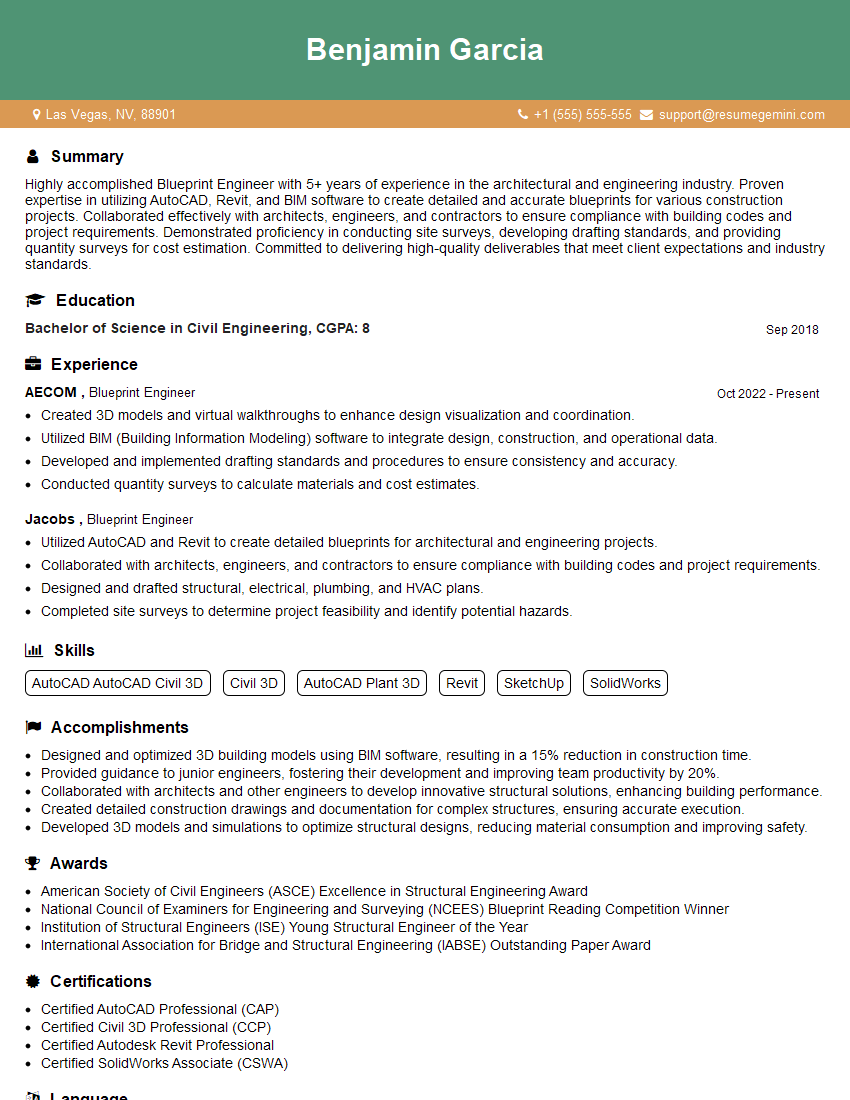
Are you gearing up for a career shift or aiming to ace your next interview? Look no further! We’ve curated a comprehensive guide to help you crack the interview for the coveted Blueprint Engineer position. From understanding the key responsibilities to mastering the most commonly asked questions, this blog has you covered. So, buckle up and let’s embark on this journey together.
Acing the interview is crucial, but landing one requires a compelling resume that gets you noticed. Crafting a professional document that highlights your skills and experience is the first step toward interview success. ResumeGemini can help you build a standout resume that gets you called in for that dream job.






Essential Interview Questions For Blueprint Engineer
1. What is the process of creating a blueprint from scratch?
The process of creating a blueprint from scratch typically involves the following steps:
- Understanding the project requirements: Gathering information about the project’s scope, objectives, and constraints.
- Site planning: Laying out the project’s overall plan and determining the location of buildings, structures, and other elements.
- Schematic design: Developing the basic layout and design of the project, including floor plans, elevations, and sections.
- Design development: Refining the schematic design by adding details, materials, and specifications.
- Construction documentation: Preparing detailed drawings and specifications for construction, including plans, elevations, sections, details, and schedules.
- Coordination and collaboration: Working with engineers, architects, and other professionals to ensure the project’s design is cohesive and meets the client’s requirements.
2. What software do you use for creating blueprints?
I am proficient in a variety of blueprint creation software, including:
- AutoCAD: Industry-leading software for 2D and 3D drafting and design.
- Revit: Building information modeling (BIM) software for creating detailed 3D models of buildings and structures.
- Bluebeam Revu: Software for viewing, editing, and collaborating on PDF blueprints.
- SketchUp: 3D modeling software for creating conceptual designs and models.
- SolidWorks: CAD software for designing mechanical parts and assemblies.
3. What types of projects have you worked on in the past?
My experience in blueprint engineering covers a wide range of projects, including:
- Residential: Single-family homes, multi-family dwellings, and apartment buildings.
- Commercial: Office buildings, retail stores, and restaurants.
- Industrial: Warehouses, factories, and manufacturing facilities.
- Healthcare: Hospitals, clinics, and medical offices.
- Educational: Schools, universities, and libraries.
I am confident in my ability to apply my skills and knowledge to any type of blueprint engineering project.
4. What are the key considerations when creating a blueprint?
When creating a blueprint, several key considerations must be taken into account, including:
- Accuracy and precision: Blueprints must be precise and accurate to ensure that the final product meets the client’s requirements and building codes.
- Clarity and readability: Blueprints should be easy to understand and interpret by contractors, engineers, and other professionals involved in the construction process.
- Completeness: Blueprints must contain all necessary information, including dimensions, materials, specifications, and construction details.
- Coordination: Blueprints must coordinate with other project documents, such as specifications and construction schedules.
- Compliance with codes and standards: Blueprints must comply with all applicable building codes and industry standards.
5. How do you ensure the accuracy and quality of your blueprints?
I follow a rigorous quality assurance process to ensure the accuracy and quality of my blueprints, which includes:
- Thorough review: I carefully review my blueprints multiple times to identify and correct any errors or omissions.
- Coordination with other professionals: I work closely with engineers, architects, and other professionals involved in the project to ensure that my blueprints are consistent with their designs.
- Compliance with codes and standards: I stay up-to-date with the latest building codes and industry standards and ensure that my blueprints comply with all applicable requirements.
- Feedback from contractors: I welcome feedback from contractors and other professionals who use my blueprints to identify any areas for improvement.
6. What are the challenges of blueprint engineering?
Blueprint engineering presents several challenges, including:
- Complexity of projects: Blueprints must accurately represent complex building designs, which can be challenging to convey on paper.
- Coordination with other professionals: Blueprint engineers must effectively collaborate with architects, engineers, and contractors to ensure that all aspects of the project are coordinated.
- Compliance with codes and standards: Blueprint engineers must stay up-to-date with the latest building codes and industry standards and ensure that their designs comply with all applicable requirements.
- Time constraints: Blueprint engineers often work under tight deadlines, which can make it challenging to produce high-quality blueprints while meeting project schedules.
7. How do you stay up-to-date with the latest trends and technologies in blueprint engineering?
I stay up-to-date with the latest trends and technologies in blueprint engineering through:
- Continuing education: I regularly attend conferences, webinars, and workshops to learn about new software, techniques, and best practices.
- Professional organizations: I am an active member of professional organizations such as the American Institute of Building Design (AIBD) and the International Code Council (ICC), which provide access to industry resources and networking opportunities.
- Research and development: I actively research and experiment with new software and technologies to improve my efficiency and the quality of my work.
8. How do you handle feedback and criticism on your work?
I value feedback and criticism as opportunities for growth and improvement. When receiving feedback on my work, I:
- Listen attentively: I actively listen to the feedback and try to understand the perspective of the person providing it.
- Evaluate the feedback: I carefully consider the feedback and assess its validity and relevance.
- Respond respectfully: I respond to feedback in a respectful and professional manner, even if I do not agree with it.
- Make improvements: If I agree with the feedback, I make the necessary improvements to my work.
9. What are your strengths and weaknesses as a blueprint engineer?
Strengths:
- Technical proficiency: I am proficient in a variety of blueprint creation software and have a strong understanding of building codes and standards.
- Attention to detail: I am meticulous in my work and pay close attention to detail to ensure accuracy and precision in my blueprints.
- Problem-solving skills: I am able to identify and solve problems quickly and efficiently, ensuring that projects are completed on time and within budget.
- Communication skills: I am able to communicate clearly and effectively with clients, contractors, and other professionals involved in the construction process.
Weaknesses:
- Time management: I am sometimes challenged with managing my time effectively, especially when working on multiple projects simultaneously.
- Delegation: I prefer to handle most aspects of my work myself, which can make it difficult for me to delegate tasks to others.
10. Why are you interested in this position?
I am very interested in this position because it aligns with my skills, experience, and career goals. I am passionate about blueprint engineering and have a proven track record of success in the industry. I am confident that I can make a significant contribution to your team and help your company achieve its objectives.
I am particularly interested in the opportunity to work on a variety of complex and challenging projects. I am also eager to learn from experienced professionals and contribute my knowledge and skills to the team.
Interviewers often ask about specific skills and experiences. With ResumeGemini‘s customizable templates, you can tailor your resume to showcase the skills most relevant to the position, making a powerful first impression. Also check out Resume Template specially tailored for Blueprint Engineer.
Career Expert Tips:
- Ace those interviews! Prepare effectively by reviewing the Top 50 Most Common Interview Questions on ResumeGemini.
- Navigate your job search with confidence! Explore a wide range of Career Tips on ResumeGemini. Learn about common challenges and recommendations to overcome them.
- Craft the perfect resume! Master the Art of Resume Writing with ResumeGemini’s guide. Showcase your unique qualifications and achievements effectively.
- Great Savings With New Year Deals and Discounts! In 2025, boost your job search and build your dream resume with ResumeGemini’s ATS optimized templates.
Researching the company and tailoring your answers is essential. Once you have a clear understanding of the Blueprint Engineer‘s requirements, you can use ResumeGemini to adjust your resume to perfectly match the job description.
Key Job Responsibilities
A Blueprint Engineer is responsible for the design and creation of technical drawings and blueprints for various construction projects, including buildings, bridges, and other structures. Key responsibilities include:
1. Design and Create Blueprints
Blueprint Engineers translate engineering designs into detailed blueprints using computer-aided design (CAD) software and manual drafting techniques. These drawings specify the dimensions, materials, and construction methods for the project.
- Utilize CAD software to create precise and detailed blueprints.
- Ensure accuracy and adherence to industry standards and building codes.
2. Review and Analyze Engineering Designs
Blueprint Engineers review and analyze engineering designs to ensure feasibility, compliance with regulations, and adherence to project specifications.
- Collaborate with architects, engineers, and contractors to ensure project alignment.
- Identify and resolve design discrepancies or conflicts.
3. Communicate with Project Stakeholders
Blueprint Engineers effectively communicate with project stakeholders, including architects, engineers, contractors, and clients, to convey design intent and resolve any issues or queries.
- Attend project meetings and present technical drawings and specifications.
- Provide technical support and guidance to contractors and construction teams.
4. Stay Updated with Industry Standards
Blueprint Engineers remain abreast of industry trends, building codes, and technological advancements in design and drafting.
- Attend industry conferences and workshops to enhance knowledge and skills.
- Stay informed about new materials, construction methods, and design software.
Interview Tips
To ace your Blueprint Engineer interview, consider these preparation tips:
1. Research the Company and Industry
Familiarize yourself with the company’s projects, industry trends, and the specific role you’re applying for. This demonstrates your interest and preparedness.
- Visit the company website, read industry publications, and attend relevant webinars.
- Identify key projects the company has worked on and highlight your knowledge of them in the interview.
2. Showcase Your Technical Skills
Highlight your proficiency in CAD software, drafting techniques, and industry standards. Provide specific examples of your work and quantify your accomplishments.
- Prepare a portfolio showcasing your best blueprints and technical drawings.
- Quantify your accomplishments, such as reducing design errors or improving project efficiency.
3. Emphasize Communication and Collaboration
Blueprint Engineers are often involved in project management and stakeholder communication. Demonstrate your ability to communicate effectively and collaborate with a diverse team.
- Share experiences where you successfully resolved design conflicts or provided technical support to contractors.
- Highlight your interpersonal skills and ability to work in a team environment.
4. Prepare for Common Interview Questions
Anticipate common interview questions and prepare thoughtful responses. Consider questions such as:
- Tell us about your experience in creating and reviewing blueprints.
- How do you ensure accuracy and compliance in your blueprints?
- How do you handle conflicting design requirements from multiple stakeholders?
Next Step:
Armed with this knowledge, you’re now well-equipped to tackle the Blueprint Engineer interview with confidence. Remember, preparation is key. So, start crafting your resume, highlighting your relevant skills and experiences. Don’t be afraid to tailor your application to each specific job posting. With the right approach and a bit of practice, you’ll be well on your way to landing your dream job. Build your resume now from scratch or optimize your existing resume with ResumeGemini. Wish you luck in your career journey!