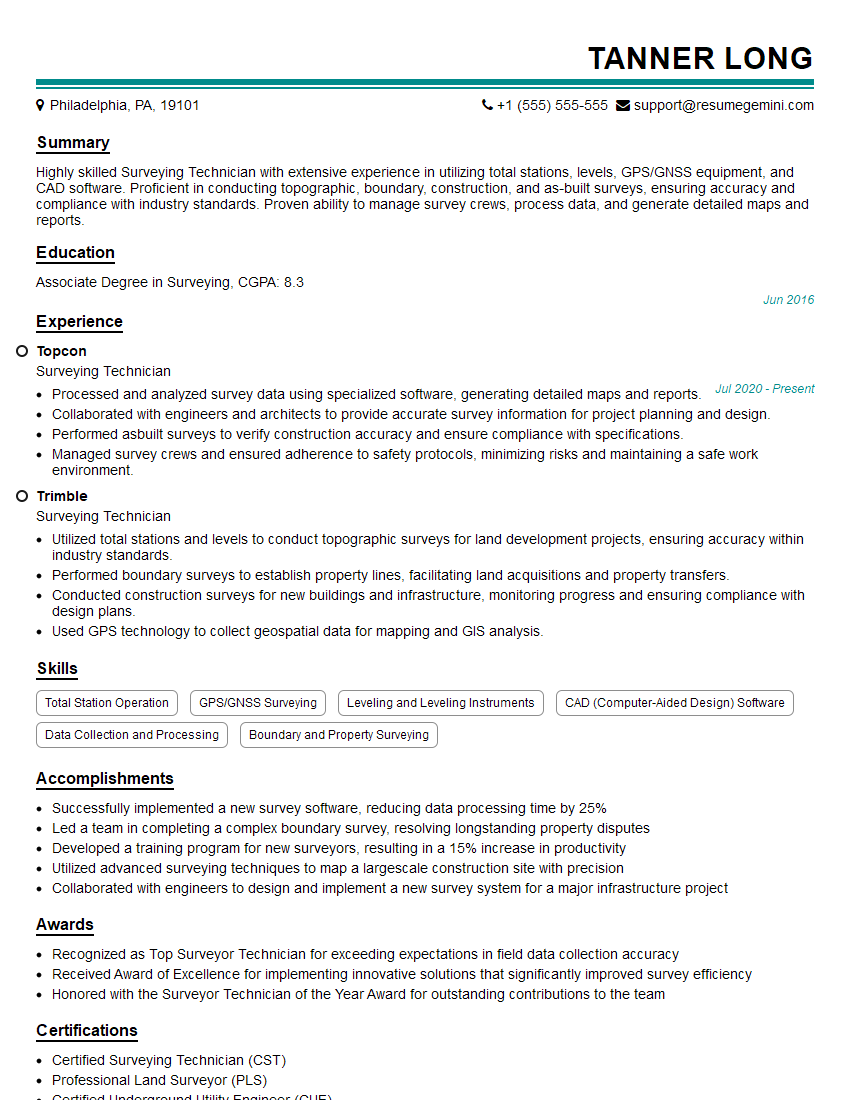
Ever felt underprepared for that crucial job interview? Or perhaps you’ve landed the interview but struggled to articulate your skills and experiences effectively? Fear not! We’ve got you covered. In this blog post, we’re diving deep into the Surveying Technician interview questions that you’re most likely to encounter. But that’s not all. We’ll also provide expert insights into the key responsibilities of a Surveying Technician so you can tailor your answers to impress potential employers.
Acing the interview is crucial, but landing one requires a compelling resume that gets you noticed. Crafting a professional document that highlights your skills and experience is the first step toward interview success. ResumeGemini can help you build a standout resume that gets you called in for that dream job.






Essential Interview Questions For Surveying Technician
1. What are the different types of surveying instruments used for topographic surveys?
There are various surveying instruments utilized in topographic surveys, including:
- Total Station: An electronic instrument that measures angles and distances, providing highly accurate data for topographic mapping.
- Theodolite: A precision instrument that measures horizontal and vertical angles, commonly used in conjunction with a distance-measuring device.
- Level: Used to establish and maintain horizontal planes of reference, allowing for accurate measurements of elevations.
- GPS Receiver: Employs satellite-based navigation systems to determine the location and elevation of points.
2. Explain the process of conducting a boundary survey.
Fieldwork:
- Review property deeds and locate property lines.
- Mark and measure property corners and boundaries.
Data Processing:
- Compile field data and create a map.
- Calculate areas and establish property descriptions.
Report Preparation:
- Create a boundary survey plat.
- Write a legal description of the property.
3. What are the common sources of error in surveying measurements and how can they be minimized?
Sources of error in surveying measurements include:
- Instrument errors: Calibrate instruments regularly to minimize inherent errors.
- Environmental factors: Temperature, wind, and atmospheric pressure can affect measurements. Use appropriate corrections and work during stable conditions.
- Human errors: Mistakes can occur during reading, recording, or calculations. Implement quality control measures and training.
- Natural phenomena: Earth movements or vegetation growth can alter measurements. Re-survey as necessary.
4. Describe the role of computer-aided design (CAD) in surveying.
CAD plays a vital role in surveying, enabling:
- Data Visualization: Create digital maps and 3D models for clear and accurate data representation.
- Data Analysis: Analyze data to identify patterns, trends, and potential issues.
- Design and Planning: Create site plans, design proposals, and infrastructure designs.
- Data Exchange: Facilitate collaboration and data sharing with stakeholders using standard file formats.
5. How do you ensure the accuracy and reliability of survey data?
Accuracy and reliability are ensured through:
- Calibration and Maintenance: Regularly calibrate and maintain equipment to minimize instrument errors.
- Field Procedures: Follow established protocols, including proper surveying techniques and data collection methods.
- Quality Control: Implement quality control measures such as double-checking measurements, using redundant systems, and reviewing data for errors.
- Data Verification: Verify data against known benchmarks or previous surveys to ensure consistency.
6. Can you explain the concept of geodetic surveying and its applications?
Geodetic surveying establishes control networks that define a specific coordinate system for a region or continent. It involves:
- Control Points: Establishing a network of precisely measured points using GPS and other techniques.
- Datum Planes: Defining horizontal and vertical reference planes for the coordinate system.
- Applications: Geodetic surveying supports various applications, including mapping, navigation, and land development.
7. What are the different methods for measuring elevations and how do you determine the most appropriate method for a specific project?
Elevation measurement methods include:
- Leveling: Using a level to establish horizontal planes and measure differences in elevation.
- Trigonometric Leveling: Employing a theodolite to measure vertical angles and calculate elevations.
- GPS Surveying: Using GPS receivers to determine elevations based on satellite data.
- Photogrammetry: Using aerial or satellite imagery to extract elevation data.
- Method Selection: The most appropriate method depends on factors such as accuracy requirements, terrain characteristics, and budget.
8. How do you handle boundary disputes and resolve conflicts with neighboring landowners?
Handling boundary disputes involves:
- Research: Review property deeds, survey records, and legal documents.
- Negotiation: Engage in respectful communication with involved parties to find mutually acceptable solutions.
- Survey Verification: Conduct a boundary survey to verify the location of property lines and resolve discrepancies.
- Mediation: Involve a neutral third party to facilitate discussions and reach a compromise.
- Legal Action: In some cases, legal proceedings may be necessary.
9. Describe your experience with using surveying software and explain its benefits in the field.
Experience with surveying software includes:
- Data Management: Storing, managing, and editing survey data in digital formats.
- Data Analysis: Performing calculations, generating reports, and creating maps.
- Field Data Collection: Utilizing software to collect and record data in the field using mobile devices or data collectors.
- Benefits: Increased efficiency, improved accuracy, enhanced data visualization, and smoother data sharing.
10. How do you stay updated with the latest surveying technologies and industry best practices?
Staying updated involves:
- Attending Conferences and Seminars: Participating in industry events to learn about new technologies and advancements.
- Continuing Education: Pursuing online courses, workshops, and certifications to enhance knowledge and skills.
- Reading Industry Publications: Staying abreast of industry journals, newsletters, and technical articles.
- Networking with Professionals: Connecting with other surveyors, engineers, and technology providers to exchange knowledge and ideas.
Interviewers often ask about specific skills and experiences. With ResumeGemini‘s customizable templates, you can tailor your resume to showcase the skills most relevant to the position, making a powerful first impression. Also check out Resume Template specially tailored for Surveying Technician.
Career Expert Tips:
- Ace those interviews! Prepare effectively by reviewing the Top 50 Most Common Interview Questions on ResumeGemini.
- Navigate your job search with confidence! Explore a wide range of Career Tips on ResumeGemini. Learn about common challenges and recommendations to overcome them.
- Craft the perfect resume! Master the Art of Resume Writing with ResumeGemini’s guide. Showcase your unique qualifications and achievements effectively.
- Great Savings With New Year Deals and Discounts! In 2025, boost your job search and build your dream resume with ResumeGemini’s ATS optimized templates.
Researching the company and tailoring your answers is essential. Once you have a clear understanding of the Surveying Technician‘s requirements, you can use ResumeGemini to adjust your resume to perfectly match the job description.
Key Job Responsibilities
As a Surveying Technician, you will be responsible for assisting surveying crews in collecting and processing data, and in maintaining and repairing surveying equipment. Your key job responsibilities will include:
1. Field Work
You will work with a surveying crew to collect data in the field, using surveying instruments such as levels, theodolites, and total stations. This data will be used to create maps, plans, and other documents.
- Operating and maintaining surveying instruments
- Collecting and recording data
- Setting up and taking down equipment
- Ensuring the accuracy of data
2. Data Processing
You will process the data that is collected in the field using computer software. This data will be used to create maps, plans, and other documents.
- Entering data into the computer
- Processing and analyzing data
- Creating maps, plans, and other documents
- Checking the accuracy of data
3. Equipment Maintenance
You will be responsible for maintaining and repairing the surveying equipment that is used in the field. This equipment includes levels, theodolites, total stations, and GPS receivers.
- Cleaning and inspecting equipment
- Performing minor repairs
- Ordering and replacing parts
- Ensuring the equipment is in good working order
4. Other Duties
You may also be responsible for other duties, such as:
- Assisting with the preparation of surveying reports
- Providing customer service
- Working with other professionals, such as engineers and architects
Interview Tips
Preparing for an interview for a Surveying Technician position can be daunting, but it is important to remember that the interviewer will be assessing your skills, experience, and personality. Here are 5 interview tips to help you ace the interview and land the job:
1. Research the Company and the Position
Before the interview, take some time to research the company and the position you are applying for. This will help you understand the company’s culture, values, and goals. It will also help you understand the specific requirements of the position, so that you can tailor your answers to the interviewer’s questions.
- Visit the company’s website
- Read the job description carefully
- Talk to people who work at the company
2. Practice Answering Common Interview Questions
There are a number of common interview questions that you can expect to be asked, such as “Tell me about yourself” and “Why are you interested in this position?” It is important to practice answering these questions in a clear and concise way.
- Use the STAR method to answer behavioral questions
- Keep your answers brief and to the point
- Be prepared to give examples of your skills and experience
3. Dress Professionally
First impressions matter, so it is important to dress professionally for the interview. This means wearing a suit or business casual attire. You should also make sure that your clothes are clean and pressed.
4. Be Punctual
Punctuality is important for any job interview, but it is especially important for a Surveying Technician position. This is because you will need to be able to work independently and manage your time effectively.
5. Be Yourself
The most important thing is to be yourself during the interview. The interviewer will be able to tell if you are being fake or dishonest, so it is important to be genuine and authentic.
Next Step:
Now that you’re armed with the knowledge of Surveying Technician interview questions and responsibilities, it’s time to take the next step. Build or refine your resume to highlight your skills and experiences that align with this role. Don’t be afraid to tailor your resume to each specific job application. Finally, start applying for Surveying Technician positions with confidence. Remember, preparation is key, and with the right approach, you’ll be well on your way to landing your dream job. Build an amazing resume with ResumeGemini