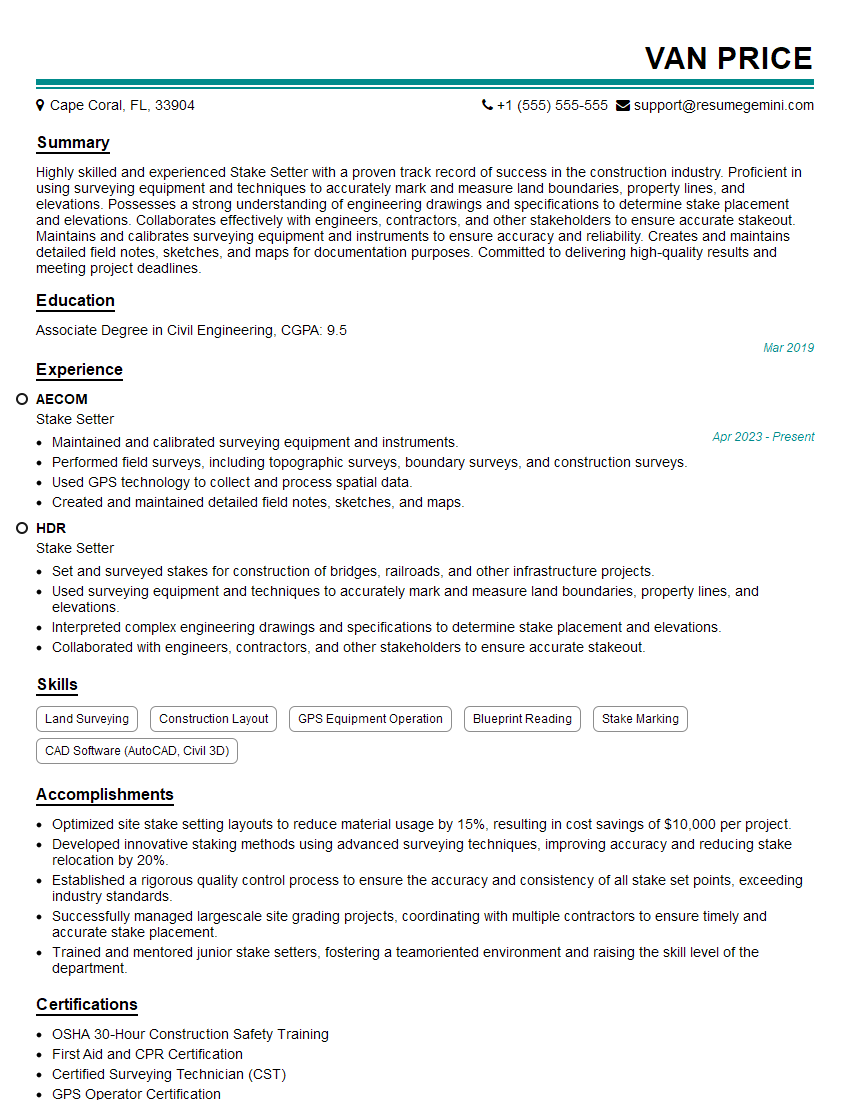
Ever felt underprepared for that crucial job interview? Or perhaps you’ve landed the interview but struggled to articulate your skills and experiences effectively? Fear not! We’ve got you covered. In this blog post, we’re diving deep into the Stake Setter interview questions that you’re most likely to encounter. But that’s not all. We’ll also provide expert insights into the key responsibilities of a Stake Setter so you can tailor your answers to impress potential employers.
Acing the interview is crucial, but landing one requires a compelling resume that gets you noticed. Crafting a professional document that highlights your skills and experience is the first step toward interview success. ResumeGemini can help you build a standout resume that gets you called in for that dream job.






Essential Interview Questions For Stake Setter
1. Describe the key responsibilities of a Stake Setter in a construction project?
As a Stake Setter, my primary responsibilities include:
- Laying out and setting stakes to establish boundaries, elevations, and control points for construction projects
- Using surveying equipment such as levels, transits, and total stations to accurately mark and align stakes
- Interpreting construction plans and specifications to determine stake locations and elevations
- Maintaining and updating stake records and documentation throughout the project
- Working closely with surveyors, engineers, and contractors to ensure accurate and timely stake placement
2. What are the different types of stakes used in construction?
- Boundary stakes: Mark the property boundaries of the construction site
- Elevation stakes: Indicate the finished grade or elevation of the project
- Control points: Provide reference points for other stakeout operations
- Layout stakes: Used to locate specific points or features within the project
- Grade stakes: Set at specific elevations to guide grading and excavation activities
3. What are the key factors to consider when setting stakes?
When setting stakes, I consider the following factors:
- Construction plans and specifications
- Site conditions and topography
- Established benchmarks and control points
- Equipment capabilities and limitations
- Safety and accessibility of the stakeout area
4. How do you ensure the accuracy of your stakeouts?
I follow these steps to ensure accuracy:
- Calibration and maintenance: Regularly calibrate and maintain surveying equipment
- Double-checking: Verify measurements and calculations using different methods and equipment
- Referencing benchmarks: Use established benchmarks as reference points to ensure consistent elevations
- Stake redundancy: Set multiple stakes around key points to minimize errors
- Site inspections: Regularly inspect stakes to ensure they are undisturbed and properly marked
5. What software and technologies do you use for stakeout operations?
I am proficient in using various software and technologies, including:
- Total station software for data collection and processing
- GPS receivers for precise positioning and mapping
- CAD software for creating and editing stakeout plans
- Cloud-based project management platforms for real-time collaboration
- Laser levels and other measuring tools for accurate stake placement
6. How do you prioritize and manage multiple stakeout tasks?
I prioritize tasks based on their importance, deadlines, and the availability of resources. I use the following strategies:
- Planning and scheduling: Create a detailed schedule to allocate time and resources effectively
- Delegation: Assign tasks to team members with appropriate skills and experience
- Communication: Keep project stakeholders informed about progress and potential delays
- Flexibility: Adjust the schedule and priorities as needed to meet changing project requirements
7. What are the safety precautions you take when working on construction sites?
Safety is my top priority on construction sites. I adhere to the following precautions:
- Wearing appropriate safety gear, including hard hat, safety glasses, and high-visibility clothing
- Being aware of potential hazards and taking steps to mitigate risks
- Following established safety protocols and procedures
- Inspecting equipment regularly and reporting any defects or malfunctions
- Maintaining a clean and organized work area
8. How do you handle discrepancies or errors in stakeout operations?
When encountering discrepancies or errors, I follow these steps:
- Verification: Double-check measurements and calculations to identify the source of the error
- Correction: Make necessary adjustments to the stakeout plan or field operations
- Communication: Inform project stakeholders about the error and any corrective actions taken
- Documentation: Record the incident, its cause, and the resolution for future reference
9. What are the emerging trends and technologies in stakeout operations?
The field of stakeout operations is constantly evolving. Some emerging trends and technologies include:
- 3D modeling and BIM: Using 3D models to visualize and plan stakeouts more accurately
- Drone technology: Utilizing drones for aerial mapping and stakeout verification
- Machine control systems: Automating stakeout operations using GPS-guided equipment
- Augmented reality (AR): Superimposing digital information onto the real world to enhance stakeout accuracy
- Cloud-based stakeout management: Centralizing stakeout data and collaboration for real-time project updates
10. Why are you interested in this Stake Setter position with our company?
I am eager to join your company as a Stake Setter because:
- Your company’s reputation for excellence in the construction industry
- The opportunity to work on challenging and complex projects
- The chance to contribute to the successful execution of your projects
- Your company’s commitment to innovation and technology in construction practices
- The potential for professional growth and development within your organization
Interviewers often ask about specific skills and experiences. With ResumeGemini‘s customizable templates, you can tailor your resume to showcase the skills most relevant to the position, making a powerful first impression. Also check out Resume Template specially tailored for Stake Setter.
Career Expert Tips:
- Ace those interviews! Prepare effectively by reviewing the Top 50 Most Common Interview Questions on ResumeGemini.
- Navigate your job search with confidence! Explore a wide range of Career Tips on ResumeGemini. Learn about common challenges and recommendations to overcome them.
- Craft the perfect resume! Master the Art of Resume Writing with ResumeGemini’s guide. Showcase your unique qualifications and achievements effectively.
- Great Savings With New Year Deals and Discounts! In 2025, boost your job search and build your dream resume with ResumeGemini’s ATS optimized templates.
Researching the company and tailoring your answers is essential. Once you have a clear understanding of the Stake Setter‘s requirements, you can use ResumeGemini to adjust your resume to perfectly match the job description.
Key Job Responsibilities
Stake Setters are responsible for preparing construction sites for building projects. They mark the locations of buildings, roads, and other structures using stakes and string.
1. Stake Out Building Locations
Stake Setters use blueprints and survey data to determine the precise locations of buildings on a construction site.
- Measure and mark the corners of building foundations
- Install stakes and string to outline the perimeter of buildings
2. Set Grades for Roads and Other Structures
Stake Setters also establish the grades for roads, sidewalks, and other structures on the site.
- Use levels and transits to determine the elevation of different points on the site
- Set stakes and string to indicate the desired grades
3. Mark Utility Locations
Stake Setters may also be responsible for marking the locations of underground utilities, such as water lines, sewer lines, and electrical cables.
- Use ground-penetrating radar or other methods to locate utilities
- Mark the locations of utilities with stakes and flags
4. Supervise and Train Crew Members
Some Stake Setters may also supervise and train crew members. They may also be responsible for ensuring that the crew complies with safety regulations.
- Train crew members on proper staking techniques
- Supervise crew members to ensure that they are working safely and efficiently
Interview Tips
To ace your interview for a Stake Setter position, it is important to be prepared and to demonstrate your knowledge of the job responsibilities.
1. Research the Company and the Position
Before your interview, take some time to research the company and the specific Stake Setter position you are applying for. This will help you understand the company’s culture and the specific requirements of the job.
- Visit the company’s website and social media pages
- Read online reviews of the company
- Talk to people you know who work for the company
2. Practice Answering Common Interview Questions
There are a number of common interview questions that you are likely to be asked in an interview for a Stake Setter position. It is important to practice answering these questions so that you can deliver clear and concise responses.
- Tell me about your experience in staking out building locations.
- How do you set grades for roads and other structures?
- What are some of the challenges of being a Stake Setter?
- What are your strengths and weaknesses as a Stake Setter?
3. Prepare Questions to Ask the Interviewer
Asking thoughtful questions at the end of an interview shows that you are interested in the position and the company. It also gives you an opportunity to learn more about the company and the job.
- What is the company culture like?
- What are the biggest challenges facing the company right now?
- What are the opportunities for advancement within the company?
4. Dress Professionally and Arrive on Time
First impressions matter, so it is important to dress professionally and to arrive on time for your interview. This shows that you are respectful of the interviewer’s time and that you are serious about the position.
- Wear a suit or business casual attire
- Arrive 10-15 minutes early for your interview
Next Step:
Armed with this knowledge, you’re now well-equipped to tackle the Stake Setter interview with confidence. Remember, a well-crafted resume is your first impression. Take the time to tailor your resume to highlight your relevant skills and experiences. And don’t forget to practice your answers to common interview questions. With a little preparation, you’ll be on your way to landing your dream job. So what are you waiting for? Start building your resume and start applying! Build an amazing resume with ResumeGemini.