Are you gearing up for a career shift or aiming to ace your next interview? Look no further! We’ve curated a comprehensive guide to help you crack the interview for the coveted Food Science Professor position. From understanding the key responsibilities to mastering the most commonly asked questions, this blog has you covered. So, buckle up and let’s embark on this journey together.
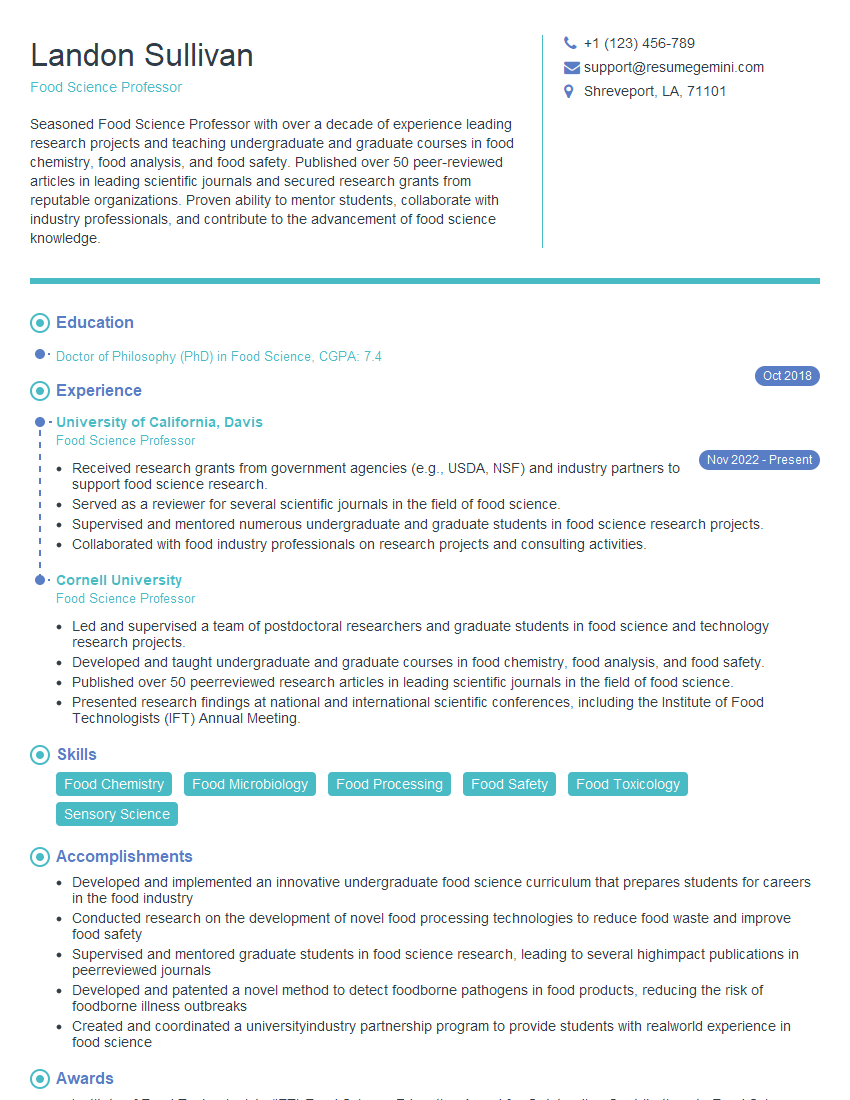
Acing the interview is crucial, but landing one requires a compelling resume that gets you noticed. Crafting a professional document that highlights your skills and experience is the first step toward interview success. ResumeGemini can help you build a standout resume that gets you called in for that dream job.






Essential Interview Questions For Food Science Professor
1. Briefly explain the process of Maillard reaction and its impact on food quality.
- Maillard reaction is a non-enzymatic browning reaction that occurs when reducing sugars react with amino acids.
- It produces a range of compounds, including melanoidins, which are responsible for the characteristic brown color and flavor of many foods.
- The Maillard reaction can also have a negative impact on food quality, leading to the formation of off-flavors and loss of nutritional value.
2. Describe the principles of food preservation and the different methods used.
Chemical preservation
- Chemical preservatives are used to inhibit the growth of microorganisms in food.
- Common chemical preservatives include sodium benzoate, potassium sorbate, and propionic acid.
Physical preservation
- Physical preservation methods include refrigeration, freezing, and drying.
- These methods prevent the growth of microorganisms by reducing their activity or availability of water.
Biological preservation
- Biological preservation methods use microorganisms or their metabolites to inhibit the growth of spoilage organisms.
- Examples include the use of lactic acid bacteria to produce fermented foods.
3. Discuss the role of enzymes in food processing and the factors that affect their activity.
- Enzymes are used in food processing to catalyze a wide range of reactions, such as the hydrolysis of proteins and the oxidation of lipids.
- The activity of enzymes is affected by a number of factors, including pH, temperature, and substrate concentration.
- It is important to control these factors to ensure that enzymes are used effectively in food processing.
4. Explain the concept of food safety and the HACCP system.
- Food safety is the assurance that food is safe to eat and does not pose a risk to human health.
- The HACCP (Hazard Analysis and Critical Control Points) system is a systematic approach to identifying and controlling food safety hazards.
- HACCP involves identifying the critical control points in a food production process and implementing controls to ensure that these points are managed safely.
5. Describe the different types of food packaging materials and their suitability for different applications.
- Food packaging materials include plastics, metals, glass, and paper.
- The choice of packaging material depends on the product being packaged, the shelf life required, and the cost.
- For example, plastics are lightweight and inexpensive, but they can be permeable to oxygen and moisture.
- Metals are impermeable to oxygen and moisture, but they are more expensive and can be heavier than plastics.
6. Discuss the principles of food sensory evaluation and the different methods used.
- Food sensory evaluation is the scientific study of how people perceive food.
- Sensory evaluation methods include analytical methods, such as descriptive analysis, and affective methods, such as consumer testing.
- Sensory evaluation is used to develop new products, improve existing products, and understand consumer preferences.
7. Explain the role of food science in addressing global food security issues.
- Food science can help to address global food security issues by developing new and more sustainable food production methods.
- Food science can also help to reduce food waste and improve the nutritional value of food.
- By working to address global food security issues, food science can help to create a more sustainable and equitable world.
8. Discuss the ethical implications of genetic engineering in the food industry.
- Genetic engineering has the potential to improve the nutritional value and yield of crops.
- However, there are also ethical concerns about the use of genetic engineering, such as the potential for harm to the environment.
- It is important to weigh the potential benefits and risks of genetic engineering before making decisions about its use in the food industry.
9. Describe the emerging trends in food science and technology.
- Emerging trends in food science and technology include the use of artificial intelligence, robotics, and nanotechnology.
- These technologies have the potential to revolutionize the way food is produced, processed, and consumed.
- For example, artificial intelligence can be used to optimize food production processes and predict consumer demand.
10. How would you approach the research and teaching responsibilities of this position?
- My research interests are in the area of food safety and quality.
- I am particularly interested in developing new methods to detect and control foodborne pathogens.
- In terms of teaching, I am passionate about sharing my knowledge of food science with students.
- I believe that it is important to create a learning environment that is both challenging and supportive.
Interviewers often ask about specific skills and experiences. With ResumeGemini‘s customizable templates, you can tailor your resume to showcase the skills most relevant to the position, making a powerful first impression. Also check out Resume Template specially tailored for Food Science Professor.
Career Expert Tips:
- Ace those interviews! Prepare effectively by reviewing the Top 50 Most Common Interview Questions on ResumeGemini.
- Navigate your job search with confidence! Explore a wide range of Career Tips on ResumeGemini. Learn about common challenges and recommendations to overcome them.
- Craft the perfect resume! Master the Art of Resume Writing with ResumeGemini’s guide. Showcase your unique qualifications and achievements effectively.
- Great Savings With New Year Deals and Discounts! In 2025, boost your job search and build your dream resume with ResumeGemini’s ATS optimized templates.
Researching the company and tailoring your answers is essential. Once you have a clear understanding of the Food Science Professor‘s requirements, you can use ResumeGemini to adjust your resume to perfectly match the job description.
Key Job Responsibilities
As a Food Science Professor, you will have the following key responsibilities:
1. Teaching
You will be responsible for developing and delivering undergraduate and graduate courses in food science. This will involve planning lectures, preparing lesson plans, grading assignments, and providing feedback to students.
- Develop and deliver lectures on food science topics.
- Prepare lesson plans and course materials.
- Grade assignments and provide feedback to students.
- Advise students on their academic progress.
2. Research
You will be expected to conduct research in food science. This may involve working with undergraduate and graduate students on research projects, publishing your findings in peer-reviewed journals, and presenting your work at conferences.
- Conduct research in food science.
- Publish findings in peer-reviewed journals.
- Present research findings at conferences.
- Secure funding for research projects.
3. Service
You will be expected to participate in service activities, such as serving on committees, advising student organizations, and outreach to the community.
- Serve on committees.
- Advise student organizations.
- Outreach to the community.
- Participate in professional development activities.
4. Other Responsibilities
You may also be responsible for other duties, such as supervising teaching assistants, developing new courses, or serving as a faculty mentor.
- Supervise teaching assistants.
- Develop new courses.
- Serve as a faculty mentor.
- Maintain a research laboratory.
Interview Tips
Preparing for an interview for a Food Science Professor position can be daunting, but by following these tips, you can increase your chances of success.
1. Research the Position and the University
Before the interview, take the time to research the specific position and the university. This will help you to understand the institution’s mission, values, and research priorities. It will also help you to tailor your answers to the specific needs of the position.
- Visit the university’s website.
- Read the position description carefully.
- Look for news articles and other information about the university and the department.
2. Practice Your Answers to Common Interview Questions
There are a number of common interview questions that you can expect to be asked, such as “Why are you interested in this position?” and “What are your strengths and weaknesses?”. It is helpful to practice your answers to these questions in advance so that you can deliver them confidently and concisely.
- Review common interview questions.
- Prepare your answers in advance.
- Practice delivering your answers out loud.
3. Be Prepared to Discuss Your Research
As a Food Science Professor, you will be expected to conduct research. In the interview, you should be prepared to discuss your research interests and accomplishments. You should also be able to explain how your research fits into the mission of the university and the department.
- Prepare a brief presentation of your research.
- Be able to explain how your research fits into the mission of the university and the department.
- Be prepared to answer questions about your research methods and findings.
4. Be Enthusiastic and Professional
It is important to be enthusiastic and professional throughout the interview process. This will show the interviewers that you are interested in the position and that you are a good fit for the university. Be sure to arrive on time for your interview and dress appropriately.
- Be on time for your interview.
- Dress appropriately.
- Be enthusiastic and professional.
- Thank the interviewers for their time.
Next Step:
Armed with this knowledge, you’re now well-equipped to tackle the Food Science Professor interview with confidence. Remember, preparation is key. So, start crafting your resume, highlighting your relevant skills and experiences. Don’t be afraid to tailor your application to each specific job posting. With the right approach and a bit of practice, you’ll be well on your way to landing your dream job. Build your resume now from scratch or optimize your existing resume with ResumeGemini. Wish you luck in your career journey!