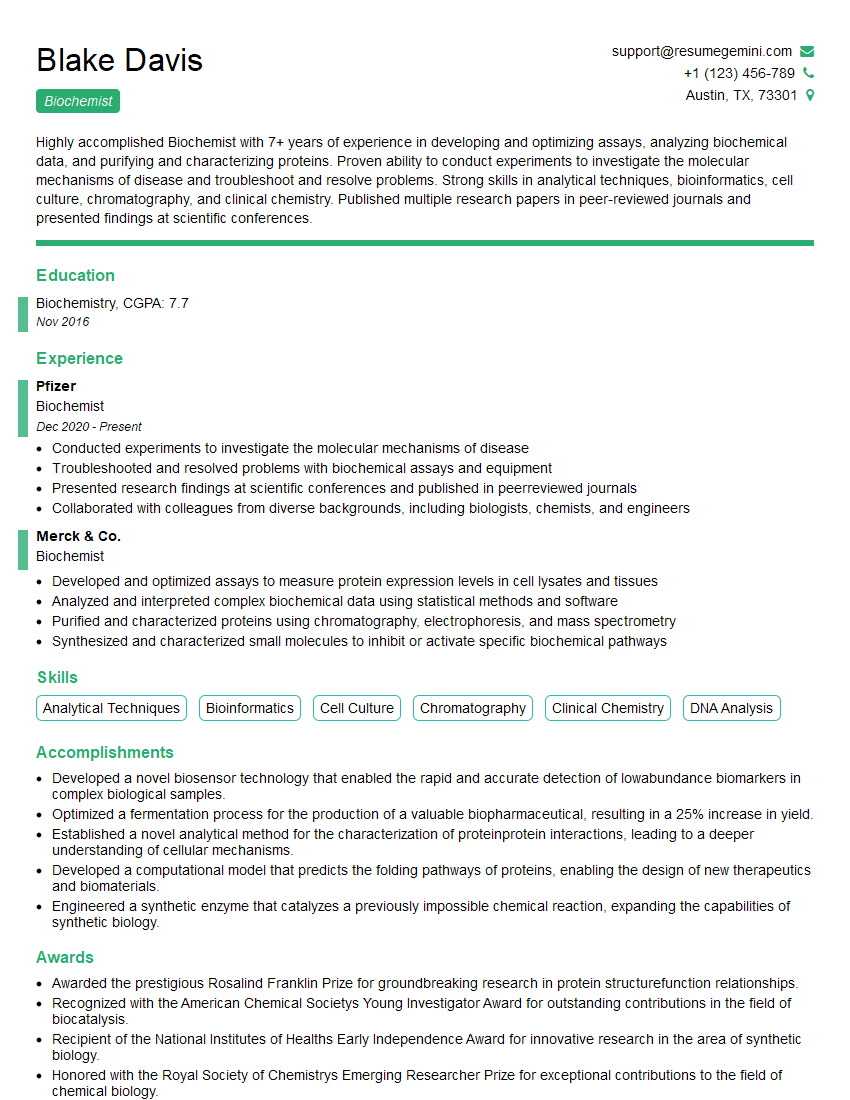
Ever felt underprepared for that crucial job interview? Or perhaps you’ve landed the interview but struggled to articulate your skills and experiences effectively? Fear not! We’ve got you covered. In this blog post, we’re diving deep into the Biochemist interview questions that you’re most likely to encounter. But that’s not all. We’ll also provide expert insights into the key responsibilities of a Biochemist so you can tailor your answers to impress potential employers.
Acing the interview is crucial, but landing one requires a compelling resume that gets you noticed. Crafting a professional document that highlights your skills and experience is the first step toward interview success. ResumeGemini can help you build a standout resume that gets you called in for that dream job.






Essential Interview Questions For Biochemist
1. Can you describe the role of enzymes in biochemical reactions?
- Enzymes are biological catalysts that increase the rate of chemical reactions without being consumed in the process.
- They work by lowering the activation energy required for a reaction to occur, allowing reactions to proceed more quickly and efficiently.
- Enzymes are highly specific, meaning they only catalyze specific reactions or a narrow range of related reactions.
- Enzyme activity can be affected by factors such as temperature, pH, and the presence of inhibitors or activators.
- Enzymes are essential for life, as they are involved in countless biochemical reactions within cells.
2. Explain the concept of enzyme kinetics and its relevance in understanding enzyme function.
- The Michaelis-Menten model is a mathematical model that describes the relationship between enzyme concentration, substrate concentration, and reaction rate.
- It allows us to determine kinetic parameters such as the Michaelis constant (Km) and the maximum reaction rate (Vmax).
- This information is crucial for understanding how enzymes function and for designing experiments to study enzyme kinetics.
- Enzyme inhibitors are molecules that bind to enzymes and reduce their activity.
- Understanding enzyme inhibition is important for developing drugs and understanding the effects of certain substances on enzyme function.
Michaelis-Menten Model
Enzyme Inhibition
3. Discuss the techniques you are proficient in for protein purification.
- Chromatography: Techniques such as ion exchange chromatography, gel filtration chromatography, and affinity chromatography.
- Electrophoresis: Techniques such as sodium dodecyl sulfate-polyacrylamide gel electrophoresis (SDS-PAGE) and isoelectric focusing.
- Centrifugation: Techniques such as differential centrifugation and ultracentrifugation.
- Precipitation and crystallization: Techniques such as ammonium sulfate precipitation and protein crystallization.
- Dialysis and ultrafiltration: Techniques for removing salts and other small molecules from protein solutions.
4. Describe the methods used to study protein structure and function.
- X-ray crystallography: Determining the atomic structure of proteins based on X-ray diffraction patterns.
- Nuclear magnetic resonance (NMR) spectroscopy: Determining the solution structure of proteins based on NMR signals.
- Cryo-electron microscopy (cryo-EM): Visualizing protein structures using electron microscopy techniques.
- Bioinformatics tools: Predicting protein structures and functions based on sequence and evolutionary information.
- Protein assays: Techniques such as Bradford assay and Western blotting for quantifying and detecting proteins.
5. Explain the central dogma of molecular biology and its implications in gene expression.
- Replication: DNA is copied to produce identical copies during cell division.
- Transcription: DNA is transcribed into RNA molecules, which carry genetic information to the cytoplasm.
- Translation: RNA is translated into proteins, which carry out specific functions in the cell.
- Gene expression: The regulation of gene transcription and translation is crucial for controlling protein production and cellular functions.
- Molecular biology techniques: Techniques such as PCR, DNA sequencing, and gene cloning are used to study and manipulate genes and DNA.
6. Discuss the principles and applications of molecular cloning.
- Restriction enzymes: Enzymes that cut DNA at specific sequences, creating sticky or blunt ends.
- Vectors: Plasmids or viruses used to carry and replicate foreign DNA.
- Ligation: Enzymes that join DNA fragments together.
- Transformation: Introduction of recombinant DNA into host cells.
- Applications: Protein expression, gene therapy, genetic engineering, and biotechnology.
7. Describe the techniques used to study gene regulation.
- Transcription factor analysis: Identifying and studying proteins that regulate gene transcription.
- Microarray analysis: Monitoring the expression of thousands of genes simultaneously.
- RNA sequencing (RNA-Seq): Determining the sequence and quantity of RNA molecules to study gene expression patterns.
- Epigenetics: Studying heritable changes in gene expression that do not involve changes in DNA sequence.
- CRISPR-Cas systems: Powerful gene editing tools for precise genome modifications.
8. Explain the principles and applications of mass spectrometry in biochemistry.
- Mass-to-charge ratio: Mass spectrometry measures the mass-to-charge ratio of ions.
- Ionization techniques: Different methods are used to ionize molecules, such as electrospray ionization (ESI) and matrix-assisted laser desorption ionization (MALDI).
- Mass analyzers: Quadrupole, time-of-flight (TOF), and ion trap analyzers separate ions based on their mass-to-charge ratio.
- Applications: Protein identification, protein sequencing, metabolite analysis, and drug discovery.
- Tandem mass spectrometry (MS/MS): Fragmentation of ions to obtain structural information.
9. Discuss the ethical implications of genetic engineering and gene therapy.
- Potential benefits: Treating genetic diseases, improving crop yields, and creating new biomaterials.
- Ethical concerns: Unintended consequences, environmental risks, and potential for discrimination.
- Regulatory considerations: Government agencies and international organizations play a role in regulating genetically modified organisms and gene therapies.
- Public engagement: Educating the public about genetic engineering and gene therapy is crucial for informed decision-making.
- Balancing scientific progress with ethical responsibilities: Researchers and policymakers must weigh the potential benefits and risks of these technologies.
10. Describe your experience working in a team environment on a scientific research project.
- Highlight your ability to collaborate effectively with others.
- Discuss your contributions to the project and how you worked together to achieve common goals.
- Emphasize your communication, problem-solving, and interpersonal skills.
- Explain how the team environment fostered innovation and learning.
- Provide specific examples to support your claims.
Interviewers often ask about specific skills and experiences. With ResumeGemini‘s customizable templates, you can tailor your resume to showcase the skills most relevant to the position, making a powerful first impression. Also check out Resume Template specially tailored for Biochemist.
Career Expert Tips:
- Ace those interviews! Prepare effectively by reviewing the Top 50 Most Common Interview Questions on ResumeGemini.
- Navigate your job search with confidence! Explore a wide range of Career Tips on ResumeGemini. Learn about common challenges and recommendations to overcome them.
- Craft the perfect resume! Master the Art of Resume Writing with ResumeGemini’s guide. Showcase your unique qualifications and achievements effectively.
- Great Savings With New Year Deals and Discounts! In 2025, boost your job search and build your dream resume with ResumeGemini’s ATS optimized templates.
Researching the company and tailoring your answers is essential. Once you have a clear understanding of the Biochemist‘s requirements, you can use ResumeGemini to adjust your resume to perfectly match the job description.
Key Job Responsibilities
Biochemists study the chemical processes that occur in living organisms. They investigate the structure and function of biological molecules, such as proteins, carbohydrates, lipids, and nucleic acids. Biochemists also study the interactions between these molecules and how they affect the overall functioning of cells, tissues, and organs. Their research has applications in fields such as medicine, agriculture, and biotechnology.
1. Conducting Research
Biochemists conduct research to investigate the chemical processes that occur in living organisms. They may work in a variety of settings, such as universities, hospitals, or research institutes. Biochemists typically use a combination of experimental and computational techniques to study the structure and function of biological molecules. They may also develop new methods for detecting and analyzing these molecules.
- Design and conduct experiments to investigate the structure and function of biological molecules.
- Develop new methods for detecting and analyzing biological molecules.
- Use computational techniques to model and simulate biological systems.
2. Teaching
Biochemists may also teach courses in biochemistry at universities or colleges. They may also give lectures or workshops on biochemistry to professionals in other fields. Biochemists who teach typically have a strong understanding of the subject matter and are able to communicate complex concepts clearly.
- Teach courses in biochemistry at universities or colleges.
- Give lectures or workshops on biochemistry to professionals in other fields.
3. Consulting
Biochemists may also work as consultants for companies or organizations that need help with biochemical research or analysis. They may provide advice on a variety of topics, such as drug development, food safety, or environmental remediation. Biochemists who work as consultants typically have a strong understanding of the field and are able to communicate their findings clearly to non-scientists.
- Provide advice on a variety of topics, such as drug development, food safety, or environmental remediation.
- Communicate their findings clearly to non-scientists.
Interview Tips
Preparing for a job interview can be nerve-wracking, but there are a few things you can do to increase your chances of success. Here are a few tips:
1. Research the company and the position
Before you go on an interview, it’s important to do your research. Learn as much as you can about the company and the position you’re applying for. This will help you answer questions intelligently and show that you’re interested in the job.
- Visit the company’s website and read about their mission, values, and products or services.
- Read the job description carefully and identify the key requirements.
2. Practice answering common interview questions
There are a few common interview questions that you’re likely to be asked, such as “Tell me about yourself” and “Why are you interested in this job?” It’s a good idea to practice answering these questions in advance so that you can deliver your responses confidently and concisely.
- Write out your answers to common interview questions and practice saying them out loud.
- Ask a friend or family member to help you practice answering questions.
3. Dress professionally
First impressions matter, so it’s important to dress professionally for your interview. This means wearing clean, pressed clothes that are appropriate for the company culture. You should also avoid wearing too much jewelry or perfume.
- Choose clothes that are clean, pressed, and appropriate for the company culture.
- Avoid wearing too much jewelry or perfume.
4. Be on time
Punctuality is important, so make sure you arrive for your interview on time. If you’re running late, call or email the interviewer to let them know.
- Plan your route in advance and leave yourself plenty of time to get to the interview.
- If you’re running late, call or email the interviewer to let them know.
Next Step:
Now that you’re armed with the knowledge of Biochemist interview questions and responsibilities, it’s time to take the next step. Build or refine your resume to highlight your skills and experiences that align with this role. Don’t be afraid to tailor your resume to each specific job application. Finally, start applying for Biochemist positions with confidence. Remember, preparation is key, and with the right approach, you’ll be well on your way to landing your dream job. Build an amazing resume with ResumeGemini