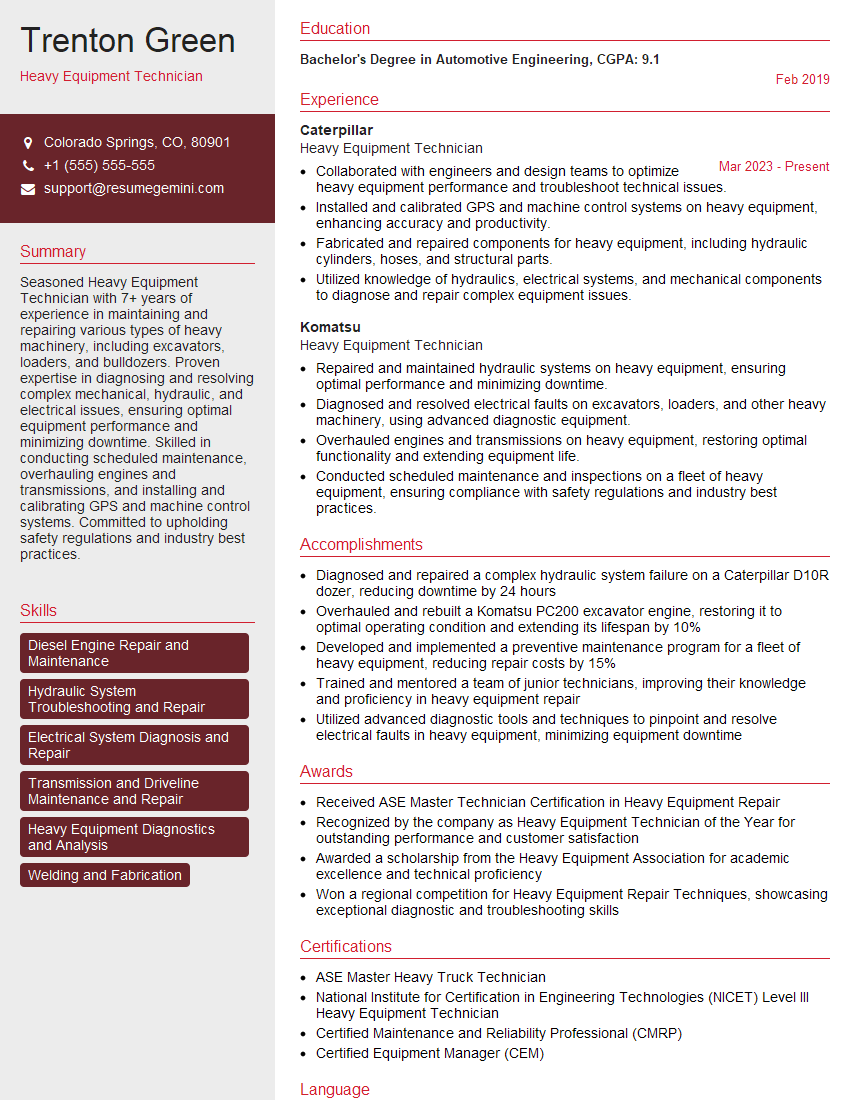
Are you gearing up for a career in Heavy Equipment Technician? Feeling nervous about the interview questions that might come your way? Don’t worry, you’re in the right place. In this blog post, we’ll dive deep into the most common interview questions for Heavy Equipment Technician and provide you with expert-backed answers. We’ll also explore the key responsibilities of this role so you can tailor your responses to showcase your perfect fit.
Acing the interview is crucial, but landing one requires a compelling resume that gets you noticed. Crafting a professional document that highlights your skills and experience is the first step toward interview success. ResumeGemini can help you build a standout resume that gets you called in for that dream job.






Essential Interview Questions For Heavy Equipment Technician
1. How would you troubleshoot a hydraulic system failure on a heavy equipment machine?
- Inspect the hydraulic lines, hoses, and fittings for leaks or damage.
- Check the hydraulic fluid level and condition, and top up or replace if necessary.
- Test the hydraulic pump pressure and flow using a pressure gauge.
- Inspect the hydraulic valves and actuators for proper operation.
- Check the hydraulic filter for contamination and replace if necessary.
2. What are the different types of engine cooling systems used in heavy equipment, and how do they work?
Liquid-cooled systems
- Use a liquid coolant (usually water or a water-glycol mixture) to absorb heat from the engine.
- The coolant is circulated through the engine by a water pump.
- The coolant passes through a radiator, where it is cooled by air or water.
Air-cooled systems
- Use air to cool the engine.
- Air is drawn in through the front of the engine by a fan.
- The air passes over the engine’s cylinders and heads, cooling them.
3. How would you diagnose and repair an electrical system problem on a heavy equipment machine?
- Check the battery voltage and terminals.
- Inspect the wiring harness for damage or loose connections.
- Test the fuses and relays.
- Use a multimeter to test the electrical components, such as the alternator, starter, and voltage regulator.
- Repair or replace any faulty components.
4. What are the different types of fuels used in heavy equipment, and what are their advantages and disadvantages?
- Diesel fuel: Advantages: high energy density, low emissions, good fuel economy. Disadvantages: high sulfur content, can be difficult to start in cold weather.
- Gasoline: Advantages: easy to start in cold weather, low cost. Disadvantages: low energy density, high emissions, poor fuel economy.
- Natural gas: Advantages: clean-burning, low emissions, low cost. Disadvantages: low energy density, requires special storage and handling equipment.
5. How would you perform a preventive maintenance inspection on a heavy equipment machine?
- Inspect the engine oil level and condition.
- Inspect the hydraulic fluid level and condition.
- Inspect the air filter.
- Inspect the fuel filter.
- Inspect the tires for wear and damage.
- Inspect the brakes for wear and damage.
6. What are the safety precautions that must be taken when working on heavy equipment?
- Wear appropriate safety gear, such as hard hat, safety glasses, and gloves.
- Never work on equipment that is running or has not been properly secured.
- Use proper tools and equipment for the job.
- Be aware of your surroundings and potential hazards.
- Follow all safety regulations and procedures.
7. What are the different types of heavy equipment attachments, and how are they used?
- Buckets: Used for digging, loading, and transporting materials.
- Forks: Used for lifting and transporting pallets and other materials.
- Augers: Used for drilling holes in the ground.
- Hammers: Used for breaking up concrete and other materials.
- Rippers: Used for breaking up hard-packed soil and rocks.
8. How would you troubleshoot a problem with a hydraulic cylinder?
- Check the hydraulic fluid level and condition.
- Inspect the hydraulic lines and hoses for leaks or damage.
- Test the hydraulic pump pressure and flow using a pressure gauge.
- Inspect the hydraulic valve for proper operation.
- Inspect the cylinder for leaks or damage.
9. What are the different types of transmissions used in heavy equipment, and how do they work?
- Manual transmissions: Use a clutch to engage and disengage the gears.
- Automatic transmissions: Use a torque converter to automatically shift gears.
- Hydrostatic transmissions: Use hydraulic fluid to transmit power from the engine to the wheels.
10. How would you perform a repair on a heavy equipment machine?
- Identify the problem and determine the necessary repairs.
- Gather the necessary tools and materials.
- Prepare the machine for repair by disconnecting the battery and removing any necessary components.
- Perform the repairs according to the manufacturer’s instructions.
- Test the repairs to ensure that the machine is operating properly.
Interviewers often ask about specific skills and experiences. With ResumeGemini‘s customizable templates, you can tailor your resume to showcase the skills most relevant to the position, making a powerful first impression. Also check out Resume Template specially tailored for Heavy Equipment Technician.
Career Expert Tips:
- Ace those interviews! Prepare effectively by reviewing the Top 50 Most Common Interview Questions on ResumeGemini.
- Navigate your job search with confidence! Explore a wide range of Career Tips on ResumeGemini. Learn about common challenges and recommendations to overcome them.
- Craft the perfect resume! Master the Art of Resume Writing with ResumeGemini’s guide. Showcase your unique qualifications and achievements effectively.
- Great Savings With New Year Deals and Discounts! In 2025, boost your job search and build your dream resume with ResumeGemini’s ATS optimized templates.
Researching the company and tailoring your answers is essential. Once you have a clear understanding of the Heavy Equipment Technician‘s requirements, you can use ResumeGemini to adjust your resume to perfectly match the job description.
Key Job Responsibilities
Heavy Equipment Technicians are responsible for maintaining, repairing, and servicing heavy equipment used in construction, mining, agriculture, and other industries. They work on a variety of machines, including excavators, bulldozers, loaders, and cranes.
1. Diagnostics and Troubleshooting
Diagnose and troubleshoot mechanical, electrical, and hydraulic systems of heavy equipment to identify and resolve issues.
- Operate diagnostic equipment to identify problems.
- Inspect and analyze equipment components to determine the root cause of malfunctions.
2. Repair and Maintenance
Perform repairs and maintenance on heavy equipment, including engine overhauls, transmission replacements, and hydraulic repairs.
- Disassemble, repair, and reassemble equipment components.
- Replace worn or damaged parts, such as bearings, seals, and gaskets.
- Ensure that equipment meets performance and safety standards.
3. Inspection and Testing
Inspect and test heavy equipment to ensure proper operation and safety.
- Conduct regular inspections of equipment to identify potential problems.
- Perform functional tests to verify the performance and reliability of equipment.
- Document inspection and test results for future reference.
4. Safety and Compliance
Adhere to safety protocols and ensure compliance with industry regulations.
- Follow proper safety procedures when working on heavy equipment.
- Inspect equipment for safety hazards and take corrective action.
- Maintain a clean and organized work environment.
Interview Tips
Preparing for an interview can be daunting, but with the right strategies, you can increase your chances of success. Here are some tips to help you ace your interview for a Heavy Equipment Technician position:
1. Research the Company and Position
Before the interview, take some time to research the company and the specific position you are applying for. This will help you understand the company’s culture, values, and what they are looking for in a candidate. By demonstrating your knowledge of the company, you will show that you are genuinely interested in the position and that you have taken the time to prepare.
- Visit the company’s website to learn about their history, mission, and products or services.
- Read articles or news stories about the company to gain insights into their industry and recent developments.
2. Highlight Your Skills and Experience
Make sure to highlight your relevant skills and experience during the interview. Be specific and provide examples of your work. If you have experience with specific types of heavy equipment or have worked on similar projects, be sure to mention this. You may also want to prepare a portfolio of your work to showcase your abilities.
- Emphasize your mechanical, electrical, and hydraulic skills, as well as your knowledge of heavy equipment systems.
- Provide examples of successful repairs or maintenance projects that you have completed.
- If you have any certifications or training in heavy equipment repair, be sure to mention this in your resume and during the interview.
3. Be Prepared for Technical Questions
During the interview, you may be asked technical questions about heavy equipment repair and maintenance. Be prepared to answer questions about equipment diagnostics, troubleshooting, and repair procedures. You should also be familiar with the safety regulations and industry best practices related to heavy equipment operation.
- Study up on common heavy equipment problems and their solutions.
- Practice answering technical questions in a clear and concise manner.
- Bring a notebook or notepad to the interview to take notes on any questions or information that you need to remember.
4. Dress Professionally and Arrive on Time
First impressions matter, so make sure to dress professionally for the interview. Arrive on time and be respectful of the interviewer’s time. Your appearance and punctuality will demonstrate that you are serious about the position and that you are a reliable candidate.
- Choose clothing that is clean, pressed, and appropriate for a professional setting.
- Arrive at the interview location a few minutes early to allow time to check in and prepare for the interview.
Next Step:
Now that you’re armed with the knowledge of Heavy Equipment Technician interview questions and responsibilities, it’s time to take the next step. Build or refine your resume to highlight your skills and experiences that align with this role. Don’t be afraid to tailor your resume to each specific job application. Finally, start applying for Heavy Equipment Technician positions with confidence. Remember, preparation is key, and with the right approach, you’ll be well on your way to landing your dream job. Build an amazing resume with ResumeGemini