Are you gearing up for a career shift or aiming to ace your next interview? Look no further! We’ve curated a comprehensive guide to help you crack the interview for the coveted Medical Lab Assistant position. From understanding the key responsibilities to mastering the most commonly asked questions, this blog has you covered. So, buckle up and let’s embark on this journey together.
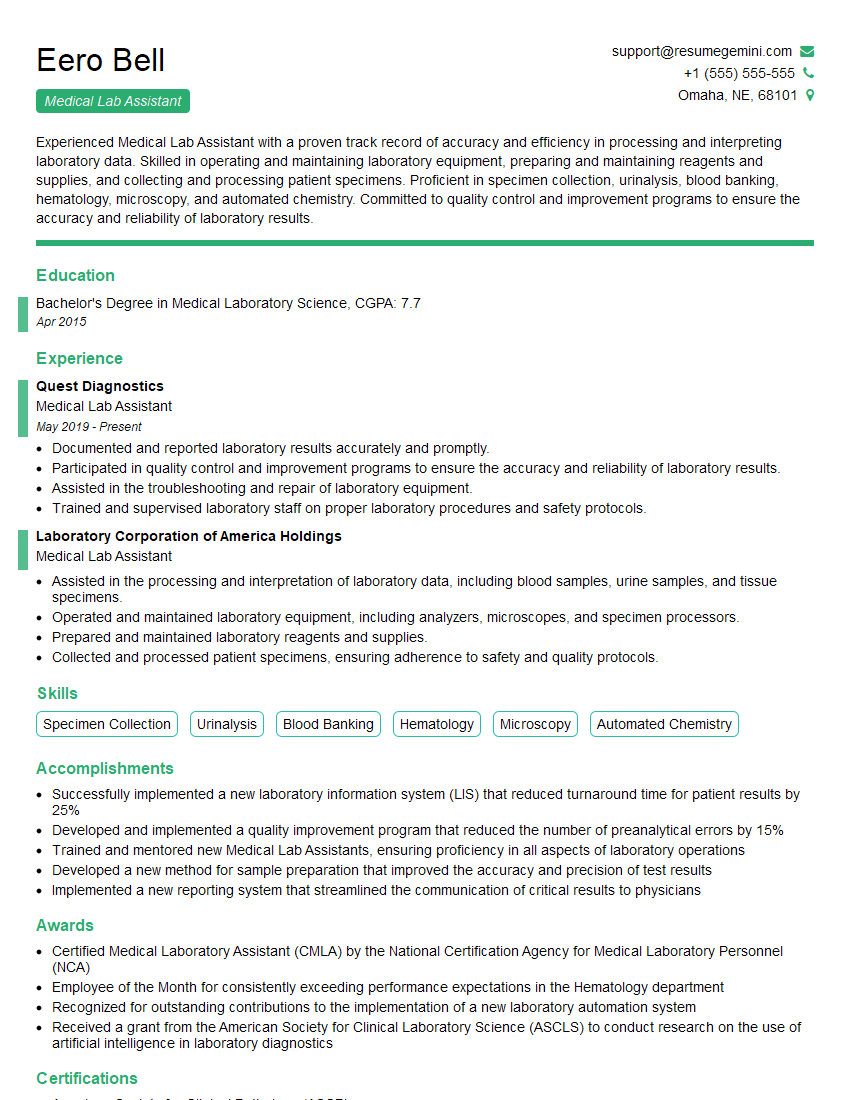
Acing the interview is crucial, but landing one requires a compelling resume that gets you noticed. Crafting a professional document that highlights your skills and experience is the first step toward interview success. ResumeGemini can help you build a standout resume that gets you called in for that dream job.






Essential Interview Questions For Medical Lab Assistant
1. What are the different types of laboratory tests you have performed in your previous role?
- Routine hematology and chemistry tests
- Microscopic examinations of blood and urine samples
- Serology and immunohematology tests
- Bacteriology and mycology tests
- Flow cytometry and cell sorting
2. Can you describe the process of collecting a blood sample for a complete blood count?
Patient preparation
- Inform the patient about the procedure and obtain consent
- Ensure that the patient is seated comfortably
- Apply a tourniquet to the upper arm
Venipuncture
- Clean the venipuncture site with an alcohol swab
- Palpate for a suitable vein
- Insert the needle into the vein at a 15-30 degree angle
- Aspirate the blood into the vacutainer tube
Final steps
- Remove the tourniquet
- Apply pressure to the venipuncture site to stop the bleeding
- Label the sample tubes and send them to the laboratory
3. How do you ensure the accuracy and reliability of laboratory results?
- Follow established laboratory protocols and procedures
- Use calibrated and certified equipment
- Perform quality control checks regularly
- Participate in proficiency testing programs
- Review and validate test results before reporting them
4. What is your experience with using laboratory information systems (LIS)?
In my previous role, I used a LIS to manage laboratory operations, including:
- Entering and tracking patient information
- Ordering and processing laboratory tests
- Reporting test results to clinicians
- Generating reports and statistics
5. Can you describe the principles of spectrophotometry?
- Spectrophotometry is a technique used to measure the absorption or emission of light by a substance
- The absorbance of a substance is directly proportional to its concentration
- Spectrophotometry can be used to quantify the concentration of analytes in a sample, such as hemoglobin, proteins, and DNA
6. What are the different types of centrifuges and their applications?
- Low-speed centrifuges: Used to separate cells and other particles from a liquid
- High-speed centrifuges: Used to separate viruses and other small particles from a liquid
- Ultracentrifuges: Used to separate very small particles from a liquid, such as ribosomes and proteins
7. What are the safety precautions that should be taken when handling hazardous materials in the laboratory?
- Wear appropriate personal protective equipment (PPE), such as gloves, lab coat, safety glasses, and a mask
- Handle hazardous materials in a well-ventilated area
- Dispose of hazardous materials properly
- Be aware of the potential hazards of each hazardous material and take appropriate precautions
- Follow all laboratory safety protocols
8. What is your experience with microscopy?
- I have experience using bright-field, dark-field, and fluorescence microscopy
- I am proficient in preparing and staining slides for microscopic examination
- I have experience using microscopy to identify and differentiate different types of cells and microorganisms
9. What is the role of a medical laboratory assistant in a healthcare team?
- Provide technical support to laboratory scientists and pathologists
- Perform routine laboratory tests and procedures
- Maintain laboratory equipment and supplies
- Communicate test results to clinicians
- Contribute to quality assurance and quality control programs
10. What are your career goals and how does this position align with them?
My career goal is to become a certified medical laboratory scientist. This position provides me with the opportunity to gain valuable experience and skills that will help me achieve my goal. I am particularly interested in the laboratory’s focus on hematology and blood banking, as these are areas that I would like to specialize in.
Interviewers often ask about specific skills and experiences. With ResumeGemini‘s customizable templates, you can tailor your resume to showcase the skills most relevant to the position, making a powerful first impression. Also check out Resume Template specially tailored for Medical Lab Assistant.
Career Expert Tips:
- Ace those interviews! Prepare effectively by reviewing the Top 50 Most Common Interview Questions on ResumeGemini.
- Navigate your job search with confidence! Explore a wide range of Career Tips on ResumeGemini. Learn about common challenges and recommendations to overcome them.
- Craft the perfect resume! Master the Art of Resume Writing with ResumeGemini’s guide. Showcase your unique qualifications and achievements effectively.
- Great Savings With New Year Deals and Discounts! In 2025, boost your job search and build your dream resume with ResumeGemini’s ATS optimized templates.
Researching the company and tailoring your answers is essential. Once you have a clear understanding of the Medical Lab Assistant‘s requirements, you can use ResumeGemini to adjust your resume to perfectly match the job description.
Key Job Responsibilities
Medical Lab Assistants play a vital role in healthcare settings by providing technical support to medical laboratory professionals. Their responsibilities encompass a wide range of tasks that ensure the accurate and timely processing and analysis of patient specimens.
1. Specimen Collection and Processing
Collects and prepares patient specimens according to established protocols, ensuring proper labeling and documentation.
- Draws blood, collects urine and other bodily fluids using appropriate techniques.
- Centrifuges, prepares slides, and stains specimens for microscopic examination.
2. Equipment Operation and Maintenance
Operates and maintains laboratory equipment, including analyzers, microscopes, and centrifuges, according to manufacturer’s instructions.
- Performs routine maintenance, calibration, and troubleshooting of equipment.
- Ensures compliance with laboratory safety and quality control standards.
3. Data Management and Reporting
Records and manages patient data, including test results, observations, and patient demographics.
- Enters data into laboratory information systems (LIS).
- Prepares reports and communicates test results to physicians and other healthcare providers.
4. Quality Control and Assurance
Participates in quality control programs to ensure the accuracy and reliability of test results.
- Performs internal and external quality control checks.
- Identifies and corrects errors or discrepancies in test results.
Interview Tips
Preparing for a Medical Lab Assistant interview requires thorough research and a clear understanding of the job responsibilities and industry best practices. Here are some tips to help you ace the interview:
1. Research the Organization and Role
Before the interview, thoroughly research the healthcare organization and the specific Medical Lab Assistant position. This will demonstrate your genuine interest and provide you with valuable insights into the company culture and expectations.
- Review the organization’s website, mission statement, and industry reputation.
- Identify the specific responsibilities and qualifications outlined in the job description.
2. Highlight Relevant Skills and Experience
During the interview, emphasize your technical skills, such as specimen collection, equipment operation, and data management. Quantify your experience whenever possible, providing specific examples of how you have contributed to laboratory operations.
- Showcase your proficiency in handling various laboratory equipment, such as analyzers, microscopes, and centrifuges.
- Demonstrate your ability to follow laboratory protocols and maintain a clean and organized work environment.
3. Emphasize Attention to Detail and Accuracy
Medical Lab Assistants are expected to be highly detail-oriented and accurate in their work. Highlight your meticulous nature and ability to produce precise results. Mention your experience in quality control and your commitment to ensuring patient safety.
- Provide examples of how you have identified and corrected errors in test results.
- Explain your understanding of laboratory accreditation standards and your role in maintaining compliance.
4. Prepare for Common Interview Questions
Familiarize yourself with common interview questions for Medical Lab Assistants. This will help you prepare thoughtful and articulate responses that showcase your knowledge and enthusiasm for the role.
- Describe your experience in collecting and processing patient specimens.
- How do you ensure the accuracy and reliability of test results?
- What are your strengths and weaknesses as a Medical Lab Assistant?
- Why are you interested in working in our laboratory?
Next Step:
Now that you’re armed with a solid understanding of what it takes to succeed as a Medical Lab Assistant, it’s time to turn that knowledge into action. Take a moment to revisit your resume, ensuring it highlights your relevant skills and experiences. Tailor it to reflect the insights you’ve gained from this blog and make it shine with your unique qualifications. Don’t wait for opportunities to come to you—start applying for Medical Lab Assistant positions today and take the first step towards your next career milestone. Your dream job is within reach, and with a polished resume and targeted applications, you’ll be well on your way to achieving your career goals! Build your resume now with ResumeGemini.