Are you gearing up for a career shift or aiming to ace your next interview? Look no further! We’ve curated a comprehensive guide to help you crack the interview for the coveted Loom Mechanic position. From understanding the key responsibilities to mastering the most commonly asked questions, this blog has you covered. So, buckle up and let’s embark on this journey together
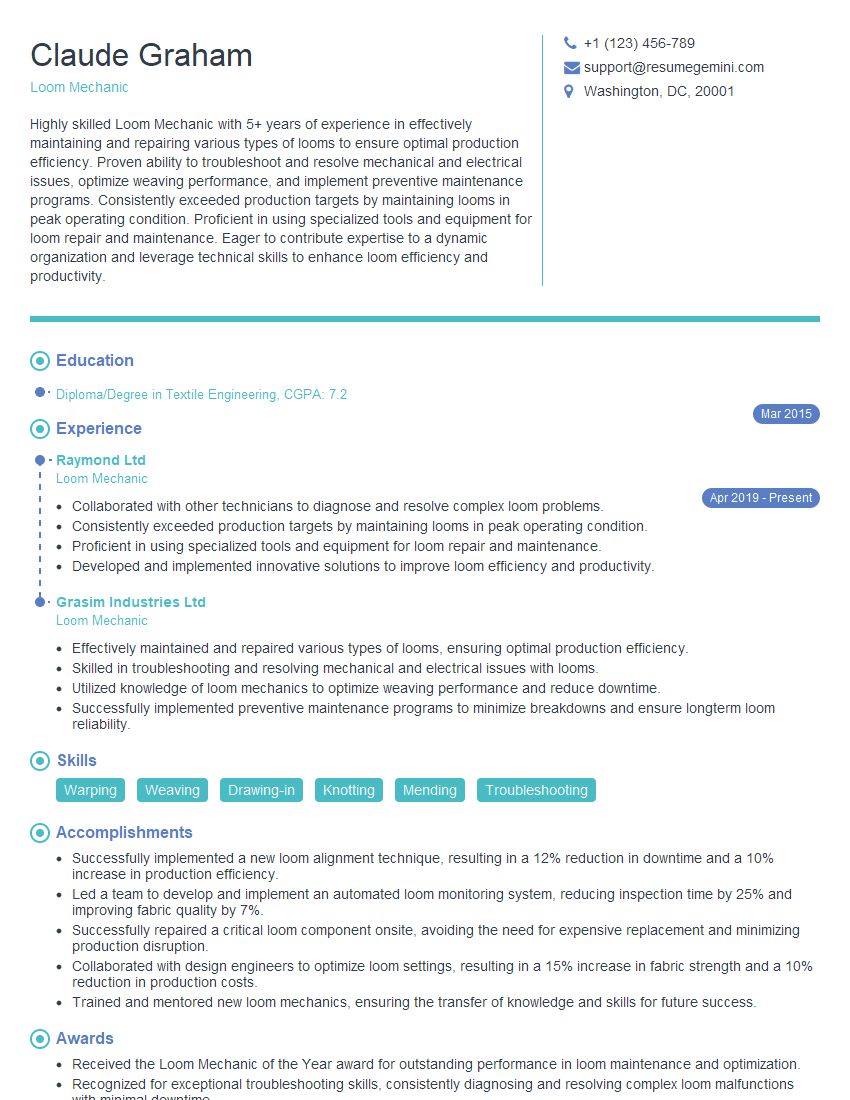
Acing the interview is crucial, but landing one requires a compelling resume that gets you noticed. Crafting a professional document that highlights your skills and experience is the first step toward interview success. ResumeGemini can help you build a standout resume that gets you called in for that dream job.






Essential Interview Questions For Loom Mechanic
1. What are the different types of looms used in textile manufacturing?
- Power looms
- Hand looms
- Semi-automatic looms
- Fully-automatic looms
- Jacquard looms
2. What are the key components of a loom?
Warp beam
- Holds the warp threads
- Controls the tension of the warp threads
Cloth beam
- Holds the finished fabric
- Controls the tension of the fabric
Shed
- Controls the opening and closing of the warp threads
- Allows the weft thread to pass through
Healds
- Control the individual warp threads
- Help to create the shed
Pickers
- Insert the weft thread into the shed
3. Describe the process of winding a warp beam.
- Inspect the warp yarn
- Load the yarn onto the creel
- Thread the yarn through the tensioning device
- Wind the yarn onto the beam
- Secure the yarn on the beam
4. How do you determine the correct tension for the warp and weft threads?
- Use a tension meter
- Check the tension by hand
- Use a sample loom to test the tension
5. What are the different types of weaving defects?
- Float
- Drop out
- Reed mark
- Slub
- Hole
6. How do you troubleshoot a loom that is not producing fabric?
- Check the power supply
- Check the yarn supply
- Check the tension of the warp and weft threads
- Check the shed formation
- Check the pickers
7. What are the safety precautions that must be followed when working on a loom?
- Wear proper safety gear
- Keep the work area clean and organized
- Do not work on a loom that is in motion
- Lock out the loom before performing any maintenance
- Never put your hands near the nip point
8. What are the different types of loom maintenance?
- Preventive maintenance
- Corrective maintenance
- Predictive maintenance
9. Describe the process of setting up a loom for a new fabric.
- Mount the warp beam
- Thread the warp threads through the heald frames and reed
- Tie the warp threads to the cloth beam
- Adjust the tension of the warp threads
- Insert the weft thread
- Start the loom
10. How do you stay up-to-date on the latest loom technology?
- Read industry publications
- Attend industry conferences
- Visit loom manufacturers
- Talk to other loom mechanics
Interviewers often ask about specific skills and experiences. With ResumeGemini‘s customizable templates, you can tailor your resume to showcase the skills most relevant to the position, making a powerful first impression. Also check out Resume Template specially tailored for Loom Mechanic.
Career Expert Tips:
- Ace those interviews! Prepare effectively by reviewing the Top 50 Most Common Interview Questions on ResumeGemini.
- Navigate your job search with confidence! Explore a wide range of Career Tips on ResumeGemini. Learn about common challenges and recommendations to overcome them.
- Craft the perfect resume! Master the Art of Resume Writing with ResumeGemini’s guide. Showcase your unique qualifications and achievements effectively.
- Great Savings With New Year Deals and Discounts! In 2025, boost your job search and build your dream resume with ResumeGemini’s ATS optimized templates.
Researching the company and tailoring your answers is essential. Once you have a clear understanding of the Loom Mechanic‘s requirements, you can use ResumeGemini to adjust your resume to perfectly match the job description.
Key Job Responsibilities
Loom Mechanics play a crucial role in maintaining and repairing industrial looms, ensuring their optimal performance and productivity. Their key responsibilities include:
1. Mechanical Maintenance
Inspecting, lubricating, adjusting, and repairing looms and associated machinery to prevent breakdowns and maintain efficient operation.
- Diagnosing mechanical issues, identifying root causes, and implementing appropriate solutions.
- Maintaining and calibrating loom settings to optimize fabric quality and production efficiency.
2. Electrical Troubleshooting
Troubleshooting and repairing electrical systems, including motors, drives, and sensors, to ensure smooth loom operation.
- Interpreting electrical schematics and diagrams to locate and resolve electrical faults.
- Replacing faulty components, such as wires, switches, and contactors.
3. Electronic Control Systems
Understanding and operating electronic control systems used in modern looms, including programmable logic controllers (PLCs) and human-machine interfaces (HMIs).
- Monitoring and adjusting electronic settings to optimize loom performance and fabric quality.
- Troubleshooting and repairing electronic components, such as sensors, actuators, and controllers.
4. Fabric Quality Monitoring
Monitoring fabric quality during production and identifying any defects or variations.
- Making adjustments to loom settings to correct fabric defects and ensure consistent quality.
- Working closely with weavers and quality control personnel to identify and resolve fabric-related issues.
Interview Tips
To ace the interview for a Loom Mechanic position, candidates should:
1. Practice and Research
Practice answering common interview questions about their experience, skills, and knowledge in loom mechanics.
- Research the company and industry before the interview to demonstrate their interest and understanding of the role.
- Be prepared to discuss specific examples of their work experience and accomplishments.
2. Highlight Technical Skills
Emphasize their technical skills in loom maintenance, repair, and troubleshooting, including:
- Experience with electrical and electronic systems, including PLC and HMI operation.
- Proficiency in using diagnostic tools and instruments to identify and resolve mechanical and electrical issues.
3. Discuss Quality Control Experience
Highlight their experience in monitoring fabric quality and working with weavers and quality control personnel to identify and resolve fabric defects.
- Explain how they use their knowledge of fabric production processes to ensure the production of high-quality fabrics.
- Provide examples of how they have implemented quality control measures to improve fabric quality.
4. Demonstrate Problem-Solving Skills
Showcase their problem-solving skills by providing examples of how they have identified and resolved complex loom issues.
- Explain their approach to troubleshooting and diagnosing mechanical, electrical, and electronic problems.
- Discuss how they have used their critical thinking and analytical skills to find and implement effective solutions.
Next Step:
Armed with this knowledge, you’re now well-equipped to tackle the Loom Mechanic interview with confidence. Remember, a well-crafted resume is your first impression. Take the time to tailor your resume to highlight your relevant skills and experiences. And don’t forget to practice your answers to common interview questions. With a little preparation, you’ll be on your way to landing your dream job. So what are you waiting for? Start building your resume and start applying! Build an amazing resume with ResumeGemini.