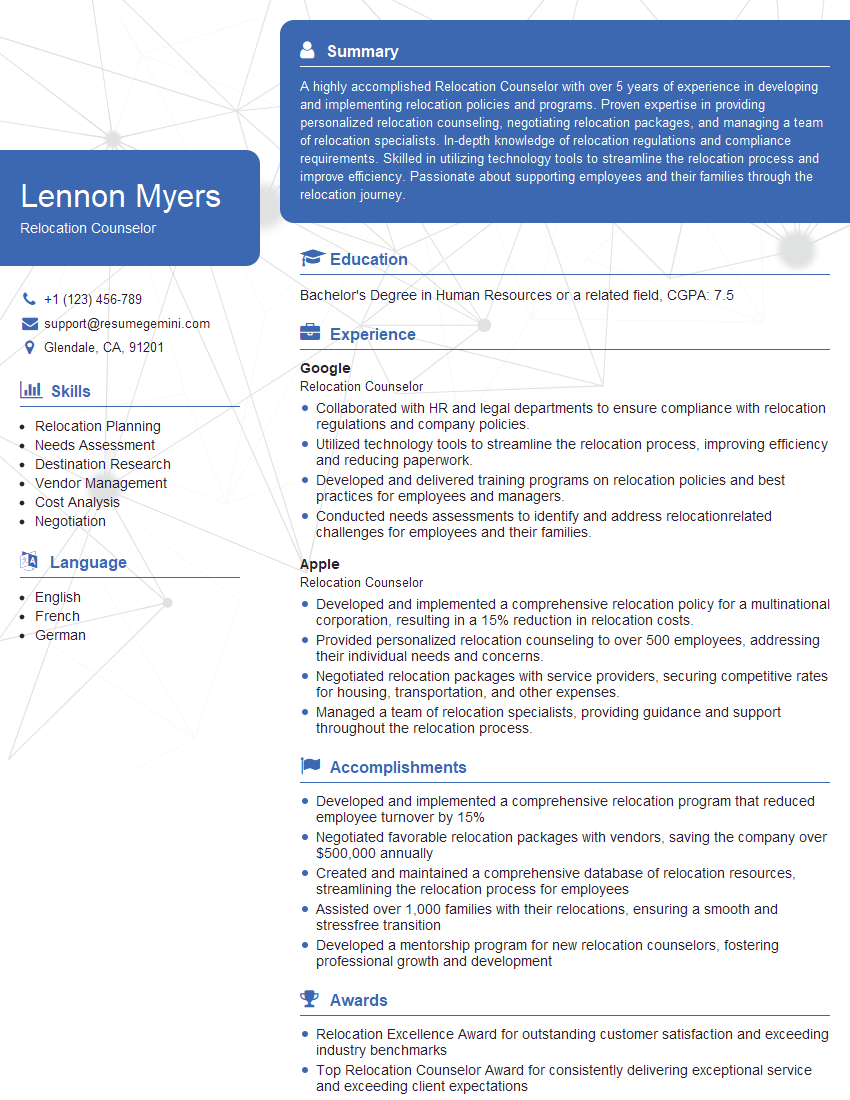
Are you gearing up for a career shift or aiming to ace your next interview? Look no further! We’ve curated a comprehensive guide to help you crack the interview for the coveted Relocation Counselor position. From understanding the key responsibilities to mastering the most commonly asked questions, this blog has you covered. So, buckle up and let’s embark on this journey together.
Acing the interview is crucial, but landing one requires a compelling resume that gets you noticed. Crafting a professional document that highlights your skills and experience is the first step toward interview success. ResumeGemini can help you build a standout resume that gets you called in for that dream job.






Essential Interview Questions For Relocation Counselor
1. How do you develop a relocation plan?
To develop a relocation plan, I typically follow these steps:
- Assessment phase: Determine the employee’s needs, including their destination, timeline, and financial constraints. Conduct a needs assessment interview and gather information about the employee’s family, pets, belongings, and any special requirements.
- Planning phase: Create a detailed plan that outlines the logistics of the move. This includes choosing a moving company, booking transportation and accommodations, and setting up utilities and services at the destination.
- Implementation phase: Oversee the move and provide support to the employee throughout the process. This includes coordinating with the moving company, monitoring the progress of the move, and resolving any issues that arise.
- Follow-up phase: Check in with the employee after the move to ensure they have settled in successfully and provide any additional support as needed.
2. What are some of the challenges you have faced in your experience as a Relocation Counselor?
Communication challenges
- Coordinating with different parties involved in the move, such as the employee, moving company, and destination service providers.
- Ensuring that all parties are on the same page and have a clear understanding of the relocation plan.
Cultural and language barriers
- Helping employees who are relocating to a different country or culture adjust to their new environment.
- Providing support and resources to employees who may face language barriers or cultural differences.
Emotional and financial challenges
- Supporting employees who may experience stress, anxiety, or other emotional challenges related to the move.
- Helping employees manage the financial aspects of the relocation, such as housing costs, transportation, and other expenses.
3. What are the ethical considerations that you keep in mind when working with clients?
- Confidentiality: Maintaining the privacy of the employee’s personal and financial information.
- Objectivity: Providing unbiased advice and recommendations based on the employee’s needs and best interests.
- Transparency: Being open and honest with the employee about the relocation process and potential challenges.
- Respect: Treating the employee with dignity and respect, regardless of their background or circumstances.
- Professionalism: Maintaining a high level of professionalism in all interactions with the employee and other parties involved in the relocation.
4. How do you stay up-to-date on the latest trends and best practices in relocation?
- Continuing education: Attending conferences, workshops, and webinars related to relocation.
- Professional development: Reading industry publications, research papers, and online resources.
- Networking: Connecting with other Relocation Counselors and professionals in the field.
- Staying informed about: Changes in relocation policies, industry regulations, and best practices.
5. What are the key qualities and skills that make a successful Relocation Counselor?
- Communication skills: Excellent verbal and written communication skills to effectively convey information and build rapport with clients.
- Interpersonal skills: Strong interpersonal skills to establish trust and rapport with employees and other stakeholders.
- Organizational skills: Ability to manage multiple tasks and deadlines effectively and maintain accurate records.
- Problem-solving skills: Ability to identify and resolve relocation-related challenges and develop creative solutions.
- Cultural sensitivity: Understanding of different cultures and customs and ability to adapt to diverse client needs.
- Ethics and confidentiality: Adherence to ethical principles and maintaining the confidentiality of client information.
6. What is your experience in managing cross-border relocations?
- Understanding of international relocation policies: Knowledge of visa requirements, immigration procedures, and other regulations related to cross-border relocations.
- Experience in coordinating with international service providers: Familiarity with global moving companies, immigration attorneys, and other partners involved in cross-border relocations.
- Cultural awareness: Sensitivity to cultural differences and ability to provide support to employees relocating to different countries.
- Tax and financial planning: Familiarity with tax implications and financial considerations related to cross-border relocations.
7. How do you assess the needs of employees with special circumstances, such as those with disabilities or families with young children?
- Conduct thorough needs assessments: Gather detailed information about the employee’s disability or family situation.
- Research and identify resources: Explore available resources and support services that can assist the employee.
- Develop tailored plans: Create customized relocation plans that address the specific needs of the employee and their family.
- Provide ongoing support: Offer regular check-ins and support throughout the relocation process and after the move.
8. What are your strategies for minimizing employee stress and anxiety during the relocation process?
- Open communication: Maintain clear and frequent communication with the employee throughout the process.
- Providing timely information: Keep the employee informed about key milestones, timelines, and any changes or challenges.
- Offering emotional support: Provide a listening ear and empathy to address the employee’s concerns and anxieties.
- Connecting with support networks: Facilitate connections with other employees who have relocated or with support groups for employees with specific needs.
9. How do you measure the effectiveness of your relocation services?
- Employee satisfaction surveys: Collect feedback from employees on their satisfaction with the relocation process and support provided.
- Tracking key metrics: Monitor relocation timelines, costs, and employee retention rates to identify areas for improvement.
- Regular performance reviews: Conduct regular performance reviews to evaluate the counselor’s skills, effectiveness, and areas for growth.
- Industry benchmarks: Compare performance to industry benchmarks and best practices to identify areas for improvement.
10. What are your strengths and weaknesses as a Relocation Counselor?
Strengths
- Strong communication and interpersonal skills: Ability to build rapport with clients, understand their needs, and effectively convey information.
- Excellent organizational and time management skills: Proven ability to manage multiple projects, meet deadlines, and maintain accurate records.
- Cultural sensitivity and adaptability: Ability to relate to clients from diverse backgrounds and adapt to different cultural norms.
- Problem-solving and decision-making skills: Quickly identify and resolve relocation-related challenges and make sound decisions.
Weaknesses
- Limited experience in managing large-scale relocations: While I have successfully managed numerous relocations, I am eager to gain experience in coordinating large-scale, complex moves.
- Need to develop a deeper understanding of tax implications: I am familiar with the basics of tax planning for relocations, but I would like to expand my knowledge in this area.
Interviewers often ask about specific skills and experiences. With ResumeGemini‘s customizable templates, you can tailor your resume to showcase the skills most relevant to the position, making a powerful first impression. Also check out Resume Template specially tailored for Relocation Counselor.
Career Expert Tips:
- Ace those interviews! Prepare effectively by reviewing the Top 50 Most Common Interview Questions on ResumeGemini.
- Navigate your job search with confidence! Explore a wide range of Career Tips on ResumeGemini. Learn about common challenges and recommendations to overcome them.
- Craft the perfect resume! Master the Art of Resume Writing with ResumeGemini’s guide. Showcase your unique qualifications and achievements effectively.
- Great Savings With New Year Deals and Discounts! In 2025, boost your job search and build your dream resume with ResumeGemini’s ATS optimized templates.
Researching the company and tailoring your answers is essential. Once you have a clear understanding of the Relocation Counselor‘s requirements, you can use ResumeGemini to adjust your resume to perfectly match the job description.
Key Job Responsibilities
Relocation Counselors are responsible for providing guidance and support to individuals and families relocating due to a job transfer, personal preference, or other life circumstances. They assist with every aspect of the relocation process, ensuring a smooth and stress-free transition.
1. Pre-move Planning
Counselors work closely with clients in the initial stages of relocation, assessing their needs and preferences. They assist with planning the logistics of the move, including determining the best moving date, selecting a moving company, and arranging for packing and transportation.
- Consult with clients to understand their individual relocation requirements.
- Develop personalized relocation plans based on clients’ needs, timelines, and budgets.
2. Home Search and Site Selection
Relocation Counselors help clients find suitable new homes. They research housing markets, identify potential neighborhoods and properties, and arrange showings. They also provide guidance on rental agreements, mortgages, and local services.
- Conduct thorough research on housing markets and identify potential neighborhoods.
- Accompany clients to property showings and provide expert advice on home selection.
3. Settlement and Adjustment
After the move, Counselors assist clients with settling into their new homes and communities. They connect them with local resources such as schools, healthcare providers, and community groups. They also provide ongoing support to ensure clients adjust smoothly to their new surroundings.
- Assist clients with the settlement process, including unpacking and setting up their new homes.
- Provide orientation to the new community, introducing clients to local resources and services.
4. Cultural and Lifestyle Support
Relocation Counselors understand the challenges of adjusting to a new culture and lifestyle. They provide support and advice to clients on issues such as language barriers, cultural differences, and social integration.
- Offer cultural sensitivity training and assist clients in adapting to their new surroundings.
- Facilitate connections with local community groups and expat organizations.
Interview Tips
Preparing thoroughly for your Relocation Counselor interview is crucial to making a strong impression and showcasing your skills. Here are some valuable tips to help you ace the interview:
1. Research the Company and Role
Take the time to research the relocation company and the specific role you’re applying for. Understand their services, their reputation in the industry, and the specific responsibilities of the position.
- Visit the company website, read their mission statement and values.
- Look for articles or reviews about the company to gain insights into their culture and approach.
2. Highlight Your Client-centricity
Relocation Counselors must be highly client-centric, with a genuine desire to help individuals and families through major life transitions. Emphasize your empathy, listening skills, and dedication to providing exceptional customer service.
- Share examples of how you have successfully assisted clients with complex relocation needs.
- Describe your ability to build strong relationships and earn the trust of clients.
3. Demonstrate Your Knowledge of Relocation Services
Showcase your comprehensive understanding of relocation services, from home search and site selection to settlement and adjustment support. Discuss your experience in working with different types of clients, including individuals, families, and corporate executives.
- Provide specific examples of relocation plans you have developed and implemented.
- Describe your knowledge of housing markets, mortgage processes, and local resources.
4. Emphasize Your Cultural Sensitivity
Relocation Counselors often assist clients from diverse backgrounds and cultures. Highlight your sensitivity to cultural differences and your ability to create a welcoming environment for clients from all walks of life.
- Share your experiences working with clients from different cultural backgrounds.
- Describe your approach to cultural immersion and adaptation.
Next Step:
Now that you’re armed with a solid understanding of what it takes to succeed as a Relocation Counselor, it’s time to turn that knowledge into action. Take a moment to revisit your resume, ensuring it highlights your relevant skills and experiences. Tailor it to reflect the insights you’ve gained from this blog and make it shine with your unique qualifications. Don’t wait for opportunities to come to you—start applying for Relocation Counselor positions today and take the first step towards your next career milestone. Your dream job is within reach, and with a polished resume and targeted applications, you’ll be well on your way to achieving your career goals! Build your resume now with ResumeGemini.