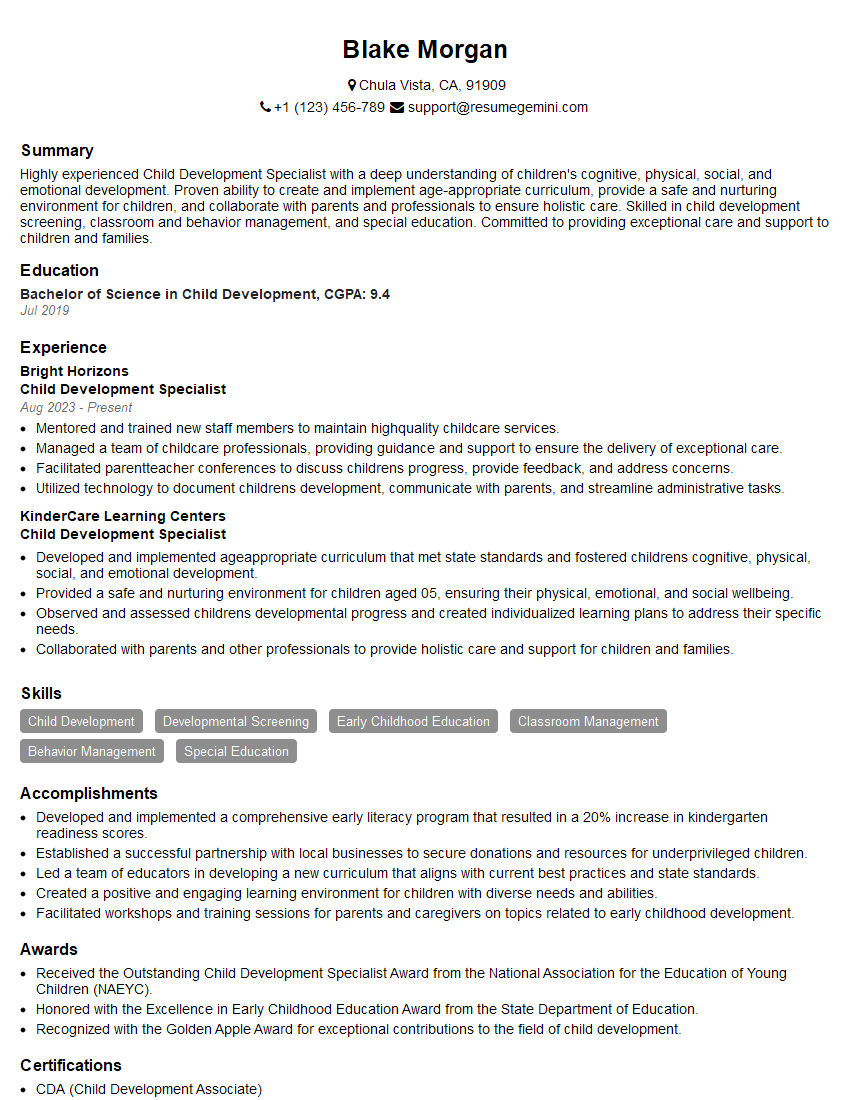
Feeling lost in a sea of interview questions? Landed that dream interview for Child Development Specialist but worried you might not have the answers? You’re not alone! This blog is your guide for interview success. We’ll break down the most common Child Development Specialist interview questions, providing insightful answers and tips to leave a lasting impression. Plus, we’ll delve into the key responsibilities of this exciting role, so you can walk into your interview feeling confident and prepared.
Acing the interview is crucial, but landing one requires a compelling resume that gets you noticed. Crafting a professional document that highlights your skills and experience is the first step toward interview success. ResumeGemini can help you build a standout resume that gets you called in for that dream job.






Essential Interview Questions For Child Development Specialist
1. What are the key milestones in child development from birth to age 5?
The key milestones in child development from birth to age 5 include:
- Gross motor skills: Holding the head up, rolling over, sitting up, crawling, walking, running, jumping, climbing.
- Fine motor skills: Grasping objects, reaching, clapping hands, picking up small objects, drawing, cutting, writing.
- Language skills: Cooing, babbling, saying single words, combining words, speaking in sentences, understanding language.
- Cognitive skills: Learning to solve problems, understanding cause and effect, developing memory, using imagination.
- Social skills: Interacting with others, sharing, cooperating, playing with peers, forming friendships.
2. What are some of the common challenges that children face in their development?
Physical Challenges
- Motor delays
- Sensory impairments
- Chronic illnesses
Cognitive Challenges
- Learning disabilities
- Attention deficit hyperactivity disorder (ADHD)
- Autism spectrum disorder (ASD)
Social and Emotional Challenges
- Behavioral problems
- Anxiety disorders
- Depression
3. How do you assess a child’s development?
I assess a child’s development using a variety of methods, including:
- Observation: I observe the child’s behavior in different settings, such as during play, mealtimes, and transitions.
- Interviews: I interview the child’s parents or caregivers to gather information about the child’s history, development, and current concerns.
- Standardized assessments: I use standardized assessments to measure the child’s development in specific areas, such as cognitive skills, language skills, and gross motor skills.
4. What are some strategies for supporting children with developmental delays?
Strategies for supporting children with developmental delays include:
- Early intervention: Providing early intervention services can help children with developmental delays catch up to their peers.
- Special education: Children with developmental delays may need special education services to help them learn and develop.
- Therapy: Therapy can help children with developmental delays improve their motor skills, language skills, cognitive skills, and social skills.
- Support groups: Support groups can provide parents and caregivers with information, support, and resources.
5. What are the ethical considerations in working with children?
Ethical considerations in working with children include:
- Confidentiality: Maintaining the confidentiality of children’s information is essential.
- Informed consent: Obtaining informed consent from parents or caregivers before conducting assessments or providing services.
- Non-maleficence: Avoiding harm to children.
- Beneficence: Acting in the best interests of children.
- Justice: Ensuring that all children have access to high-quality services.
6. What are the different types of child development theories?
There are many different child development theories, including:
- Piaget’s cognitive development theory: Piaget’s theory focuses on how children’s cognitive skills develop through four stages.
- Vygotsky’s sociocultural theory: Vygotsky’s theory emphasizes the role of social interaction in children’s development.
- Erikson’s psychosocial development theory: Erikson’s theory focuses on how children’s personality and social development unfold through eight stages.
- Attachment theory: Attachment theory focuses on the importance of early relationships in children’s development.
7. How do you stay up-to-date on the latest research in child development?
I stay up-to-date on the latest research in child development by:
- Reading journals and books: I read professional journals and books to learn about new research findings.
- Attending conferences: I attend conferences to learn about new research and network with other professionals.
- Taking continuing education courses: I take continuing education courses to learn about new developments in child development.
8. What are your strengths as a Child Development Specialist?
My strengths as a Child Development Specialist include my:
- Education and experience: I have a master’s degree in child development and several years of experience working with children.
- Knowledge of child development: I am knowledgeable about all aspects of child development, including physical, cognitive, social, and emotional development.
- Skills in assessment and intervention: I am skilled in assessing children’s development and providing early intervention services.
- Communication and interpersonal skills: I am able to communicate effectively with children, parents, and other professionals.
- Passion for working with children: I am passionate about helping children reach their full potential.
9. What are your career goals as a Child Development Specialist?
My career goals as a Child Development Specialist include:
- To help children reach their full potential: I want to use my knowledge and skills to help children learn and grow.
- To make a difference in the lives of children: I want to make a positive impact on the lives of children and their families.
- To advance my knowledge and skills: I want to continue to learn and grow as a professional.
- To become a leader in the field of child development: I want to make a significant contribution to the field of child development.
10. What questions do you have for me?
I have a few questions for you:
- What are the biggest challenges facing the field of child development today?
- What are your expectations for this position?
- What are the opportunities for professional development within your organization?
Interviewers often ask about specific skills and experiences. With ResumeGemini‘s customizable templates, you can tailor your resume to showcase the skills most relevant to the position, making a powerful first impression. Also check out Resume Template specially tailored for Child Development Specialist.
Career Expert Tips:
- Ace those interviews! Prepare effectively by reviewing the Top 50 Most Common Interview Questions on ResumeGemini.
- Navigate your job search with confidence! Explore a wide range of Career Tips on ResumeGemini. Learn about common challenges and recommendations to overcome them.
- Craft the perfect resume! Master the Art of Resume Writing with ResumeGemini’s guide. Showcase your unique qualifications and achievements effectively.
- Great Savings With New Year Deals and Discounts! In 2025, boost your job search and build your dream resume with ResumeGemini’s ATS optimized templates.
Researching the company and tailoring your answers is essential. Once you have a clear understanding of the Child Development Specialist‘s requirements, you can use ResumeGemini to adjust your resume to perfectly match the job description.
Key Job Responsibilities
Child Development Specialists are responsible for the cognitive, physical, and emotional development of children from infancy to adolescence. They work in various settings, including schools, childcare centers, and hospitals.
1. Assessment of Developmental Needs
They assess children’s developmental needs through observations, interviews, and standardized testing.
- Conduct developmental screenings and assessments to identify potential developmental delays or concerns.
- Interpret assessment results and develop individualized intervention plans tailored to each child’s needs.
2. Planning and Implementation of Interventions
They develop and implement individualized intervention plans based on each child’s needs.
- Design and implement individualized intervention plans that address the specific developmental needs of each child.
- Use evidence-based practices and techniques to promote children’s learning and development.
3. Collaboration with Families and Professionals
They regularly collaborate with families and other professionals to ensure a consistent approach to the child’s development.
- Communicate effectively with families and caregivers to provide support, education, and guidance on child development.
- Collaborate with other professionals, such as teachers, therapists, and medical professionals, to provide a comprehensive approach to the child’s care.
4. Monitoring and Evaluation of Progress
They monitor children’s progress and make adjustments to intervention plans as needed.
- Monitor children’s progress regularly to track their developmental growth and identify any need for adjustments.
- Evaluate the effectiveness of intervention plans and make data-driven adjustments to optimize child outcomes.
Interview Tips
To ace an interview for a Child Development Specialist position, it is important to be well-prepared and demonstrate your knowledge, skills, and passion for working with children.
1. Research the Company and Position
Research the organization and the specific role you are applying for.
- Visit the company’s website to learn about their mission, values, and services.
- Read the job description carefully to understand the specific requirements and responsibilities of the role.
2. Highlight Your Skills and Experience
Showcase your relevant skills and experience in your resume and cover letter.
- Quantify your accomplishments using specific examples and data whenever possible.
- Emphasize your expertise in child development principles and practices.
3. Practice Your Answers
Prepare answers to common interview questions and practice delivering them clearly and concisely.
- Expect questions about your experience in working with children, your knowledge of child development theories, and your ability to collaborate with families and professionals.
- Use the STAR method to structure your answers (Situation, Task, Action, Result).
4. Demonstrate Your Passion for Children
Convey your genuine passion for working with children and your commitment to their well-being.
- Share examples of your experiences interacting with children and the positive impact you had on their lives.
- Explain how your values and beliefs align with the mission of the organization you are applying to.
Next Step:
Now that you’re armed with a solid understanding of what it takes to succeed as a Child Development Specialist, it’s time to turn that knowledge into action. Take a moment to revisit your resume, ensuring it highlights your relevant skills and experiences. Tailor it to reflect the insights you’ve gained from this blog and make it shine with your unique qualifications. Don’t wait for opportunities to come to you—start applying for Child Development Specialist positions today and take the first step towards your next career milestone. Your dream job is within reach, and with a polished resume and targeted applications, you’ll be well on your way to achieving your career goals! Build your resume now with ResumeGemini.